

[Feb 23, 2026] aPHRi certification guide Q&A from Training Expert Lead1Pass
aPHRi Certification Overview Latest aPHRi PDF Dumps
One of the benefits of earning an aPHRi certification is that it can help individuals stand out in a competitive job market. It demonstrates to potential employers that an individual has a solid foundation of HR knowledge and is committed to their professional development. Additionally, the certification can lead to increased earning potential and career advancement opportunities.
The aPHRi certification is a great way to establish credibility and demonstrate expertise in the field of HR. It is also a stepping stone for individuals who are looking to advance their careers in HR, as it provides a solid foundation of knowledge and skills that can be built upon with more advanced certifications. Additionally, the certification can help individuals stand out in a competitive job market and increase their earning potential.
NEW QUESTION # 66
An employee who has come to a time where there is little or no possibility of promotion has reached a(n):
- A. Employment conflict
- B. Vesting cliff
- C. Career plateau
- D. Dual career ladder
Answer: C
Explanation:
Comprehensive and Detailed in Depth Explanation:
A career plateau occurs when an employee reaches a point in their career where there is little or no opportunity for further promotion or advancement, often due to organizational structure, lack of openings, or the employee's current skill level. This can impact motivation and requires HR to provide alternative development opportunities.
* Option A (Dual career ladder):This is a system allowing employees to advance in technical or managerial tracks, not a lack of promotion.
* Option B (Career plateau):Correct, as it describes the situation where promotion opportunities are limited.
* Option C (Employment conflict):This refers to disputes or issues in the workplace, not a lack of promotion.
NEW QUESTION # 67
What is an effective strategy for assessing employee morale within an organization?
- A. Conducting anonymous employee surveys.
- B. Offering more vacation days.
- C. Mandating team-building exercises.
- D. Increasing salaries across the board.
Answer: A
Explanation:
Conducting anonymous employee surveys is an effective strategy for assessing employee morale within an organization. This method allows employees to provide honest feedback without fear of repercussions, helping management identify true sentiments and areas needing improvement.
NEW QUESTION # 68
Tom needs to improve his company''s HR forms management system. What is a key strategy he should implement?
- A. Implement an electronic filing system
- B. Hire additional HR staff
- C. Create standardized form templates
- D. Implement a mentorship program
Answer: A
Explanation:
Implementing an electronic filing system is a key strategy Tom should use to improve his company,s HR forms management system. Electronic systems enhance accessibility, reduce physical storage needs, and allow for more efficient document management.
NEW QUESTION # 69
Which of the following methods is commonly used to screen applicants based on their qualifications and experience?
- A. Resume reviews
- B. Personality tests
- C. Reference checks
- D. Group interviews
Answer: A
Explanation:
Resume reviews are a common method used to screen applicants based on their qualifications and experience, allowing employers to match candidates with job requirements.
NEW QUESTION # 70
An employee who reveals priority information has breached:
- A. Organizational-culture
- B. General guidelines
- C. A non-disclosure agreement.
Answer: C
Explanation:
Revealing proprietary information constitutes a breach of a non-disclosure agreement (NDA), which legally binds employees to maintain confidentiality about sensitive organizational information.
* Explanation of Other Options:
* A. General guidelines: Broad policies not specific to confidentiality.
* B. Organizational culture: Refers to shared values and norms, not legal requirements.
References:SHRM - Attrition and Workforce Planning
OSHA - Healthy Workspace Environmental Factors
SHRM - Bereavement Policy Best Practices
CIPD - Non-Disclosure Agreement Guidelines
NEW QUESTION # 71
Which HR process involves identifying and preparing employees to potentially fill key positions in the organization?
Response:
- A. Performance Management
- B. Talent Acquisition
- C. Compensation Planning
- D. Succession Planning
Answer: D
NEW QUESTION # 72
Place the commonly used steps in the employment termination process in order.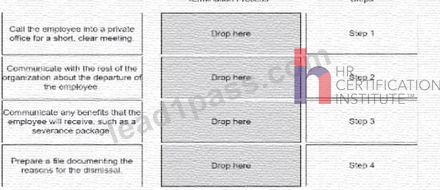
Answer:
Explanation: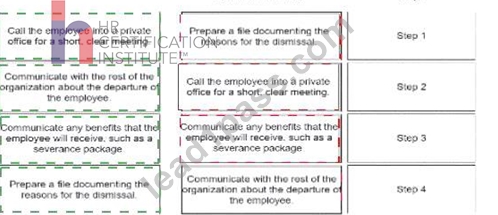
Explanation: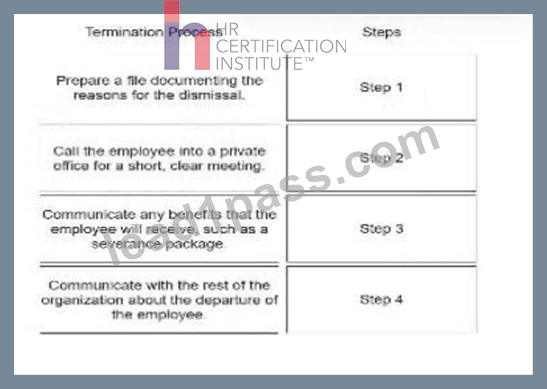
Ordered Employment Termination Process:
* Prepare a file documenting the reasons for the dismissal # Step 1
* Explanation:Documentation is the foundation of any termination process. It ensures that the reasons for termination are clear, consistent, and legally compliant. Proper records help protect the organization from potential legal challenges and ensure fairness.
Reference: SHRM's "Guide to Documenting Employee Performance Issues" (2022).
Call the employee into a private office for a short, clear meeting # Step 2 Explanation:A private meeting is essential to communicate the termination decision respectfully and clearly.
This ensures confidentiality and professionalism, allowing the employee to process the information in a dignified manner.
Reference: SHRM, "How to Conduct a Termination Meeting" (2021).
Communicate any benefits that the employee will receive, such as a severance package # Step 3 Explanation:Clearly communicating severance, benefits, or final paycheck details demonstrates fairness and reduces post-termination misunderstandings. It also supports compliance with labor laws and ensures a smoother transition.
Reference: "Severance Pay Best Practices," International Labour Organization (ILO) (2023).
Communicate with the rest of the organization about the departure of the employee # Step 4 Explanation:Informing the organization appropriately helps maintain workplace morale and transparency. The announcement should respect the departing employee's privacy while addressing any operational impacts.
Reference: CIPD's "Managing Organizational Changes and Communication" (2022).
Final Matching Summary:
Step 1: Prepare a file documenting the reasons for the dismissal.
Step 2: Call the employee into a private office for a short, clear meeting.
Step 3: Communicate any benefits that the employee will receive, such as a severance package.
Step 4: Communicate with the rest of the organization about the departure of the employee.
References:
Society for Human Resource Management (SHRM), "Guide to Documenting Employee Performance Issues" (2022).
SHRM, "How to Conduct a Termination Meeting" (2021).
International Labour Organization (ILO), "Severance Pay Best Practices" (2023).
Chartered Institute of Personnel and Development (CIPD), "Managing Organizational Changes and Communication" (2022).
Harvard Business Review, "Steps to Ethical Termination Practices" (2020).
NEW QUESTION # 73
Why is introducing company culture important during orientation?
- A. It increases employee engagement and morale
- B. It reduces employee turnover rates
- C. It helps employees align with organizational values
- D. It improves job performance and satisfaction
Answer: C
Explanation:
Introducing company culture during orientation is important because it helps employees align with the organizational values, ensuring a cohesive work environment.
NEW QUESTION # 74
A company''s business goals should be aligned with its __________ to ensure consistent progress towards achieving its overall mission and vision.
- A. mission and vision statements
- B. employee engagement surveys
- C. financial performance metrics
- D. customer feedback mechanisms
Answer: A
Explanation:
A company,s business goals should be aligned with its mission and vision statements to ensure consistent progress towards achieving its overall mission and vision. This alignment ensures all efforts are directed towards the same overarching purpose.
NEW QUESTION # 75
Which of the following are areas of focus for organization trying to help employees achieve work-life balance? (Select TWO options.)
- A. Use of temporary employees
- B. Training schedule
- C. Compressed schedule
- D. Flex-time
- E. Internal transfers
Answer: C,D
Explanation:
Work-Life Balance Initiatives:
* Flex-time allows employees to choose start and end times within core working hours, offering flexibility to accommodate personal needs.
* A compressed schedule allows employees to work longer hours over fewer days, providing additional days off.
Why These Options are Correct:
* Both arrangements reduce stress and improve work-life integration, enhancing overall job satisfaction and retention.
Eliminating Incorrect Options:
* C. Training schedule: Training is unrelated to work-life balance.
* D. Internal transfers: Focuses on career progression, not work-life integration.
* E. Use of temporary employees: Addresses staffing flexibility but not employee work-life balance directly.
International HR References:
* SHRM Guidelines on Work-Life Balance: Highlights flex-time and compressed schedules as key practices.
NEW QUESTION # 76
What department is responsible for producing a product from available resources?
- A. Marketing
- B. Operations
- C. Legal
- D. Sales
Answer: B
Explanation:
Comprehensive and Detailed in Depth Explanation:
The operations department is responsible for managing the production process, which includes transforming available resources (e.g., raw materials, labor) into finished products or services. Operations ensures efficiency and quality in production, a key function in manufacturing or service-oriented organizations.
* Option A (Legal):The legal department handles compliance and legal issues, not production.
* Option B (Operations):Correct, as operations oversees the production process.
* Option C (Marketing):Marketing focuses on promoting products, not producing them.
NEW QUESTION # 77
An employee who has come to a time where there is little or no possibility of promotion has reached a(n):
- A. Employment conflict
- B. Vesting cliff
- C. Career plateau
- D. Dual career ladder
Answer: C
Explanation:
Comprehensive and Detailed in Depth Explanation:
A career plateau occurs when an employee reaches a point in their career where there is little or no opportunity for further promotion or advancement, often due to organizational structure, lack of openings, or the employee's current skill level. This can impact motivation and requires HR to provide alternative development opportunities.
* Option A (Dual career ladder): This is a system allowing employees to advance in technical or managerial tracks, not a lack of promotion.
* Option B (Career plateau): Correct, as it describes the situation where promotion opportunities are limited.
* Option C (Employment conflict): This refers to disputes or issues in the workplace, not a lack of promotion.
Reference: aPHRi knowledge domain - Talent Development: Career development and managing career plateaus.===========
NEW QUESTION # 78
The primary purpose of a needs assessment is to:
- A. Evaluate performance
- B. Identify training gaps
- C. Motivate employees
- D. Align compensation
Answer: B
Explanation:
Comprehensive and Detailed in Depth Explanation:
A needs assessment is a systematic process used in HR to identify gaps between current and desired performance or skills within an organization. Its primary purpose is to determine training and development needs by assessing what skills, knowledge, or behaviors employees lack to meet organizational goals. This ensures that training programs are targeted and effective.
* Option A (Align compensation): Compensation alignment involves adjusting pay structures, not assessing training needs.
* Option B (Motivate employees): While training can motivate employees, motivation is not the primary purpose of a needs assessment.
* Option C (Identify training gaps): Correct, as a needs assessment focuses on identifying deficiencies in skills or knowledge that training can address.
Reference: aPHRi knowledge domain - Talent Development: Conducting needs assessments to identify training and development requirements.===========
NEW QUESTION # 79
A key indicator of an engaged employee is:
- A. Achieving minimum targets
- B. Attending meetings regularly
- C. Socializing with colleagues
- D. Alignment with organizational goals
Answer: D
Explanation:
Comprehensive and Detailed in Depth Explanation:
An engaged employee is one who is committed to their work and the organization's success. A key indicator of engagement is alignment with organizational goals, as it shows the employee understands and actively supports the company's mission and objectives.
* Option A (Socializing with colleagues): While this may indicate a positive work environment, it is not a key indicator of engagement.
* Option B (Achieving minimum targets): This reflects basic performance, not engagement.
* Option C (Attending meetings regularly): Attendance is a compliance measure, not a sign of engagement.
Reference: aPHRi knowledge domain - Employee Relations: Indicators of employee engagement, including goal alignment.
NEW QUESTION # 80
When disciplining an employee, the role of human resources is to:
- A. Promote well-trained employees to supervisory roles to avoid similar issues
- B. Serve in an advisory role and guide the supervisor in the process
- C. Administer the disciplinary action to protect the supervisor and employee relationship
- D. Train employees to avoid further disciplinary action
Answer: B
Explanation:
Comprehensive and Detailed in Depth Explanation:
In the disciplinary process, HR's role is to act as a neutral advisor, ensuring that the process is fair, consistent, and compliant with organizational policies and legal standards. HR guides the supervisor on how to handle the situation, including following proper procedures, documenting the issue, and ensuring the employee's rights are protected. This helps maintain fairness and reduces the risk of legal issues.
* Option A (Administer the disciplinary action to protect the supervisor and employee relationship):While HR may help maintain relationships, their primary role is not to administer the action but to advise. Supervisors typically administer discipline.
* Option B (Train employees to avoid further disciplinary action):Training may follow discipline, but it is not HR's primary role during the disciplinary process.
* Option C (Serve in an advisory role and guide the supervisor in the process):Correct, as HR ensures the process is handled appropriately and legally.
NEW QUESTION # 81
An organization that focuses primarily on mid-level to senior level recruitment is commonly referred to as a (n):
- A. Professional association
- B. Executive search firm
- C. HR placement firm
- D. Recruitment agency
Answer: B
NEW QUESTION # 82
Match each safety issues to the appropriate prevention strategy.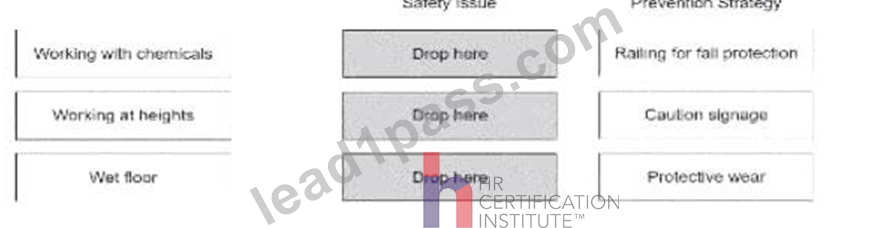
Answer:
Explanation:
Explanation:
Matched Safety Issues to Prevention Strategies:
* Working with Chemicals#Protective Wear
* Explanation:When working with hazardous chemicals, protective gear such as gloves, goggles, aprons, and respiratory masks are essential. These reduce exposure to harmful substances and ensure the safety of workers.
NEW QUESTION # 83
The extent to which employees identify with their positions is called job:
- A. Sharing
- B. Involvement
- C. Enlargement
- D. Enrichment
Answer: B
Explanation:
Comprehensive and Detailed in Depth Explanation:
Job involvement refers to the degree to which employees identify with their roles, feel psychologically attached to their work, and see their job as a central part of their identity. High job involvement is associated with greater engagement and commitment.
* Option A (Enrichment): Job enrichment involves adding meaningful tasks to a role to increase motivation, not identification.
* Option B (Enlargement): Job enlargement adds more tasks of the same level, not related to identification.
* Option C (Involvement): Correct, as it describes the extent of identification with the position.
Reference: aPHRi knowledge domain - Employee Relations: Concepts of employee engagement, including job involvement.===========
NEW QUESTION # 84
Which of the following initiatives will most likely ensure that employees' skill continue to be relevant to business trends? (Two options.)
- A. Online training
- B. Knowledge sharing
- C. Team bonding
- D. Career planning
- E. Salary increases
Answer: A,B
Explanation:
* Online Training:
* Provides employees with access to updated skills and knowledge aligned with business trends.
* Scalable and customizable to individual and organizational needs.
* Knowledge Sharing:
* Encourages collaboration and dissemination of industry trends and innovations among employees, ensuring continuous learning and adaptability.
* Explanation of Other Options:
* A. Team bonding: Improves teamwork but does not address skill relevance.
* C. Career planning: Focuses on long-term growth rather than immediate skill relevance.
* D. Salary increases: Motivates employees but does not ensure skill improvement.
NEW QUESTION # 85
A company needs temporary staff to cover a seasonal increase in workload. Which external HR service provider should they contact?
- A. Staffing agencies
- B. Training firms
- C. Career coaches
- D. Recruitment firms
Answer: A
Explanation:
Staffing agencies provide temporary staff to cover increases in workload, such as seasonal demands. They have a pool of candidates ready to step in and help businesses manage short-term staffing needs.
NEW QUESTION # 86
John, an HR specialist, ensures that all new hires sign non-disclosure agreements and other necessary legal documents before they begin work. What aspect of post-offer employment activities is he focusing on?
- A. Ensuring legal compliance
- B. Providing a supportive environment
- C. Managing employee benefits
- D. Enhancing company culture
Answer: A
Explanation:
Ensuring legal compliance by having new hires sign non-disclosure agreements and other necessary legal documents is crucial to protect company interests and maintain legal standards.
NEW QUESTION # 87
Which of the following is a mandatory employment requirement?
- A. Providing benefits
- B. Administering orientation
- C. Giving work breaks
Answer: C
Explanation:
Comprehensive and Detailed in Depth Explanation:
A mandatory employment requirement refers to a practice that employers are legally obligated to follow under labor laws. While the mandatory nature of these options depends on the jurisdiction, giving work breaks is often a legal requirement in many regions to ensure employee health and safety.
* Option A (Providing benefits): Providing benefits like health insurance or paid leave is not universally mandatory. For example, in the U.S., the FLSA does not require benefits, though some countries (e.g., the UK) mandate certain benefits like paid vacation.
* Option B (Giving work breaks): Correct, as many jurisdictions require employers to provide breaks. For instance, the EU Working Time Directive mandates a 20-minute break for shifts over 6 hours, and some U).S. states (e.g., California) require meal and rest breaks. This makes it the most likely mandatory requirement among the options.
Reference: aPHRi knowledge domain - HR Operations: Compliance with labor laws, including mandatory break requirements.===========
NEW QUESTION # 88
Which of the following is a document that outlines an organization's policies on legal and ethical standards?
- A. Code of conduct
- B. Confidentially agreement
- C. Standard operating procedure
- D. Conflict of interest
Answer: A
Explanation:
ACode of Conductoutlines an organization's policies on legal and ethical standards, defining acceptable behaviors and guiding employees in decision-making.
* Explanation of Other Options:
* B. Conflict of interest: Focuses on situations where personal interests may conflict with organizational goals but is part of the broader code of conduct.
* C. Confidentiality agreement: A legal document ensuring sensitive information is protected, but it doesn't cover comprehensive ethical guidelines.
* D. Standard operating procedure: Describes step-by-step workflows, unrelated to legal/ethical standards.
NEW QUESTION # 89
Lisa, an HR manager, is evaluating different health care plans to offer employees. She considers plans that provide comprehensive coverage, including medical, dental, and vision care. What is the primary goal of offering such health care plans?
- A. Ensuring compliance with health regulations
- B. Offering competitive salaries
- C. Reducing health care costs for the company
- D. Providing comprehensive health coverage
Answer: D
Explanation:
The primary goal of offering comprehensive health care plans, including medical, dental, and vision care, is to provide employees with complete health coverage, enhancing their well-being and satisfaction.
NEW QUESTION # 90
Which of the following is most likely to be included in a new employee orientation handbook?
- A. Top performers of the organization
- B. Budget statements
- C. Change management process
- D. Organizational chart
Answer: D
Explanation:
Comprehensive and Detailed in Depth Explanation:
A new employee orientation handbook is designed to help new hires understand the organization, its structure, policies, and expectations. It typically includes information that helps employees integrate into the workplace, such as the company's mission, values, policies, benefits, and structure. An organizational chart is a common inclusion because it visually represents the company's hierarchy, helping new employees understand reporting lines and departmental structures.
* Option A (Top performers of the organization): This is not typically included in an orientation handbook, as it is not directly relevant to a new employee's onboarding process and may change frequently.
* Option B (Change management process): While important for organizational development, change management processes are too complex and situational to be a standard part of an orientation handbook.
* Option C (Budget statements): Budget statements are financial documents meant for management or stakeholders, not new employees, and are not relevant to orientation.
Reference: aPHRi knowledge domain - Talent Development: Onboarding processes, including the contents of an employee orientation handbook.===========
NEW QUESTION # 91
......
The Human Resource Certification Institute (HRCI) is a globally recognized organization that provides professional certification to individuals working in the human resources field. The Associate Professional in Human Resources - International (aPHRi) is a certification program offered by HRCI for professionals who are just starting their career in HR or are looking to transition into the HR field. The aPHRi certification is designed to assess the knowledge and skills of individuals in HR operations, laws, and regulations relevant to the international HR industry.
The Best HRCI aPHRi Study Guides and Dumps of 2026: https://www.lead1pass.com/HRCI/aPHRi-practice-exam-dumps.html
Top HRCI aPHRi Exam Audio Study Guide! Practice Questions Edition: https://drive.google.com/open?id=111keY3xICO7SDbe7MsvF1WjfVeXUHIge