

2025 Reliable Study Materials & Testing Engine for DP-203 Exam Success!
Validate your Skills with Updated DP-203 Exam Questions & Answers and Test Engine
NEW QUESTION # 163
You have an Azure data factory.
You execute a pipeline that contains an activity named Activity1. Activity1 produces the following output.
For each of the following statements select Yes if the statement is true. Otherwise, select No.
NOTE: Each correct selection is worth one point.
Answer:
Explanation:
Explanation
NEW QUESTION # 164
You have an Azure subscription that contains the resources shown in the following table.
You need to ingest the Parquet files from storage1 to SQL1 by using pipeline1. The solution must meet the following requirements:
* Minimize complexity.
* Ensure that additional columns in the files are processed as strings.
* Ensure that files containing additional columns are processed successfully.
How should you configure pipeline1? To answer, select the appropriate options in the answer area.
NOTE: Each correct selection is worth one point.
Answer:
Explanation:
Explanation:
NEW QUESTION # 165
You have two Azure Storage accounts named Storage1 and Storage2. Each account holds one container and has the hierarchical namespace enabled. The system has files that contain data stored in the Apache Parquet format.
You need to copy folders and files from Storage1 to Storage2 by using a Data Factory copy activity. The solution must meet the following requirements:
No transformations must be performed.
The original folder structure must be retained.
Minimize time required to perform the copy activity.
How should you configure the copy activity? To answer, select the appropriate options in the answer area.
NOTE: Each correct selection is worth one point.
Answer:
Explanation:
Reference:
https://docs.microsoft.com/en-us/azure/data-factory/format-parquet
https://docs.microsoft.com/en-us/azure/data-factory/connector-azure-data-lake-storage
NEW QUESTION # 166
You need to design a data storage structure for the product sales transactions. The solution must meet the sales transaction dataset requirements.
What should you include in the solution? To answer, select the appropriate options in the answer area.
NOTE: Each correct selection is worth one point.
Answer:
Explanation:
Explanation
Graphical user interface, text, application, chat or text message Description automatically generated
Box 1: Hash
Scenario:
Ensure that queries joining and filtering sales transaction records based on product ID complete as quickly as possible.
A hash distributed table can deliver the highest query performance for joins and aggregations on large tables.
Box 2: Set the distribution column to the sales date.
Scenario: Partition data that contains sales transaction records. Partitions must be designed to provide efficient loads by month. Boundary values must belong to the partition on the right.
Reference:
https://rajanieshkaushikk.com/2020/09/09/how-to-choose-right-data-distribution-strategy-for-azure-synapse/
NEW QUESTION # 167
You need to implement a Type 3 slowly changing dimension (SCD) for product category data in an Azure Synapse Analytics dedicated SQL pool.
You have a table that was created by using the following Transact-SQL statement.
Which two columns should you add to the table? Each correct answer presents part of the solution.
NOTE: Each correct selection is worth one point.
- A. [OriginalProduccCacegory] [nvarchar] (100) NOT NULL,
- B. [CurrentProduccCacegory] [nvarchar] (100) NOT NULL,
- C. [EffectiveEndDace] [dacecime] NULL,
- D. [EffectiveScarcDate] [datetime] NOT NULL,
- E. [ProductCategory] [nvarchar] (100) NOT NULL,
Answer: A,B
Explanation:
A Type 3 SCD supports storing two versions of a dimension member as separate columns. The table includes a column for the current value of a member plus either the original or previous value of the member. So Type 3 uses additional columns to track one key instance of history, rather than storing additional rows to track each change like in a Type 2 SCD.
This type of tracking may be used for one or two columns in a dimension table. It is not common to use it for many members of the same table. It is often used in combination with Type 1 or Type 2 members.
Reference:
https://k21academy.com/microsoft-azure/azure-data-engineer-dp203-q-a-day-2-live-session-review/
NEW QUESTION # 168
You are building an Azure Stream Analytics job to identify how much time a user spends interacting with a feature on a webpage.
The job receives events based on user actions on the webpage. Each row of data represents an event. Each event has a type of either 'start' or 'end'.
You need to calculate the duration between start and end events.
How should you complete the query? To answer, select the appropriate options in the answer area.
NOTE: Each correct selection is worth one point.
Answer:
Explanation:
Reference:
https://docs.microsoft.com/en-us/azure/stream-analytics/stream-analytics-stream-analytics-query-patterns
NEW QUESTION # 169
You are designing a highly available Azure Data Lake Storage solution that will include geo-zone-redundant storage (GZRS).
You need to monitor for replication delays that can affect the recovery point objective (RPO).
What should you include in the monitoring solution?
- A. Last Sync Time
- B. Average Success E2E Latency
- C. 5xx: Server Error errors
- D. availability
Answer: A
Explanation:
Explanation
Because geo-replication is asynchronous, it is possible that data written to the primary region has not yet been written to the secondary region at the time an outage occurs. The Last Sync Time property indicates the last time that data from the primary region was written successfully to the secondary region. All writes made to the primary region before the last sync time are available to be read from the secondary location. Writes made to the primary region after the last sync time property may or may not be available for reads yet.
Reference:
https://docs.microsoft.com/en-us/azure/storage/common/last-sync-time-get
NEW QUESTION # 170
You need to ensure that the Twitter feed data can be analyzed in the dedicated SQL pool. The solution must meet the customer sentiment analytics requirements.
Which three Transaction-SQL DDL commands should you run in sequence? To answer, move the appropriate commands from the list of commands to the answer area and arrange them in the correct order.
NOTE: More than one order of answer choices is correct. You will receive credit for any of the correct orders you select.
Answer:
Explanation:
Reference:
https://docs.microsoft.com/en-us/azure/synapse-analytics/sql/develop-tables-external-tables
NEW QUESTION # 171
You have a Microsoft SQL Server database that uses a third normal form schema.
You plan to migrate the data in the database to a star schema in an Azure Synapse Analytics dedicated SQI pool.
You need to design the dimension tables. The solution must optimize read operations.
What should you include in the solution? to answer, select the appropriate options in the answer area.
NOTE: Each correct selection is worth one point.
Answer:
Explanation:
Reference:
https://www.mssqltips.com/sqlservertip/5614/explore-the-role-of-normal-forms-in-dimensional-modeling/
https://docs.microsoft.com/en-us/azure/synapse-analytics/sql-data-warehouse/sql-data-warehouse-tables-identity
NEW QUESTION # 172
You are planning the deployment of Azure Data Lake Storage Gen2.
You have the following two reports that will access the data lake:
* Report1: Reads three columns from a file that contains 50 columns.
* Report2: Queries a single record based on a timestamp.
You need to recommend in which format to store the data in the data lake to support the reports. The solution must minimize read times.
What should you recommend for each report? To answer, select the appropriate options in the answer area.
NOTE: Each correct selection is worth one point.
Answer:
Explanation:
Explanation:
Report1: CSV
CSV: The destination writes records as delimited data.
Report2: AVRO
AVRO supports timestamps.
Not Parquet, TSV: Not options for Azure Data Lake Storage Gen2.
Reference:
https://streamsets.com/documentation/datacollector/latest/help/datacollector/UserGuide/Destinations/ADLS-G2-
NEW QUESTION # 173
You have an Azure Synapse Analytics serverless SQL pool, an Azure Synapse Analytics dedicated SQL pool, an Apache Spark pool, and an Azure Data Lake Storage Gen2 account.
You need to create a table in a lake database. The table must be available to both the serverless SQL pool and the Spark pool.
Where should you create the table, and Which file format should you use for data in the table? TO answer, select the appropriate options in the answer area.
NOTE: Each correct selection is worth one point.
Answer:
Explanation:
Explanation:
The dedicated SQL pool
Apache Parquet
NEW QUESTION # 174
You need to ensure that the Twitter feed data can be analyzed in the dedicated SQL pool. The solution must meet the customer sentiment analytics requirements.
Which three Transaction-SQL DDL commands should you run in sequence? To answer, move the appropriate commands from the list of commands to the answer area and arrange them in the correct order.
NOTE: More than one order of answer choices is correct. You will receive credit for any of the correct orders you select.
Answer:
Explanation:
Explanation:
Scenario: Allow Contoso users to use PolyBase in an Azure Synapse Analytics dedicated SQL pool to query the content of the data records that host the Twitter feeds. Data must be protected by using row-level security (RLS). The users must be authenticated by using their own Azure AD credentials.
Box 1: CREATE EXTERNAL DATA SOURCE
External data sources are used to connect to storage accounts.
Box 2: CREATE EXTERNAL FILE FORMAT
CREATE EXTERNAL FILE FORMAT creates an external file format object that defines external data stored in Azure Blob Storage or Azure Data Lake Storage. Creating an external file format is a prerequisite for creating an external table.
Box 3: CREATE EXTERNAL TABLE AS SELECT
When used in conjunction with the CREATE TABLE AS SELECT statement, selecting from an external table imports data into a table within the SQL pool. In addition to the COPY statement, external tables are useful for loading data.
Reference:
https://docs.microsoft.com/en-us/azure/synapse-analytics/sql/develop-tables-external-tables
NEW QUESTION # 175
You are creating dimensions for a data warehouse in an Azure Synapse Analytics dedicated SQL pool.
You create a table by using the Transact-SQL statement shown in the following exhibit.
Use the drop-down menus to select the answer choice that completes each statement based on the information presented in the graphic.
NOTE: Each correct selection is worth one point.
Answer:
Explanation: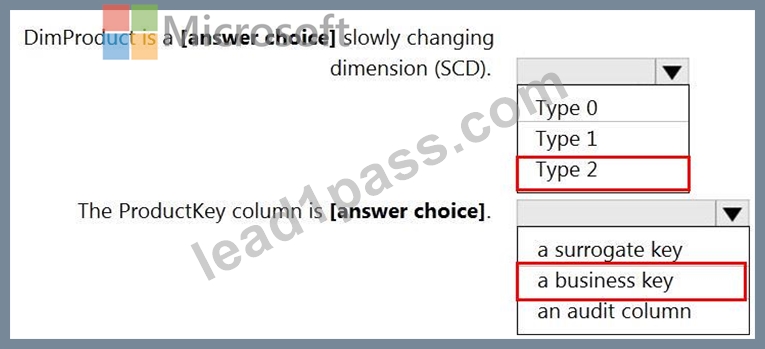
Reference:
https://docs.microsoft.com/en-us/learn/modules/populate-slowly-changing-dimensions-azure-synapse-analytics-pipelines/3-choose-between-dimension-types
NEW QUESTION # 176
The following code segment is used to create an Azure Databricks cluster.
For each of the following statements, select Yes if the statement is true. Otherwise, select No.
NOTE: Each correct selection is worth one point.
Answer:
Explanation:
Explanation
Graphical user interface, text, application Description automatically generated
Box 1: Yes
A cluster mode of 'High Concurrency' is selected, unlike all the others which are 'Standard'. This results in a worker type of Standard_DS13_v2.
Box 2: No
When you run a job on a new cluster, the job is treated as a data engineering (job) workload subject to the job workload pricing. When you run a job on an existing cluster, the job is treated as a data analytics (all-purpose) workload subject to all-purpose workload pricing.
Box 3: Yes
Delta Lake on Databricks allows you to configure Delta Lake based on your workload patterns.
Reference:
https://adatis.co.uk/databricks-cluster-sizing/
https://docs.microsoft.com/en-us/azure/databricks/jobs
https://docs.databricks.com/administration-guide/capacity-planning/cmbp.html
https://docs.databricks.com/delta/index.html
NEW QUESTION # 177
You have an Azure subscription that contains an Azure Data Lake Storage Gen2 account named storage1.
Storage1 contains a container named container1. Container1 contains a directory named directory1. Directory1 contains a file named file1.
You have an Azure Active Directory (Azure AD) user named User1 that is assigned the Storage Blob Data Reader role for storage1.
You need to ensure that User1 can append data to file1. The solution must use the principle of least privilege.
Which permissions should you grant? To answer, drag the appropriate permissions to the correct resources.
Each permission may be used once, more than once, or not at all. You may need to drag the split bar between panes or scroll to view content.
Answer:
Explanation:
Explanation
Box 1: Execute
If you are granting permissions by using only ACLs (no Azure RBAC), then to grant a security principal read or write access to a file, you'll need to give the security principal Execute permissions to the root folder of the container, and to each folder in the hierarchy of folders that lead to the file.
Box 2: Execute
On Directory: Execute (X): Required to traverse the child items of a directory Box 3: Write On file: Write (W): Can write or append to a file.
Reference:
https://docs.microsoft.com/en-us/azure/storage/blobs/data-lake-storage-access-control
NEW QUESTION # 178
......
Regular Free Updates DP-203 Dumps Real Exam Questions Test Engine: https://www.lead1pass.com/Microsoft/DP-203-practice-exam-dumps.html
Tested & Approved DP-203 Study Materials Download: https://drive.google.com/open?id=1jboqKDF3oBfvwF5LLTwTTN-2V5Jn841K