

[Oct 15, 2024] Powerful SOA-C02 PDF Dumps for SOA-C02 Questions
Authentic SOA-C02 Dumps - Free PDF Questions to Pass
The AWS Certified SysOps Administrator - Associate (SOA-C02) certification exam consists of 65 multiple-choice and multiple-response questions, and candidates have 130 minutes to complete the exam. The passing score for the exam is 720 out of a possible 1000 points. Upon successfully passing the exam, candidates receive the AWS Certified SysOps Administrator - Associate certification, which is valid for two years.
NEW QUESTION # 29
A web service runs on Amazon EC2 instances behind an Elastic Load Balancing (ELB) load balancer. External clients must whitelist specific public IP addresses in their firewalls to access the service.
What load balancer or ELB feature should be used for this application?
- A. Application Load Balancer
- B. Classic Load Balancer
- C. Network Load Balancer
- D. Load balancer target groups
Answer: C
Explanation:
Network Loadbalancer work on IP.
Application load balancer work on DNS address.
NEW QUESTION # 30
A SysOps administrator is unable to authenticate an AWS CLI call to an AWS service Which of the following is the cause of this issue?
- A. The server certificate is missing
- B. There is no access key
- C. The IAM password is incorrect
- D. The SSH key pair is incorrect
Answer: B
Explanation:
The most likely reason for being unable to authenticate an AWS CLI call to an AWS service is the absence of an access key. AWS CLI requires an access key and secret key to authenticate requests.
* Access Key and Secret Key:
* AWS uses access keys to identify and authenticate the identity of the requester.
* Ensure that the AWS CLI is configured with a valid access key and secret key.
* Check AWS CLI Configuration:
* Use the aws configure command to set up the AWS CLI with the necessary credentials.
* Verify that the ~/.aws/credentials file contains the correct access key and secret key.
* References:
* AWS CLI Configuration
* Managing Access Keys
NEW QUESTION # 31
A company needs to view a list of security groups that are open to the internet on port 3389.
What should a SysOps administrator do to meet this requirement?
- A. Configure a service control policy (SCP) to identify security groups that allow unrestricted access on port 3389.
- B. Use AWS Identity and Access Management Access Analyzer to find any instances that have unrestricted access on port 3389.
- C. Configure Amazon GuardDuty to scan security groups and report unrestricted access on port 3389.
- D. Use AWS Trusted Advisor to find security groups that allow unrestricted access on port 3389
Answer: D
Explanation:
To view a list of security groups that are open to the internet on port 3389, the most appropriate tool is AWS Trusted Advisor.
* AWS Trusted Advisor:
* AWS Trusted Advisor provides real-time guidance to help you provision your resources following AWS best practices.
* It includes a security check that identifies security groups with unrestricted access.
* Using Trusted Advisor:
* Go to the AWS Trusted Advisor console.
* In the "Security" category, look for the check that identifies security groups with unrestricted access.
* Review the report to find security groups that allow unrestricted access on port 3389 (RDP).
References:
* AWS Trusted Advisor
* AWS Trusted Advisor Best Practices
NEW QUESTION # 32
A SysOps administrator configured AWS Backup to capture snapshots from a single Amazon EC2 instance that has one Amazon Elastic Block Store (Amazon EBS) volume attached. On the first snapshot, the EBS volume has 10 GiB of data. On the second snapshot, the EBS volume still contains 10 GiB of data, but 4 GiB have changed. On the third snapshot, 2 GiB of data have been added to the volume, for a total of 12 GiB.
How much total storage is required to store these snapshots?
- A. 32 GiB
- B. 12 GiB
- C. 26 GiB
- D. 16 GiB
Answer: D
Explanation:
https://docs.aws.amazon.com/AWSEC2/latest/UserGuide/EBSSnapshots.html#how_snapshots_ work
NEW QUESTION # 33
A SysOps administrator receives an alert from Amazon GuardDuty about suspicious network activity on an Amazon EC2 instance. The GuardDuty finding lists a new external IP address as a traffic destination. The SysOps administrator does not recognize the external IP address. The SysOps administrator must block traffic to the external IP address that GuardDuty identified.
Which solution will meet this requirement?
- A. Use VPC flow logs with Amazon Athena to block traffic to the external IP address.
- B. Create a new security group to block traffic to the external IP address. Assign the new security group to the entire VPC.
- C. Create a network ACL. Add an outbound deny rule for traffic to the external IP address.
- D. Create a new security group to block traffic to the external IP address. Assign the new security group to the EC2 instance.
Answer: C
Explanation:
https://docs.aws.amazon.com/vpc/latest/userguide/vpc-network-acls.html
NEW QUESTION # 34
A company uses Amazon S3 to aggregate raw video footage from various media teams across the US. The company recently expanded into new geographies in Europe and Australia. The technical teams located in Europe and Australia reported delays when uploading large video tiles into the destination S3 bucket m toe United States.
What are the MOST cost-effective ways to increase upload speeds into the S3 bucket? (Select TWO.)
- A. Use AWS Global Accelerator for file uploads into the destination S3 bucket from the branch offices in Europe and Australia.
- B. Create multiple AWS Site-to-Site VPN connections between AWS and branch offices in Europe and Australia for file uploads into the destination S3 bucket.
- C. Use multipart uploads for file uploads into the destination S3 bucket from the branch offices in Europe and Australia.
- D. Create multiple AWS Direct Connect connections between AWS and branch offices in Europe and Australia tor He uploads into the destination S3 bucket
- E. Use Amazon S3 Transfer Acceleration for file uploads into the destination S3 bucket.
Answer: C,E
Explanation:
To increase upload speeds into the S3 bucket from Europe and Australia, the SysOps administrator should use Amazon S3 Transfer Acceleration and multipart uploads. These methods are cost-effective and efficient.
* Amazon S3 Transfer Acceleration:
* This feature speeds up uploads by using the globally distributed edge locations of Amazon
* CloudFront. Data is routed to the closest edge location, which then forwards the data to the S3 bucket in the destination region.
* This reduces latency and increases the upload speed for large files.
* Multipart Uploads:
* Multipart upload allows you to upload a single large object as a set of parts. Each part is independently uploaded and can be uploaded in parallel.
* This method improves the upload efficiency and resiliency, especially for large files.
* Configuration Steps:
* Enable Transfer Acceleration on the S3 bucket through the AWS Management Console or AWS CLI.
* Implement multipart upload in the application or scripts used for uploading files.
References:
* Amazon S3 Transfer Acceleration
* Multipart Upload Overview
NEW QUESTION # 35
A SysOps administrator migrates NAT instances to NAT gateways. After the migration, an application that is hosted on Amazon EC2 instances in a private subnet cannot access the internet.
Which of the following are possible reasons for this problem? (Choose two.)
- A. The NAT gateway is in an unsupported Availability Zone.
- B. The NAT gateway is not in the Available state.
- C. The application is using a protocol that the NAT gateway does not support.
- D. The NAT gateway is not in a security group.
- E. The port forwarding settings do not allow access to internal services from the internet.
Answer: B,C
Explanation:
https://docs.aws.amazon.com/vpc/latest/userguide/nat-gateway-troubleshooting.html#nat- gateway-troubleshooting-no-internet-connection
NEW QUESTION # 36
An Amazon EC2 instance is running an application that uses Amazon Simple Queue Service (Amazon SQS) queues.
A SysOps administrator must ensure that the application can read, write, and delete messages from the SQS queues.
Which solution will meet these requirements in the MOST secure manner?
- A. Create an IAM user with an IAM policy that allows the sqs:SendMessage permission, the sqs:ReceiveMessage permission, and the sqs:DeleteMessage permission to the appropriate queues.
Export the IAM user's access key and secret access key as environment variables on the EC2 instance. - B. Create an IAM user with an IAM policy that allows the sqs:SendMessage permission, the sqs:ReceiveMessage permission, and the sqs:DeleteMessage permission to the appropriate queues.
Embed the IAM user's credentials in the application's configuration. - C. Create and associate an IAM role that allows EC2 instances to call AWS services. Attach an IAM policy to the role that allows sqs:* permissions to the appropriate queues.
- D. Create and associate an IAM role that allows EC2 instances to call AWS services. Attach an IAM policy to the role that allows the sqs:SendMessage permission, the sqs:ReceiveMessage permission, and the sqs:DeleteMessage permission to the appropriate queues.
Answer: D
NEW QUESTION # 37
A webpage is stored in an Amazon S3 bucket behind an Application Load Balancer (ALB). Configure the SS bucket to serve a static error page in the event of a failure at the primary site.
1. Use the us-east-2 Region for all resources.
2. Unless specified below, use the default configuration settings.
3. There is an existing hosted zone named lab-
751906329398-26023898.com that contains an A record with a simple routing policy that routes traffic to an existing ALB.
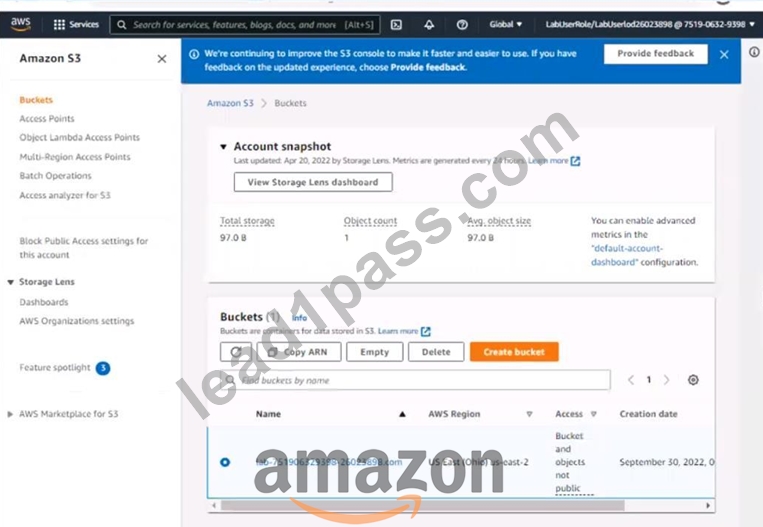
4. Configure the existing S3 bucket named lab-751906329398-26023898.com as a static hosted website using the object named index.html as the index document
5. For the index-html object, configure the S3 ACL to allow for public read access. Ensure public access to the S3 bucketjs allowed.
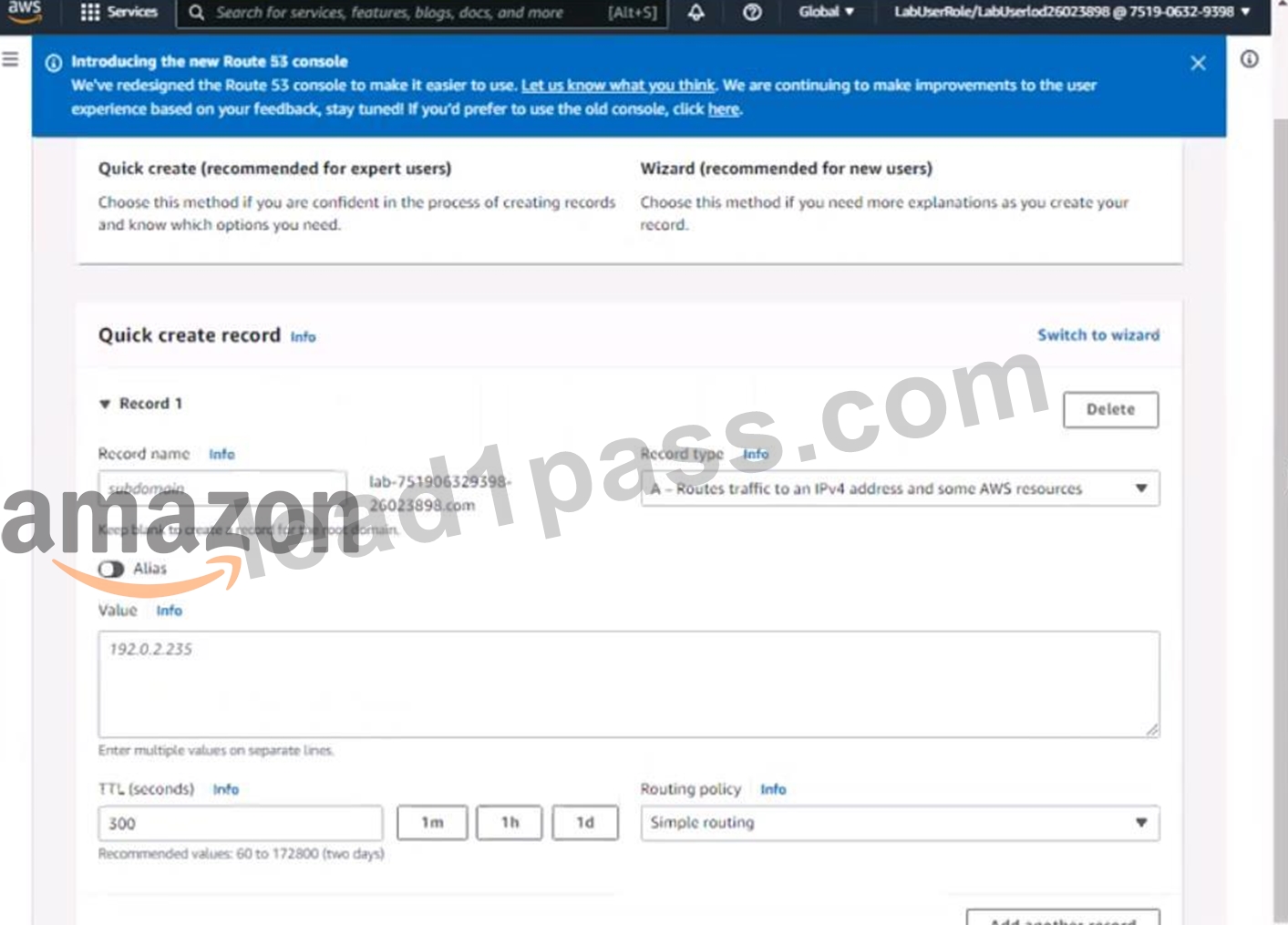
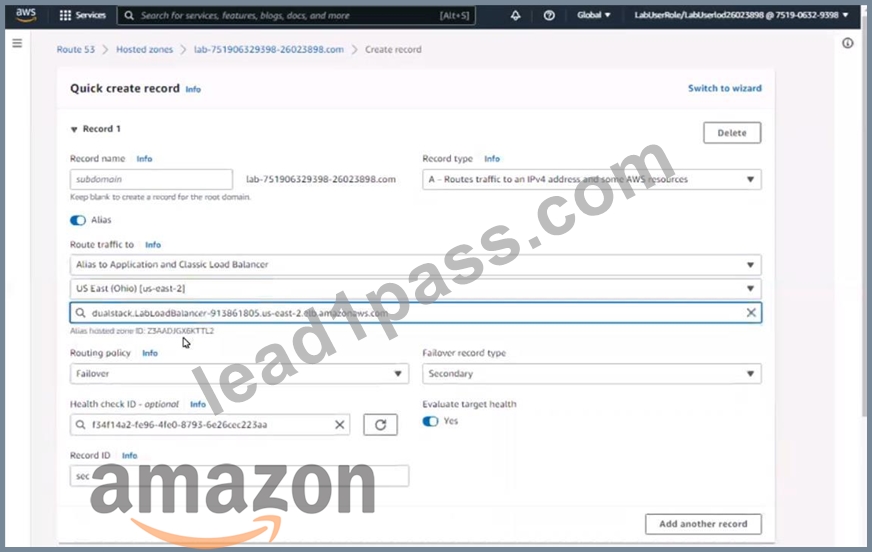
6. In Amazon Route 53, change the A record for domain lab-751906329398-26023898.com to a primary record for a failover routing policy. Configure the record so that it evaluates the health of the ALB to determine failover.
7. Create a new secondary failover alias record for the domain lab-751906329398-26023898.com that routes traffic to the existing 53 bucket.
Answer:
Explanation:
See the Explanation for solution.
Explanation:
Here are the steps to configure an Amazon S3 bucket to serve a static error page in the event of a failure at the primary site:
* Log in to the AWS Management Console and navigate to the S3 service in the us-east-2 Region.
* Find the existing S3 bucket named lab-751906329398-26023898.com and click on it.
* In the "Properties" tab, click on "Static website hosting" and select "Use this bucket to host a website".
* In "Index Document" field, enter the name of the object that you want to use as the index document, in this case, "index.html"
* In the "Permissions" tab, click on "Block Public Access", and make sure that "Block all public access" is turned OFF.
* Click on "Bucket Policy" and add the following policy to allow public read access:
{
"Version": "2012-10-17",
"Statement": [
{
"Sid": "PublicReadGetObject",
"Effect": "Allow",
"Principal": "*",
"Action": "s3:GetObject",
"Resource": "arn:aws:s3:::lab-751906329398-26023898.com/*"
}
]
}
* Now navigate to the Amazon Route 53 service, and find the existing hosted zone named lab-751906329398-26023898.com.
* Click on the "A record" and update the routing policy to "Primary - Failover" and add the existing ALB as the primary record.
* Click on "Create Record" button and create a new secondary failover alias record for the domain lab-751906329398-26023898.com that routes traffic to the existing S3 bucket.
* Now, when the primary site (ALB) goes down, traffic will be automatically routed to the S3 bucket serving the static error page.
Note:
* You can use CloudWatch to monitor the health of your ALB.
* You can use Amazon S3 to host a static website.
* You can use Amazon Route 53 for routing traffic to different resources based on health checks.
* You can refer to the AWS documentation for more information on how to configure and use these services:
* https://aws.amazon.com/s3/
* https://aws.amazon.com/route53/
* https://aws.amazon.com/cloudwatch/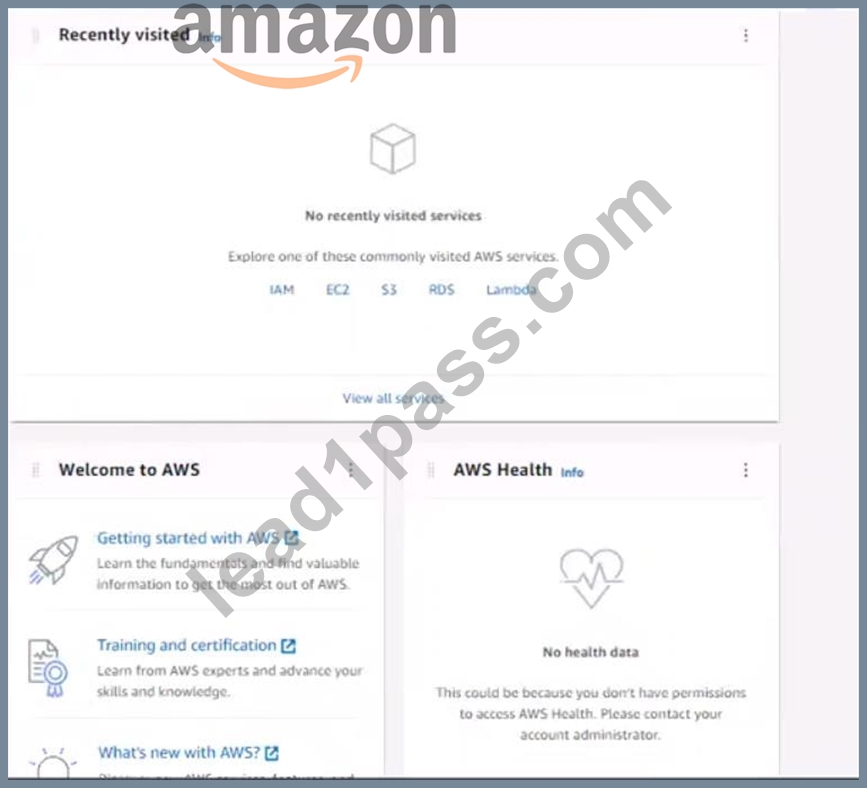
Graphical user interface, text, application Description automatically generated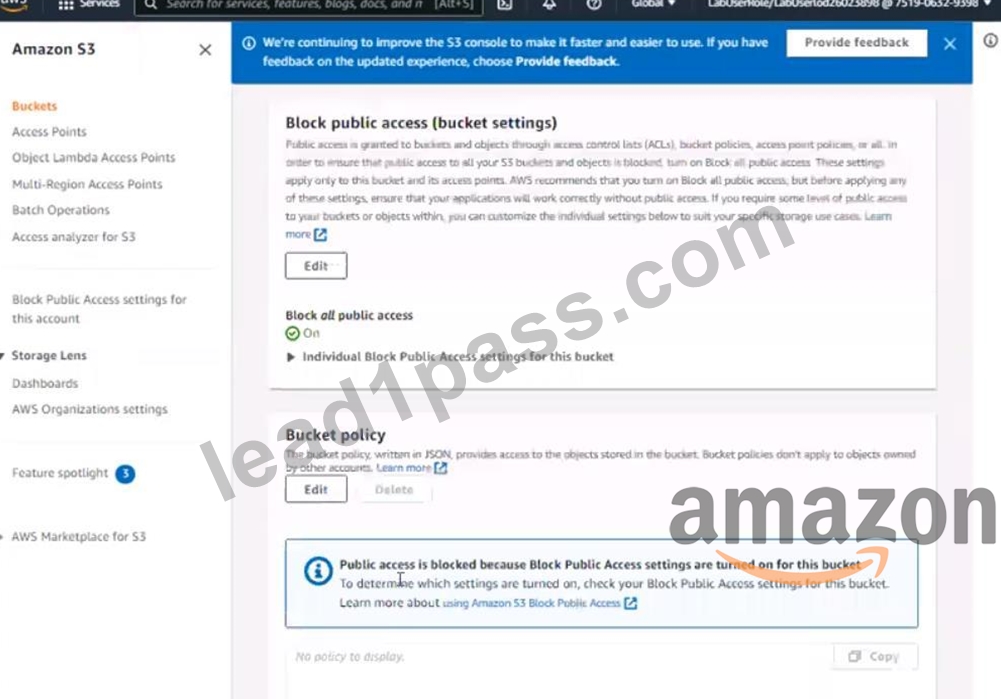
Graphical user interface, application, Teams Description automatically generated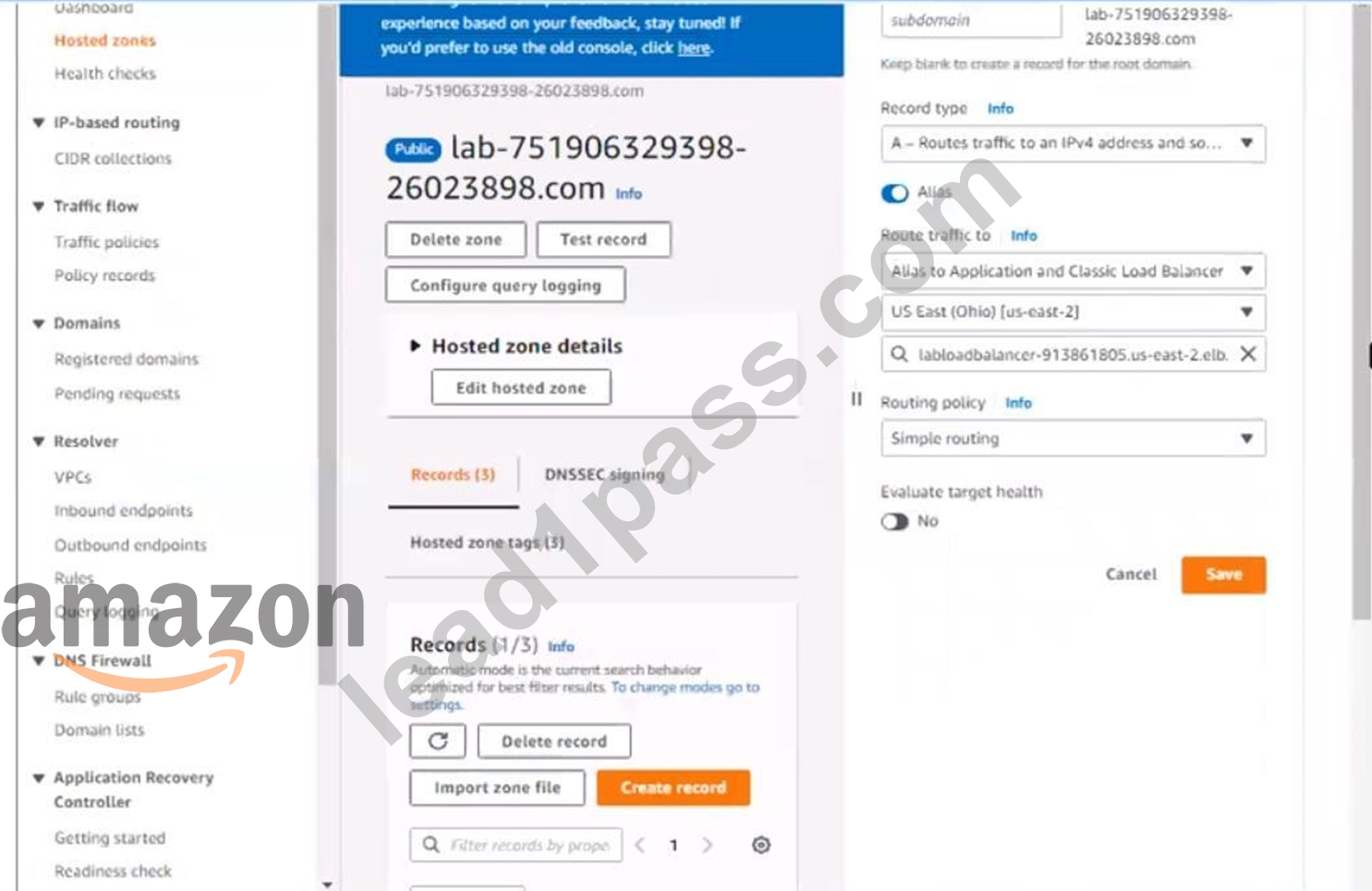
NEW QUESTION # 38
A SysOps administrator has used AWS Cloud Formal ion to deploy a serverless application Into a production VPC. The application consists of an AWS Lambda function an Amazon DynamoDB table, and an Amazon API Gateway API. The SysOps administrator must delete the AWS Cloud Formation stack without deleting the DynamoDB table.
Which action should the SysOps administrator take before deleting the AWS Cloud Formation stack?
- A. Add a Snapshot deletion policy to the DynamoDB resource in the AWS CloudFormation stack.
- B. Add a Retain deletion policy to the DynamoDB resource in the AWS CloudFormation stack
- C. Update the application's IAM policy with a Deny statement for the dynamodb:DeleteTabie action.
- D. Enable termination protection on the AWS Cloud Formation stack.
Answer: B
Explanation:
To delete the AWS CloudFormation stack without deleting the DynamoDB table, you need to apply a deletion policy to the DynamoDB resource. The Retain deletion policy ensures that the specified resource is not deleted when the stack is deleted. Instead, it is retained.
Steps:
* Modify the CloudFormation Template:
* Add a deletion policy to the DynamoDB table resource.
json
Copy code
{
"Resources": {
"MyDynamoDBTable": {
"Type": "AWS::DynamoDB::Table",
"DeletionPolicy": "Retain",
}
}
}
Reference: AWS CloudFormation DeletionPolicy Attribute
Update the Stack:
Update the CloudFormation stack with the modified template.
Reference: Updating a Stack
Delete the Stack:
Proceed to delete the stack. The DynamoDB table will be retained.
Reference: Deleting a Stack
NEW QUESTION # 39
A SysOps administrator has been able to consolidate multiple, secure websites onto a single server, and each site is running on a different port. The administrator now wants to start a duplicate server in a second Availability Zone and put both behind a load balancer for high availability.
What would be the command line necessary to deploy one of the sites' certificates to the load balancer?
- A. aws elb set-load-balancer-listener-ssl-certificate --load-balancer-name my-load-balancer ? load- balancer-port 443 ?ssl-certificate-id arn:aws:iam::123456789012:server-certificate/new- server-cert
- B. aws ec2 put-ssl-certificate ?load-balancer-name my-load-balancer ?load-balancer-port 443 ?-ssl- certificate-id arn:aws:iam::123456789012:server-certificate/new-server-cert
- C. aws kms modify-listener ?load-balancer-name my-load-balancer -certificates CertificateArn=arn:aws:iam::123456789012:server-certifiate/my-new-server-cert
- D. aws acm put-ssl-certificate ?load-balancer-name my-load-balancer ?load-balancer-port 443 ?ssl- certificate-id arn:aws:iam::123456789012:server-certificate/new-server-cert
Answer: A
NEW QUESTION # 40
A Sysops administrator wants to share a copy of a production database with a migration account. The production database is hosted on an Amazon RDS DB instance and is encrypted at rest with an AWS Key Management Service (AWS KMS) key that has an alias of What must the Sysops administrator do to meet these requirements with the LEAST administrative overhead?
- A. Take a snapshot of the RDS DB instance in the production account. Amend the KMS key policy of the production-rds-key KMS key to give access to the migration account's root user. Share the snapshot with the migration account.
- B. Create an RDS read replica in the migration account. Configure the KMS key policy to replicate the production-rds-key KMS key to the migration account.
- C. Use native database toolsets to export the RDS DB instance to Amazon S3. Create an S3 bucket and an S3 bucket policy for cross-account access between the production account and the migration account. Use native database toolsets to import the database from Amazon S3 to a new RDS DB instance.
- D. Take a snapshot of the RDS DB instance in the production account. Share the snapshot with the migration account. In the migration account, create a new KMS key that has an identical alias.
Answer: A
Explanation:
To share an encrypted Amazon RDS DB instance snapshot across accounts, the least administrative overhead involves directly managing permissions on the AWS KMS key and sharing the snapshot. Here's how to do it:
Take a Snapshot: Initiate a snapshot of your Amazon RDS DB instance in the production account. This captures the current state of the database.
Modify KMS Key Policy: Adjust the policy of the KMS key used for encryption (identified by the alias 'production-rds-key') to grant the kms:Decrypt permission to the migration account's root user. This step is crucial as it allows the migration account to use the same encryption key to decrypt the snapshot.
Share the Snapshot: Share the newly created snapshot with the migration account using the RDS console or AWS CLI. The migration account will now be able to see and use this snapshot to create a new RDS instance.
AWS Documentation Reference:
You can refer to the AWS documentation on sharing encrypted snapshots: Sharing Encrypted Snapshots.
NEW QUESTION # 41
A SysOps administrator is configuring an application on Amazon EC2 instances for a company Teams in other countries will use the application over the internet. The company requires the application endpoint to have a static pubic IP address.
How should the SysOps administrator deploy the application to meet this requirement?
- A. Behind an Amazon API Gateway API
- B. Behind an Application Load Balancer
- C. Behind an internet-facing Network Load Balancer
- D. In an Amazon CloudFront distribution
Answer: C
Explanation:
To ensure that the application endpoint has a static public IP address, the SysOps administrator should deploy the application behind an internet-facing Network Load Balancer (NLB):
* Network Load Balancer:
* An NLB automatically provides a static IP address that can be associated with the load balancer. It supports static IP addresses for each Availability Zone and can handle a high number of requests per second.
Reference: Network Load Balancer Documentation
Configuration Steps:
Create an internet-facing NLB and configure the target groups to point to the EC2 instances running the application.
Assign Elastic IP addresses to the NLB for a static public IP.
Reference: Create an NLB
NEW QUESTION # 42
A SysOps administrator is re-architecting an application. The SysOps administrator has moved the database from a public subnet, where the database used a public endpoint. into a private subnet to restrict access from the public network. After this change, an AWS Lambda function that requires read access to the database cannot connect to the database. The SysOps administrator must resolve this issue without compromising security.
Which solution meets these requirements?
- A. Create an AWS PrivateLink interface endpoint for the Lambda function. Connect to the database using its private endpoint.
- B. Move the database to a public subnet. Use security groups for secure access.
- C. Attach an 1AM role to the Lambda function with read permissions to the database.
- D. Connect the Lambda function to the database VPC. Connect to the database using its private endpoint.
Answer: D
Explanation:
To resolve the issue of an AWS Lambda function unable to connect to a database that has been moved to a private subnet, the Lambda function needs to be connected to the same VPC as the database. This is done by configuring the Lambda function with VPC access. This involves specifying the VPC, subnets, and security groups for the Lambda function so that it can communicate with the database using its private endpoint.
Option B is correct as it directly addresses the issue without compromising security. AWS documentation on configuring VPC access for Lambda provides guidance on this setup Configuring VPC Access for Lambda.
NEW QUESTION # 43
A company has a simple web application that runs on a set of Amazon EC2 instances behind an Elastic Load Balancer in the eu-west-2 Region. Amazon Route 53 holds a DNS record for the application with a simple touting policy.
Users from all over the world access the application through their web browsers.
The company needs to create additional copies of the application in the us-east-1 Region and in the ap-south-1 Region.
The company must direct users to the Region that provides the fastest response times when the users load the application.
What should a SysOps administrator do to meet these requirements?
- A. In each new Region, create a new Elastic Load Balancer and a new set of EC2 Instances to run a copy of the application.
Transition to a geolocation routing policy. - B. In each new Region, create a new Elastic Load Balancer and a new set of EC2 instances to run a copy of the application.
Transition to a latency routing policy. - C. In each new Region, create a copy of the application on new EC2 instances.
Add these new EC2 instances to the Elastic Load Balancer in eu-west-2.
Transition to a multivalue routing policy. - D. In each new Region, create a copy of the application on new EC2 instances.
Add these new EC2 instances to the Elastic Load Balancer in eu-west-2.
Transition to a latency routing policy.
Answer: B
NEW QUESTION # 44
A new application runs on Amazon EC2 instances and accesses data in an Amazon RDS database instance. When fully deployed in production, the application fails. The database can be queried from a console on a bastion host. When looking at the web server logs, the following error is repeated multiple times:
"** Error Establishing a Database Connection
Which of the following may be causes of the connectivity problems? (Choose two.)
- A. The security group for the database does not have the appropriate egress rule from the database to the web server.
- B. The security group for the database does not have the appropriate ingress rule from the web server to the database.
- C. The certificate used by the web server is not trusted by the RDS instance.
- D. The port used by the application developer does not match the port specified in the RDS configuration.
- E. The database is still being created and is not available for connectivity.
Answer: B,D
Explanation:
Database can be queried from Bastion, so E is out. Security groups are stateful, so you don't have to bother with the egress rules in this situation, as long as you have the proper ingress rule.
NEW QUESTION # 45
A SysOps administrator Is troubleshooting an AWS Cloud Formation template whereby multiple Amazon EC2 instances are being created The template is working In us-east-1. but it is failing In us-west-2 with the error code:
How should the administrator ensure that the AWS Cloud Formation template is working in every region?
- A. Edit the AWS CloudFormatton template to offer a drop-down list of all AMIs to the user by using the aws :: EC2:: ami :: imageiD control.
- B. Modify the AWS CloudFormation template by including the AMI IDs in the "Mappings" section. Refer to the proper mapping within the template for the proper AMI ID.
- C. Edit the AWS CloudFormatton template to specify the region code as part of the fully qualified AMI ID.
- D. Copy the source region's Amazon Machine Image (AMI) to the destination region and assign it the same ID.
Answer: D
NEW QUESTION # 46
......
Achieving the AWS Certified SysOps Administrator - Associate certification can provide numerous benefits to professionals, including increased job opportunities, higher salaries, and recognition in the industry as an AWS expert. AWS Certified SysOps Administrator - Associate (SOA-C02) certification can also demonstrate the candidate's ability to manage and deploy applications on the AWS platform effectively, which is a valuable skill in today's cloud-based world.
Guaranteed Accomplishment with Newest Oct-2024 FREE: https://www.lead1pass.com/Amazon/SOA-C02-practice-exam-dumps.html
Use Valid New Free SOA-C02 Exam Dumps & Answers: https://drive.google.com/open?id=1Oo_EnIHPKaU1-e74KcM9nxtPNAdmkjh8