

Latest Salesforce B2B-Solution-Architect PDF and Dumps (2023) Free Exam Questions Answers
Pass Your Architect Exams B2B-Solution-Architect Exam on Jul 21, 2023 with 114 Questions
NEW QUESTION # 66
Universal Containers (UC) is looking to implement a CPQ + B2B Commerce multi-cloud solution and use the CPQ B2B Commerce Connector to keep the two in sync. As part of this implementation, UC is looking to be able to have a streamlined product and pricing experience. As UC would like to sell product kits with tiered pricing through the self-service storefront, it would like to ensure this model can be supported effectively.
Which two considerations should a Solution Architect keep in mind for the implementation?
Choose 2 answers
- A. for supporting kits in the B2B Commerce Storefront, they need to create equivalent bundle products on the CPQ side.
- B. It is important to ensure the Price Rules run for Quotes initiated via 628 Commerce Storefront to maintain consistency in business rules being applied.
- C. For the described multi-cloud solution, it is a best practice to set the CPQ precision to two decimal points.
- D. On the CPQ 826 Commerce Connector, the default mapping of tiered pricing in 826 Commerce is to Discount Schedules in CPQ.
Answer: A,D
Explanation:
The CPQ B2B Commerce Cloud Connector is an unmanaged package from Salesforce Labs that allows B2B Commerce and CPQ customers to configure or customize functionality12. It syncs products, pricing, quote requests, and orders in both clouds12.
For supporting kits in the B2B Commerce Storefront, they need to create equivalent bundle products on the CPQ side3. A kit is a product that contains other products as components3. A bundle is a product that has one or more options that can be added or removed by a user4. The connector maps kits to bundles using a custom field called Kit ID on both objects3.
On the CPQ 826 Commerce Connector, the default mapping of tiered pricing in 826 Commerce is to Discount Schedules in CPQ5. Tiered pricing lets you set different prices for different quantities of a product5. Discount schedules let you apply discounts based on quantity or amount ranges for a product. The connector maps tiered prices to discount schedules using a custom field called Tiered Price ID on both objects5.
NEW QUESTION # 67
Universal Containers (UC) wants to add and integrate Marketing Cloud Account Engagement after a recent acquisition. The integration into the global architecture will be as follows:
* Marketing Cloud Account Engagement will be used for lead nurturing with Engagement Studio.
* Marketing Cloud Account Engagement forms will be set up in a website.
* Sales Cloud will manage leads created by Marketing Cloud Account Engagement.
UC wants to facilitate adoption by giving sales representatives and marketers enough time to learn about new features on a training platform.
Which approach should a Solution Architect recommend in order to set up an environment in which users can test the functionalities from end to end?
- A. Create a new Marketing Cloud Account Engagement business unit, recreate the configuration, and link it to a full copy Sales Cloud sandbox.
- B. Create a new Marketing Cloud Account Engagement business unit, recreate the configuration, and link it to the production Sales Cloud org.
- C. Create Marketing Cloud Account Engagement training environments, synchronize the environments, and link it to a full copy Sales Cloud sandbox.
- D. Create a new Marketing Cloud Account Engagement business unit, synchronize the production unit and the training unit, and link it to a full copy Sales Cloud sandbox.
Answer: D
Explanation:
Create a new MCAE business unit, recreate the configuration, and link it to a full copy Sales Cloud sandbox. This way, users can test the lead nurturing with Engagement Studio, the forms on the website, and the lead management in Sales Cloud without affecting the production data or settings23.
The recommended approach for setting up an environment in which users can test the functionalities of Marketing Cloud Account Engagement would be to create a new Marketing Cloud Account Engagement business unit, synchronize the production unit and the training unit, and link it to a full copy Sales Cloud sandbox. This allows for a dedicated training environment that can be synchronized with the production environment to ensure that data and configurations are consistent between the two. Additionally, linking it to a full copy Sales Cloud sandbox enables end-to-end testing of the solution. (Reference: Salesforce Help - Create a Marketing Cloud Account, https://help.salesforce.com/s/articleView?id=sf.mc_create_account.htm&type=5)
NEW QUESTION # 68
P&C Hardware is a large manufacturer of computer components and already has an extensive Salesforce technology stack including MuleSoft, Sales Cloud, Service Cloud, and Field Service, as well as Shield capabilities. P&C Hardware is in the process of launching an online store based on Salesforce technology that's supposed to go live in 6 weeks. P&C Hardware needs to analyze performance to identify bottlenecks and optimize the configuration using its agile process with weekly releases. So far, P&C Hardware has covered similar requirements for other technologies using a third-party monitoring and alerting tool it deployed in the cloud.
What are two viable options a Solution Architect should explore in more detail with the client?
Choose 2 answers
- A. Leverage the B2B Commerce built-in performance monitoring dashboard to analyze performance in near real time.
- B. Leverage Shield Event Monitoring and MuleSoft to provide monitoring data to the third-party monitoring and alerting solution that's already in place at P&C Hardware.
- C. Leverage Shield Event Monitoring in combination with the CRM Analytics Event Monitoring app as a simple out-of-the-box solution.
- D. Leverage Shield Event Monitoring in conjunction with the Salesforce Debug Logs, and establish a regular review process for the Operations and Administration team.
Answer: B,D
NEW QUESTION # 69
Universal Containers (UC) currently utilizes Sales Cloud and Experience Cloud for its customers. For the next phase in its digital transformation, UC would like to enable its vast dealer network with the kinds of tools its direct Sales teams are currently using. UC is considering Partner Communities (PRM) on Experience Cloud.
UC's concern at the moment is making sure that its dealer network only gets access to the opportunities they themselves bring to UC or that UC submits to the dealer to close. This is a concern for the VP of direct sales who has issues with bringing PRM in at all.
What is the initial suggestion a Solution Architect should provide to make Partner Communities work for UC?
- A. Utilize the external sharing model to differentiate the sharing models between Internal Sales users and External Communities users.
- B. Create public groups of partner companies and users at dealers, and share the opportunities using sharing rules.
- C. Create two account lookups on the opportunity, one for dealer and one for partner company, and create sharing rules to share the records.
- D. Utilize the same sharing model within the Partner Community that customers are currently using within the Customer Community.
Answer: C
NEW QUESTION # 70
Universal Containers (UC) is implementing a Salesforce B2B multi-cloud project with large volumes of data and daily transactions from multiple third-party systems via multiple integrations. UC is looking at transactions of more than 1 million records a week and, in higher seasons, 10 million records a week. UC has made the decision to get a full copy sandbox to use to test all of its third-party integrations across its multiple clouds. UC has also invested in MuleSoft and the Anypoint Platform as the single enterprise service bus for all of the third-party data going into Salesforce.
Which type of performance testing should a Solution Architect recommend for testing data at scale on this project?
- A. Perform API load test against the partial copy sandbox before go live.
- B. Perform unit testing against the full copy sandbox codebase before go live in production.
- C. Perform API load test against the full copy sandbox before go live.
- D. Perform page load testing against production after go live.
Answer: A
NEW QUESTION # 71
AC Computers has decided to extend its existing Sales Cloud solution by implementing Service Cloud and Marketing Cloud Account Engagement. AC Computers has defined two different work streams for Service Cloud and Marketing Cloud Account Engagement and wants each workstream to work iteratively in separate sandboxes and migrate to a single sandbox for UAT and integration testing. With the multiple workstreams, AC Computers needs a more rigorous change management process and an audit process.
Which two options should AC Computers consider to supportboth implementation workstreams?
Choose 2 answers
- A. Use scratch orgs and continuous deployment tools to merge the workstream builds.
- B. Use multiple development sandboxes and merge the workstream builds using change sets.
- C. Use a version control system and CLI-based deployment tools to merge the workstream builds.
- D. Use package-based deployments and scratch orgs to merge the workstream builds.
Answer: A,B
NEW QUESTION # 72
Refer to the images below: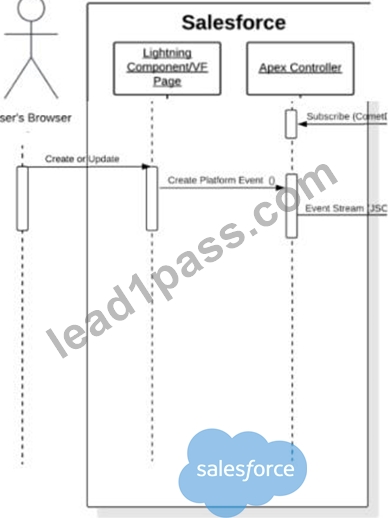
As part of its solution to accelerate overall sales. Universal Containers (UC) has chosen to implement a CPQ solution using Salesforce CPQ. As part of the CPQ solution, there is a requirement to retain UC's ERP as the Pricing and Product master.
UC's business process results in Products and Pricing being updated sporadically once a week, and then on a much larger scale on a monthly basis, which could result in a large amount of records that need to be updated in Salesforce.
Which strategy should the Solution Architect choose to handle this scenario?
- A. Option A, utilizing a VF/Lightning component in combination with an Apex Controller to make a REST call to the external service
- B. Option B, utilizing Process Builder and Platform Events to communicate with the external services Subscriber Listener
- C. Option C, utilizing a VF/Lightning component in combination with an Apex Controller to make a call utilizing the Streaming API
- D. Option D, utilizing an external ETL tool to batch load the records into Salesforce
Answer: D
Explanation:
Salesforce CPQ is an extension of the Salesforce CRM that automates the generation and processing of quotes, orders, and contracts. It enables your sales team to create quotes quickly and with minimal errors and efforts.
Salesforce CPQ can be integrated with ERP systems by converting Salesforce CPQ lead-to-order data into transactional data. This allows ERP systems to take over matching data and use it for accounting functions.
an external ETL tool can be used to batch load the records into Salesforce from the ERP system. This can handle large amounts of records that need to be updated sporadically or on a monthly basis.
https://www.rapidionline.com/blog/salesforce-cpq-data-integration-increase-sales
https://www.salesforce.com/products/cpq/resources/what-is-salesforce-cpq/
NEW QUESTION # 73
Universal Containers (UC) recently went live with a multi-cloud implement at ton consisting of Experience Cloud, Service Cloud, and Marketing Cloud Account Engagement. The UC Marketing team wants to generate Marketing Cloud Account Engagement emails using the same dynamic content that users access in Experience Cloud. They want to trigger Marketing Cloud Account Engagement emails based on certain user actions while keeping the content dynamic and configurable via a user- friendly mechanism.
Which approach should a Solution Architect recommend m this case?
- A. Build a custom application using Lightning Web Components to make the email content dynamic and configurable.
- B. Consider finding AppExchange packages that support this functionality on Experience Cloud and Marketing Cloud Account Engagement.
- C. Change the data model to support sending Marketing Cloud Account Engagement email via the Experience cloud site.
- D. Use Salesforce CMS on Experience Cloud and the new Marketing Cloud Account Engagement Lightning Email Experience.
Answer: D
NEW QUESTION # 74
Universal Containers (UC) is currently utilizing Sales Cloud and Revenue Cloud for its direct Sales team. UC would like to create an indirect Sales team with its vendors using Experience Cloud as the front end with the same kind of quoting functionality the direct Sales team uses within Revenue Cloud. However, UC wants to ensure that data from the internal direct Sales team is not visible to the external indirect Sales team in Experience Cloud.
What is the first configuration a Solution Architect should consider when implementing Experience Cloud in this scenario?
- A. Add Indirect Sales Team to existing Direct Sales Team Role Hierarchy.
- B. Enable External Sharing Model to create external organization-wide defaults.
- C. Make internal organization-wide defaults Public Read Only to create external visibility.
- D. Start creating Sharing Sets for Experience Cloud users to access Sales Cloud.
Answer: B
NEW QUESTION # 75
Universal Containers (UC) wants to enhance the online purchase experience for its customers. The product and pricing information is managed in a separate ERP, while customer purchases are primarily triggered online through self-service. UC often offers promotions and discounts through various online seasonal events.
UC wants the ability to provide customized quotes based on its relationship with the customer, as well as proactively process and monitor renewal and upgrade opportunities.
A Solution Architect has identified Sales Cloud, CPQ, Billing, and B2B Commerce as part of a potential multi-cloud solution.
Based on the above considerations, which option identifies the optimal data flow for this solution?
- A. Pricing and Product data should be pushed from ERP to B2B Commerce via the CPQ B2B Commerce Connector to CPQ. Promotions should be handled in B2B Commerce. Invoice and Billing should be maintained in Billing and surfaced on B2B Commerce via a Lightning component.
- B. Pricing and Product data should be pushed from ERP to both CPQ and B2B Commerce, keeping single source of truth. Promotions should be handled in B2B Commerce. Invoice and Billing should be maintained in Billing and pushed to B2B Commerce.
- C. Pricing and Product data should be pushed from ERP to CPQ and from there to B2B Commerce via the CPQ B2B Commerce Connector. Promotions should be managed in CPQ as CPQ is the pricing master.
Invoice and Billing should be managed in B2B Commerce and pushed to Billing. - D. Pricing and Product data should be pushed from ERP to CPQ and from there to B2B Commerce via the CPQ B2B Commerce Connector. Promotions should be handled in B2B Commerce. Invoice and Billing should be maintained in Billing and presented on B2B Commerce via a Lightning component.
Answer: A
NEW QUESTION # 76
Universal Containers (UC) currently has Sales Cloud, Revenue Cloud, and Marketing Cloud Account Engagement within its existing Salesforce environment and is utilizing a standard Lead to Cash solution across those clouds. UC is 2 years into its Salesforce implementation, and the CIO is getting concerned with the sheer amount of data affecting its environment's data limits.
IT is doing upkeep on older records that may no longer be relevant. They have decided to start looking at data archival strategies and what to archive correctly. Given that this solution involves Leads from Marketing Cloud Account Engagement, Opportunities from Sales Cloud, and Quotes from Revenue Cloud, they are concerned about archiving related data on active sales pipelines. They also want to keep a historical snapshot of all of their Quotes, Opportunities, and Leads for future pipeline performance purposes and are open to options.
Choose 2 answers
- A. Understand the organization's regulatory requirements around right to retain or delete data.
- B. Segment the data in terms of data needed for daily operations, data that is used occasionally at demand, and data that is used purely for historical purposes.
- C. Recommend AppExchange solutions that provide capabilities around data archiving to the CIO.
- D. Propose Skinny Tables to the CIO before doing anything else.
Answer: A,D
NEW QUESTION # 77
Universal Containers serves customers globally across two businesses. Each business has its own org for managing its sales and support operations. Each line of business also maintains its own reporting systems using both CRM Analytics and Salesforce reports, but the CEO is asking for a unique dashboard that includes the global opportunity pipeline with data from both orgs.
What should a Solution Architect propose?
- A. Use one org as primary and create external objects for the accounts and opportunities of the other one.
Then, use standard reports. - B. Use CRM Analytics in the primary org and create a Salesforce External Connection. Then, create a dataflow to combine data from both orgs.
- C. Use one org as primary and an ETL tool to synchronize the accounts and opportunities of the other org.
Then, use standard reports. - D. Use CRM Analytics in the primary org and then, in the dashboards, use Salesforce Connect to query the data from the other org.
Answer: B
NEW QUESTION # 78
Universal Containers (UC) acquired two companies. As part of its transformation and consolidation program, UC needs to bring all of its disparate partner strategies together and see what can be combined across all of its indirect sales channels. Each company currently has its own Salesforce environment utilizing Sales Cloud and Experience Cloud for Partners. Each company also follows its own unique business processes for partners.
However, UC has recently developed a new vision and journey focused on a single indirect channel with a single Salesforce environment aligned to its corporate strategy.
Given UC's new journey for engaging its indirectchannel, what are the nexttwo steps the Solution Architect should recommend?
Choose 2 answers
- A. Create an adoption plan for the Direct Sales team to engage with the Indirect Sales team in a sell-with model within the new Partner Communities.
- B. Completely unify all the channel strategies under the acquiring company's brand and strategy.
- C. Tell the stakeholders to focus on having a single Partner Community across all channels with a singular branding.
- D. Identify the need for multiple Partner Communities by Indirect Sales Channel with branding and content specific to each channel.
Answer: A,B
NEW QUESTION # 79
Universal Containers (UC) uses Marketing Cloud and recently added Sales Cloud to manage its business activities, as well as B2B Commerce to redesign its website. Today, a lead is created each time a customer leaves the site without finalizing their purchase. The number of leads created is increasing and representatives can no longer meet their callback deadlines.
With the new website, UC wants to increase the number of finalized sales and offer similar products to customers while reducing the Sales team's workload. Sales representatives should only call back customers if there is an upsell or cross-sell opportunity.
Which three recommendations should a Solution Architect make to meet these needs' Choose 3 answers
- A. Create an opportunity when a customer clicks a cross-sell or upsell email link.
- B. Send automated emails in Sales Cloud with discounted offers to customers who abandoned their cart.
- C. Stop creating leads in Sales Cloud for abandoned carts.
- D. Put all leads from the abandoned carts in a queue.
- E. Set up lead nurturing with Marketing Cloud and automate emails through journeys.
Answer: A,B,E
NEW QUESTION # 80
Universal Containers serves customers globally across two businesses. Each business has its own org for managing its sales and support operations. Each line of business also maintains its own reporting systems using both CRM Analytics and Salesforce reports, but the CEO is asking for a unique dashboard that includes the global opportunity pipeline with data from both orgs.
What should a Solution Architect propose?
- A. Use one org as primary and an ETL tool to synchronize the accounts and opportunities of the other org. Then, use standard reports.
- B. Use CRM Analytics in the primary org and create a Salesforce External Connection. Then, create a dataflow to combine data from both orgs.
- C. Use one org as primary and create external objects for the accounts and opportunities of the other one. Then, use standard reports.
- D. Use CRM Analytics in the primary org and then, in the dashboards, use Salesforce Connect to query the data from the other org.
Answer: B
NEW QUESTION # 81
Big Server Company sells complex server solutions to customers through a reseller channel. Resellers will purchase complex servers as well as have warehouses to store quick need products for their customers, such as additional hard drives and cables. Big Server Company currently uses Salesforce CPQ for its Sales team. Big Server Company would like to be able to give resellers easy access to purchase warehouse type products through B2B Commerce; however, the company would also like to allow resellers to request additional discounts for large volume orders from the Sales team.
Which recommendation should a Solution Architect make to integrate B2B Commerce and Salesforce CPQ to accomplish this request?
- A. Create a request special pricing button in B2B Commerce that will create an opportunity for the sales representative and allow the sales representative to follow up.
- B. Implement the Salesforce CPQ & Billing and CPQ B2B Commerce Connector and use the Cart to Quote flow to sync the cart to Salesforce CPQ, and have a reseller price rule adjust pricing for the reseller based on volume.
- C. Utilize an integration software, like MuleSoft, to sync carts and pricing between B2B Commerce and Salesforce CPQ.
- D. Implement the Salesforce CPQ & Billing and CPQ B2B Commerce Connector and use the Cart to Quote flow to create a quote from the Resellers Cart, allowing a sales representative to configure discounts and sync back to cart.
Answer: D
Explanation:
This option allows you to use the Cart to Quote flow to create a quote from the Resellers Cart, allowing a sales representative to configure discounts and sync back to cart1.
https://appexchange.salesforce.com/appxListingDetail?listingId=a0N3u00000MSk6gEAD
NEW QUESTION # 82
Universal Containers (UC) recently completed a successful implementation of B2B Commerce classic and saw an immediate increase in both its customer experience ratings and overall bottom line due to the influx of sales through its commerce application. After this initial experience, UC decided to target its internal Sales team for the same successful outcome with Salesforce CPQ and Sales Cloud.
UC's requirements include that its internal Sales team be able to sell its current commerce catalog and expand this catalog to include even more products. In addition, UC wants to give its internal Sales team the ability to utilize CPQ's discounting functionality, along with approval rules for its Sales leadership team. Today, product and pricing is mastered in B2B Commerce and orders are fulfilled in the ERP.
What should a Solution Architect recommend when architecting a solution to meet UC's requirements?
- A. The Product and Pricing data should be mastered in B2B Commerce and integrated into CPQ via REST API, and finally integrated to the ERP via SOAP API.
- B. The Product and Pricing data should be mastered in CPQ and integrated to B2B Commerce via Apex, and then finally integrated into the ERP via a middleware solution.
- C. The Product data should be mastered inside B2B Commerce, while Pricing should be mastered inside CPQ. Both solutions should be integrated via Apex and then integrated to the ERP via SOAP API.
- D. The Product and Pricing Data should be mastered in the ERP and then integrated into both B2B Commerce and CPQ via REST API.
Answer: A
Explanation:
it leverages the existing product and pricing data that is mastered in B2B Commerce and integrates it into CPQ via REST API, which is a standard and flexible way of exchanging data between different systems. There are connectors available on AppExchange that can help synchronize product and pricing data between B2B Commerce and CPQ, as well as streamline channel experiences and align order history. Integrating the final orders to the ERP via SOAP API can also ensure that the fulfillment process is consistent and accurate.
https://appexchange.salesforce.com/appxListingDetail?listingId=a0N3u00000MSk6gEAD
NEW QUESTION # 83
Universal Containers (UC) is about to start a massive digital transformation project across multiple service channels. UC plans on using Service Cloud, Omni-Channel, chatbots, Knowledge, and Einstein AI throughout all the service capabilities. Before discovery can start, the key stakeholder would like to see the automated chat capabilities in action. They currently use a third-party Knowledge Base and are wondering what is the value of it over Salesforce Knowledge. They believe it will be chatbots but they are unsure.
What is one of the key benefits the Solution Architect should address within the context of the demo?
- A. Demo how a human being can have a real conversation with an Einstein Al-driven chatbot.
- B. Demo how the chatbot can provide a response to a customer's request by bringing together content from Knowledge articles.
- C. Demo how the chatbot can anticipate the responses of the customer before they make it, and generate Knowledge article responses based on what they have bought.
- D. Demo how the chatbot can utilize Knowledge within it to deflect customer issues before a case is created.
Answer: D
Explanation:
This answer shows how the chatbot can leverage Knowledge articles to provide relevant and helpful information to customers without requiring them to contact a live agent. This can improve customer satisfaction and reduce service costs.
https://trailhead.salesforce.com/content/learn/modules/service_bots_basics/learn-about-einstein-bots
NEW QUESTION # 84
A Solution Architect hat been hired to consult Ace Computers with its integration solution. Ace Computers has a combination of four on-premise and cloud systems with data that need to be integrated to Salesforce. Ace Computers expects to have large data volumes and wants to minimize impact on end-user operations during business hours.
Which integration solution should the Solution Architect recommend for the company's business needs?
- A. MuteSoft Composer
- B. Platform Events
- C. MuteSoft Anypoint Platform
- D. Salesforce Data Loader
Answer: C
NEW QUESTION # 85
Universal Containers (UC) uses Sales Cloud, Service Cloud, and Experience Cloud. The implementation was completed 5+ years ago, and Service Cloud users are now expressing dissatisfaction with system performance.
A custom Visualforce page was developed to show relevant data to Experience Cloud users. The same page is used by the Support team but displays more information based on their profile. UC has a small internal Support team for Salesforce that periodically enables new features in production.
Which best practice should the Solution Architect recommend to avoid these types of issues in the future?
- A. Assess the level of data quality and test new features with a subset of users in production before enabling all users.
- B. Assess the level of technical debt and test new features with the Product team in a Developer sandbox.
- C. Assess the level of data quality and test new features with a pilot before enabling for all users.
- D. Assess the level of technical debt and test new features in a sandbox before enabling in production.
Answer: C
NEW QUESTION # 86
A team at Universal Containers (UC) is currently working on an initial release of Service Cloud. However, UC's management team is very enthusiastic about new features of the platform and wants to go to market with the new Service Cloud solution as soon as possible. The current objective of their initial Service Cloud release is mostly about managing their case workload and case assignment processes. A Solution Architect is called into a management meeting and asked when UC can go live with automated chatbots, Einstein case classification, and CRM Analytics for data insights.
How should a Solution Architect respond to the management team considering their request for these new capabilities'?
- A. Agree that the new features are crucial to the success of the initiative and swap parts of the current scope for the most innovative feature.
- B. Explain the long-term vision and roadmap, and then propose a logical phasing in which the planned minimum viable product (MVP) is the first step on the journey that will eventually include the desired features.
- C. Agree with the management team to postpone the go-live and increase the scope to include the desired features.
- D. Explain to the management team that these features are still evolving and that it is best to wait a few releases so that they are stable before starting to use them in production.
Answer: B
Explanation:
Explaining the long-term vision and roadmap, and then proposing a logical phasing in which the planned minimum viable product (MVP) is the first step on the journey that will eventually include the desired features2. This option can help UC align their expectations with their business goals and priorities, while also demonstrating how they can achieve incremental value from their Service Cloud solution over time. The Solution Architect can also highlight the benefits of delivering an MVP first, such as validating assumptions, testing functionality, gathering feedback, and reducing risks.
https://trailhead.salesforce.com/credentials/b2bsolutionarchitect
NEW QUESTION # 87
GG3 has gone live with a B2B multi-cloud solution and plans to add more functionality over time. The company has a team of system administrators who each focus on a specific cloud and area of functionality.
GG3 has decided to use an Org-Based deployment approach. It wants to protect the investment made and set the team up for success in the future.
What should a Solution Architect recommend as a best practice to put checks in place for decisions on changes moving forward?
- A. Engage a third-party company to manage all governance and represent as the Steering Committee.
- B. Budget for a Governance and Monitoring structure that includes a communications plan and project methodology for the following year.
- C. Engage Salesforce services to manage all governance and represent as the Steering Committee.
- D. Set up a Governance and Monitoring structure that includes a Steering Committee, a Center of Excellence, and a Data governance council.
Answer: A
NEW QUESTION # 88
......
B2B-Solution-Architect Dumps for Architect Exams Certified Exam Questions and Answer: https://www.lead1pass.com/Salesforce/B2B-Solution-Architect-practice-exam-dumps.html
B2B-Solution-Architect Free Exam Study Guide! (Updated 114 Questions): https://drive.google.com/open?id=1gU6353EB7FRvHms2D-PwFiPlqwgFgujy