

Sep-2025 New Version CPC Certificate & Helpful Exam Dumps is Online
CPC Free Certification Exam Material with 197 Q&As
NEW QUESTION # 41
When a provider's documentation refers to use, abuse, and dependence of the same substance (e.g. alcohol), which statement is correct?
- A. If both use and abuse are documented, assign abuse as the first code and use as the additional code.
- B. If use, abuse, and dependence are documented, report all three codes separately.
- C. If both abuse and dependence are documented, assign only the code for abuse.
- D. If both use and dependence are documented, assign only the code for dependence.
Answer: D
Explanation:
According to ICD-10-CM coding guidelines for substance use, abuse, and dependence, when multiple levels (use, abuse, and dependence) of the same substance are documented, only the highest level of severity is coded. The hierarchy is as follows: dependence > abuse > use.
D: If both use and dependence are documented, assign only the code for dependence is correct, as dependence represents the highest severity level and supersedes both use and abuse.
A: is incorrect because if both use and abuse are documented without dependence, only abuse would be coded as it is of a higher severity than use.
B: is incorrect because all three codes (use, abuse, dependence) should not be reported together; only the highest level should be coded.
C: is incorrect because if both abuse and dependence are documented, only dependence (the higher severity level) should be coded, not abuse.
Therefore, the correct answer is D. If both use and dependence are documented, assign only the code for dependence.
NEW QUESTION # 42
The pulmonologist performs a bronchoscopy with fluoroscopic guidance. The scope is introduced into the right nostril and advanced to the vocal cords and into the trachea. The scope is advanced to the right upper lobe and a lung nodule is noted. An endobronchial biopsy is performed.
What CPT code is reported for the procedure?
- A. 0
- B. 1
- C. 2
- D. 3
Answer: A
Explanation:
The CPT code 31625 is used for bronchoscopy with a transbronchial lung biopsy. This includes the use of fluoroscopic guidance, as described in the scenario.
References:
* AMA's CPT Professional Edition (current year)
NEW QUESTION # 43
Patient had polyps removed on a previous colonoscopy. The patient returns three months later for a follow-up examination for another colonoscopy. No new polyps are seen.
What diagnosis coding is reported for the second colonoscopy?
- A. K63.5
- B. Z86.010, K63.5
- C. Z09, Z86.010
- D. Z09, K63.5
Answer: C
Explanation:
For a follow-up examination after the removal of polyps with no new polyps found, the appropriate diagnosis codes are:
* Z09: Encounter for follow-up examination after completed treatment for conditions other than malignant neoplasm.
* Z86.010: Personal history of colonic polyps.
Using Z09 indicates that the follow-up exam is to check the patient after treatment, and Z86.010 indicates a history of colonic polyps, which is relevant to the patient's medical history.
References:
* ICD-10-CM guidelines
* AMA's CPT Professional Edition (current year)
NEW QUESTION # 44
A patient has chronic cholesteatoma in the right middle ear. The otolaryngologist performed a tympanoplasty with a radical mastoidectomy, removing the middle ear cholesteatoma. Grafting technique was used to repair the eardrum without ossicular chain reconstruction.
What CPT code is reported for this surgery?
- A. 0
- B. 1
- C. 2
- D. 3
Answer: A
NEW QUESTION # 45
A three-year-old patient is in the operative suite for stage 2 of treatment for double right outlet syndrome. The patient previously had the pulmonary artery banded and is returning for removal of the pulmonary band and transposition repair of the great vessels via aortic pulmonary reconstruction.
The surgeon performs a time-out and pre-incision review of respiration and BP then the previous sternal incision site is inspected and lightly painted with povidone. Next, reopens the sternal cavity and inserts central cannulae in the IVC, SVC and ascending aorta for extra corporeal membrane oxygenation (ECMO) bypass, chemical cardioplegia is initiated, stopping the heart and ECMO is initiated. A physician assistant monitors vitals and oxygenation until heart function resumes. The surgeon carefully incised and removes the Dacron band encircling the pulmonary artery, with nominal need for dilation. A section of coronary ostia is removed and sutured to the root of the pulmonary trunk. The pulmonary trunk and aortic root are then transected and transposed to allow for ideal cardiac circulation. Once structural integrity is visually confirmed, the physician assistant is permitted to administer the cardioplegia reversal solution and the surgeon removes the central cannulae after heart function safely resumes. The sternotomy is closed and the patient is transported to the NICU.
What CPTcodes are reported for the surgery today?
- A. 33778-78, 33953-78, 33985-78
- B. 33779-58, 33955-58, 33985-58
- C. 33779-78, 33953-78, 33985-78
- D. 33778-58, 33955-58, 33985-58
Answer: C
Explanation:
1. Procedure Details and CPTCode Selection:
The patient is undergoing stage 2 treatment for double outlet right ventricle (DORV) with a removal of the pulmonary artery band and transposition repair of the great vessels.
Code 33779 is specific for correction of a double outlet right ventricle, with transposition of the great arteries.
This code accurately reflects the procedure performed, including the complex repair involving the transposition of the pulmonary trunk and aortic root.
Code 33953 is used to report the initiation of extracorporeal membrane oxygenation (ECMO), which was used to maintain oxygenation during the procedure.
Code 33985 is for the termination of ECMO following the surgical repair once heart function has resumed.
Both 33953 and 33985 accurately document the initiation and termination of ECMO during this complex heart repair.
2. Modifier Selection:
Modifier 78 (unplanned return to the operating room for a related procedure during the postoperative period) is appropriate here. This is a subsequent stage in the treatment plan, but due to the complexity and specific surgical intervention required, it is treated as a return to the OR for related procedure coding.
Modifier 58 (staged or related procedure during the postoperative period) would not be as suitable here because the procedure involves a new return to the OR.
3. AAPC and CPTCoding Guidelines:
AAPC guidelines support the use of specific modifiers (78 for unplanned return) and appropriate ECMO codes (33953 and 33985) in complex cardiac cases requiring bypass and staged treatment.
Thus, the correct CPTcodes based on CPTand AAPC coding standards are C. 33779-78, 33953-78,
33985-78.
NEW QUESTION # 46
A 25-year-old woman underwent percutaneous breast biopsy on the right breast with placement of a Gelmark clip. The procedure was performed using stereotactic imaging.
What CPT codes will be reported?
- A. 19081, 19283
- B. 19100, 76098
- C. 0
- D. 19101, 19283
Answer: A
NEW QUESTION # 47
A 20-year-old female is being seen for the first time by a primary care physician to have a yearly physical.
During the examination for the physical, the provider discovers non-inflammed lesions on her legs and arms.
The physician performs a complete physical and additional separate documentation for the treatment of the lesions on the bilateral upper and lower extremities. The provider has the patient buy an over-the-counter ointment and will continue to watch them.
What CPT coding is reported for this visit?
- A. 0
- B. 1
- C. 99385-25, 99203
- D. 99385, 99203-25
Answer: D
Explanation:
CPT code 99385 is used for initial comprehensive preventive medicine evaluation and management of an individual, including a detailed history and examination, and anticipatory guidance. Since additional documentation and treatment for non-inflamed lesions are provided, an additional E/M service code 99203 with modifier -25 (significant, separately identifiable evaluation and management service by the same physician on the same day) is appropriate to indicate both services were rendered. References: CPT Professional Edition (current year), AMA.
NEW QUESTION # 48
A 60-year-old male suffering from degenerative disc disease at the L3-L4 and L5-S1 levels was placed under general anesthesia. Using an anterior approach, the L3-L4 disc space was exposed. Using blunt dissection, the disc space was cleaned. The disc space was then sized and trialed. Excellent placement and insertion of the artificial disc at L3-L4 was noted. The area was inspected and there was no compression of any nerve roots.
Same procedure was performed on L5-S1 level. Peritoneum was then allowed to return to normal anatomic position and entire area was copiously irrigated. The wound was closed in a layered fashion. The patient tolerated the discectomy and arthroplasty well and was returned to recovery in good condition. What CPT coding is reported for this procedure?
- A. 0
- B. 1
- C. 22857 x 2
- D. 22857, 22860
Answer: C
Explanation:
This scenario describes an anterior discectomy and arthroplasty at two levels (L3-L4 and L5-S1) using artificial discs. CPT code 22857 describes total disc arthroplasty (artificial disc), anterior approach, including discectomy to prepare interspace (other than for decompression), single interspace, lumbar. Since the procedure was performed at two levels, the code should be reported twice.
References:
* AMA's CPT Professional Edition (current year), Code 22857
NEW QUESTION # 49
A patient presents with recurrent spontaneous episodes of dizziness of unclear etiology. Caloric vestibular testing is performed irrigating both ears with warm and cold water while evaluating the patient's eye movements. There is a total of three irrigations.
What CPT coding is reported?
- A. 92537-52
- B. 92537-50-52
- C. 92538-50
- D. 92537-50
Answer: A
NEW QUESTION # 50
A patient is taken to the radiology department for a radiological cardiac catheterization. An acute MI of the left anterior descending coronary artery is found. The cardiologist performs a suction thrombectomy, followed by atherectomy and a stent to the artery. A CRNA provides MAC for this patient, who is status P5.
What code/modifier combination would you report for the services of the CRNA?
- A. 01925-QZ-QS-P5
- B. 01925-QZ-P5
- C. 00520-QX-QS-P5
- D. 00520-QZ-P5
Answer: A
NEW QUESTION # 51
A patient with Parkinson's has sialorrhea. The physician administers an injection of atropine bilaterally into a total of four submandibular salivary glands.
What CPT coding is reported?
- A. 64611 x 4
- B. 0
- C. 64611-50
- D. 64611-52
Answer: B
NEW QUESTION # 52
A patient with empyema requires a Schede thoracoplasty.
What CPT code is reported for this procedure?
- A. 0
- B. 1
- C. 2
- D. 3
Answer: A
Explanation:
The Schede thoracoplasty for empyema is accurately described by CPT code 32905, which covers the radical procedure involving the resection of multiple ribs and often the obliteration of the pleural cavity to treat chronic empyema.
References:
* AMA's CPT Professional Edition (current year)
NEW QUESTION # 53
A 45-year-old has a dislocated patella in the left knee after a car accident. She taken to the hospital by EMS for surgical treatment. In the surgery suite, the patient is placed under general anesthesia. After being prepped and draped, the surgeon makes an incision above the knee joint in front of the patella. Dissection is carried through soft tissue and reaching the patella in attempt to reduce the dislocation. When the patella is exposed, it is severely damaged due to cartilage breakdown. The tendon is dissected and using a saw the entire patella is freed and removed. The tendon sheath is closed with sutures.
What procedure code is reported for this surgery?
- A. 27566-LT
- B. 27556-LT
- C. 27562-LT
- D. 27552-LT
Answer: A
NEW QUESTION # 54
A 55-year-old patient was recently diagnosed with an enlarged goiter. It has been two years since her last visit to the endocrinologist. A new doctor in the exact same specialty group will be examining her. The physician performs a medically appropriate history and exam. The provider reviewed the TSH results and ultrasound. The provider orders a fine needle aspiration biopsy which is a minor procedure.
What E/M code is reported?
- A. 0
- B. 1
- C. 2
- D. 3
Answer: A
NEW QUESTION # 55
A physician excises a 3.5 cm malignant lesion including margins from the back. Then a destruction of a 2.0 cm benign lesion on the right cheek of the face with cryosurgery.
What CPT@ and ICD-10-CM is reported?
- A. 11604, 11642, C76.8, C76.0
- B. 11404, 11442, C44.509, D23.39
- C. 11604, 11442, C76.8, C76.0
- D. 11604, 17110, C44.509, D23.39
Answer: D
Explanation:
1. CPTCode 11604: This code is used for the excision of a malignant lesion on the back, with a size of 3.5 cm including margins. The 11600 series covers excision of malignant skin lesions, with 11604 being the correct code for a lesion size over 3.0 cm but not exceeding 4.0 cm.
2. CPTCode 17110: This code is appropriate for the destruction of a benign lesion on the face (right cheek) via cryosurgery. 17110 covers the destruction of benign lesions (up to 14 lesions).
3. ICD-10-CM Code C44.509: This code represents unspecified malignant neoplasm of skin of trunk (back).
4. ICD-10-CM Code D23.39: This code is used for a benign neoplasm of skin of other parts of the face (right cheek).
Explanation of other options:
A: 11604, 11442, C76.8, C76.0: Incorrect because 11442 is for excision of a benign lesion, not a malignant lesion.
B: 11404, 11442, C44.509, D23.39: Incorrect because 11404 is used for a benign lesion excision, not malignant.
D: 11604, 11642, C76.8, C76.0: Incorrect as 11642 would indicate a second malignant excision rather than the benign lesion destruction.
Thus, the correct answer is C. 11604, 17110, C44.509, D23.39.
NEW QUESTION # 56
Which place of service code is submitted on the claim for a service that is performed in an outpatient surgical floor?
- A. 0
- B. 1
- C. 2
- D. 3
Answer: B
NEW QUESTION # 57
This 27-year-old male has morbid obesity with a BMI of 45 due to a high calorie diet. He has decided to have an open Roux-en-Y gastric bypass. The patient is brought to the operating room and placed in supine position.
A midline abdominal incision is made. The stomach is mobilized, and the proximal stomach is divided and stapled creating a small proximal pouch in continuity with the esophagus. A short limb of the proximal bowel of 155 cm is divided. It is brought up and anastomosed to the gastric pouch. The other end of the divided bowel is connected back into the distal small bowel to the short limb's gastric anastomosis to restore intestinal continuity. The abdominal incision is closed.
What are the procedure and diagnosis codes for this encounter?
- A. 43847, E66.01, Z68.42
- B. 43644, E66.01, Z68.43
- C. 43847, E66.9, Z68.42
- D. 43645, E66.8, Z68.42
Answer: A
Explanation:
* Open Roux-en-Y Gastric Bypass: The procedure involves creating a small gastric pouch and anastomosing it to the jejunum.
* CPT Code 43847: This code describes a surgical gastric restrictive procedure with gastric bypass for morbid obesity, open.
* ICD-10-CM Code E66.01: This code represents morbid (severe) obesity due to excess calories.
* ICD-10-CM Code Z68.42: This code indicates a BMI of 45.
References:
* AMA's CPT Professional Edition (current year)
* ICD-10-CM (current year)
NEW QUESTION # 58
A 57-year-old woman with a physical status of 3 received general endotracheal anesthesia for a panniculectomy. The anesthesiologist personally performed the entire anesthesia service.
What CPT@ coding is reported for the anesthesia?
- A. 00802-AA-P3
- B. 00800-AA-P3
- C. 00800-P3, 99140-P3
- D. 00802, 99140-AA-P3
Answer: B
Explanation:
To code for anesthesia services, we select the correct CPTanesthesia code based on the procedure, modifiers, and physical status of the patient:
00800 represents "Anesthesia for procedures on the lower abdomen not otherwise specified," which includes procedures like a panniculectomy. The code 00802 is not appropriate here because it is used for lower abdominal procedures involving "major lower abdominal vessels," which does not apply to a panniculectomy.
AA Modifier indicates that the anesthesia services were personally performed by the anesthesiologist, as stated in the scenario.
P3 Modifier reflects a physical status of 3, which indicates a patient with a "severe systemic disease," matching the patient's documented condition.
The emergency modifier 99140 is not appropriate here, as there is no indication that the procedure was performed under emergency conditions.
Thus, the correct answer is 00800-AA-P3.
NEW QUESTION # 59
The surgeon performs Roux-en-Y anastomosis of the extrahepatic biliary duct to the gastrointestinal tract on a
45-year-old patient.
What CPT code is reported?
- A. 0
- B. 1
- C. 2
- D. 3
Answer: D
NEW QUESTION # 60 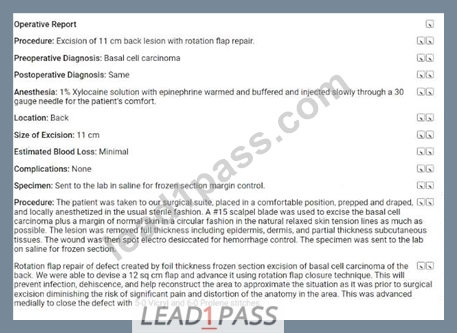
Refer to the supplemental information when answering this question:
View MR 623654
What CPTO coding is reported for this case?
- A. 0
- B. 14001, 11606-51
- C. 14001, 11606-51, 12034-51
- D. 1
Answer: D
NEW QUESTION # 61
A patient suffers a ruptured infrarenal abdominal aortic aneurysm requiring emergent endovascular repair. An aorto-aortic tube endograft is positioned in the aorta and a balloon dilation is performed at the proximal and distal seal zones of the endograft. The balloon angioplasty is performed for endoleak treatment.
What CPT code does the vascular surgeon use to report the procedure?
- A. 0
- B. 1
- C. 2
- D. 3
Answer: A
Explanation:
The emergent endovascular repair of an infrarenal abdominal aortic aneurysm with an aorto-aortic tube endograft is coded with CPT 34702. This code includes the deployment of the endograft and the necessary balloon angioplasty for sealing the proximal and distal attachment zones.
References:
* AMA's CPT Professional Edition (current year)
NEW QUESTION # 62
A patient who has colon adenocarcinoma undergoes a laparoscopic partial colectomy. The surgeon removes the proximal colon and terminal ileum and reconnects the cut ends of the distal ileum and remaining colon.
What procedure and diagnosis codes are reported?
- A. 44140, C18.9
- B. 44160, C18.2
- C. 44205, C18.9
- D. 44204, C18.2
Answer: D
Explanation:
The procedure involves a laparoscopic partial colectomy where the surgeon removes the proximal colon and terminal ileum, then reconnects the cut ends of the distal ileum and remaining colon.
* Procedure Description:
* Laparoscopic partial colectomy.
* Removal of the proximal colon and terminal ileum.
* Anastomosis of the distal ileum and remaining colon.
* CPT Coding:
* 44204: Laparoscopy, surgical; colectomy, partial, with anastomosis.
* ICD-10-CM Coding:
* C18.2: Malignant neoplasm of ascending colon.
References:
* AMA's CPT Professional Edition (current year).
* ICD-10-CM for corresponding diagnosis codes.
NEW QUESTION # 63
A patient has a bone infection being treated with vancomycin. A therapeutic drug assay is performed to measure the concentration of vancomycin in the patient's blood.
What lab test is reported?
- A. 0
- B. 1
- C. 2
- D. 3
Answer: B
Explanation:
1. Procedure and CPTCode Selection:
The test performed is a therapeutic drug assay to measure the concentration of vancomycin in the patient's blood.
CPTCode 80184 is specific for a therapeutic drug assay of vancomycin, making it the correct code to report for this test.
2. Rationale for Excluding Other Options:
Code 80197 is used for therapeutic drug assays of another antibiotic, gentamicin, and does not apply to vancomycin.
Code 80202 is for measuring the levels of cyclosporine, another drug, and is not relevant to vancomycin.
Code 80299 is for an unlisted therapeutic drug assay, which is unnecessary since a specific code (80184) exists for vancomycin.
3. AAPC and CPTCoding Guidelines:
According to AAPC guidelines, specific therapeutic drug assay codes, like 80184 for vancomycin, should be used when available.
Therefore, the correct answer is C. 80184.
NEW QUESTION # 64
......
Get The Important Preparation Guide With CPC Dumps: https://www.lead1pass.com/AAPC/CPC-practice-exam-dumps.html
UPDATED CPC Exam Questions Certification Test Engine to PDF: https://drive.google.com/open?id=1JKsW9Hq0EtyH_9JUEQ4F788z3sAA_m3I