

SAP C-BCBAI-2509 Practice Verified Answers - Pass Your Exams For Sure! [2025]
Valid Way To Pass SAP Certified Associate's C-BCBAI-2509 Exam
SAP C-BCBAI-2509 Exam Syllabus Topics:
| Topic | Details |
|---|---|
| Topic 1 |
|
| Topic 2 |
|
NEW QUESTION # 33
Which protocol enables autonomous AI agents to discover each other, delegate tasks, and collaborate across platforms?
- A. Agent-to-Orchestrator (A200)
- B. Model Context Protocol (M CP)
- C. Agent2Agent (A2A)
- D. Agent Hub
Answer: C
NEW QUESTION # 34
How can you interact with Joule and boost productivity and decision-making? Note: There are 3 correct answers to this question.
- A. Informational
- B. Conventional
- C. Analytical
- D. Navigational
Answer: A,C,D
Explanation:
Joule, SAP's AI copilot, enhances productivity and decision-making through multiple interaction modes. Informational interactions allow users to retrieve data and insights from SAP systems, enabling quick access to relevant information. Analytical interactions leverage Joule's ability to analyze data, generate reports, and provide predictive insights, supporting informed decision-making. Navigational interactions help users navigate SAP applications efficiently, streamlining workflows and reducing time spent on system interactions. These capabilities are detailed in the SAP Business AI Joule User Guide, which emphasizes Joule's role in boosting efficiency across business processes. Conventional is not a recognized interaction mode in SAP's framework, and educational interactions are not explicitly supported by Joule. These interaction types collectively empower users to work smarter and faster.
Reference:
---
NEW QUESTION # 35
Which protocol enables autonomous AI agents to discover each other, delegate tasks, and collaborate across platforms?
- A. Model Context Protocol (MCP)
- B. Agent-to-Orchestrator (A2O)
- C. Agent2Agent (A2A)
- D. Agent Hub
Answer: C
Explanation:
The Agent2Agent (A2A) protocol enables autonomous AI agents to discover each other, delegate tasks, and collaborate across platforms, as detailed in SAP Business AI documentation. This protocol facilitates direct communication and coordination between AI agents, allowing them to share tasks and data seamlessly within and across SAP ecosystems. This ensures efficient, decentralized collaboration for complex workflows. The Agent-to-Orchestrator (A2O) protocol focuses on orchestration, not direct agent collaboration. The Model Context Protocol (MCP) and Agent Hub are not defined protocols in SAP's framework for this purpose. A2A's design supports scalable, autonomous AI operations, enhancing enterprise agility and interoperability.
NEW QUESTION # 36
What are some important features of the Joule Agent architecture? Note: There are 3 correct answers to this question.
- A. Managed agent runtime
- B. Seamless collaboration
- C. Bi-directional connectivity
- D. Shared agent services
Answer: A,B,D
Explanation:
The Joule Agent architecture includes key features that enhance its functionality, as per SAP Business AI documentation. Managed agent runtime provides a controlled environment for executing AI agents, ensuring reliability and performance. Seamless collaboration enables agents to work together across business functions, supporting complex workflows. Shared agent services allow agents to leverage common resources, such as data models or APIs, for efficiency and consistency. Bi-directional connectivity, while relevant to integration, is not explicitly highlighted as a core feature of the Joule Agent architecture. These features ensure that Joule Agents deliver scalable, collaborative, and efficient AI solutions within SAP ecosystems.
NEW QUESTION # 37
What are some of the challenges LLLMS face that SAP Knowledge Graph tries to deal with?
- A. Providing subjective and contextual information
- B. Overlooking relationships between entities
- C. Generating factually incorrect or fabricated information
- D. Capturing of dynamic and real-time information
Answer: B,C,D
NEW QUESTION # 38
What are some characteristics of ready-to-use Joule Agents? Note: There are 3 correct answers to this question.
- A. They deliver contextual insights and recommendations.
- B. They automate complex, multi-step workflows.
- C. They provide long-term memory and learning.
- D. They guarantee accuracy and reliability.
- E. They collaborate across business functions.
Answer: A,B,E
NEW QUESTION # 39
How can SAP Knowledge Graph provide context to AI agents? Note: There are 2 correct answers to this question.
- A. By using advanced analytics and machine learning capabilities
- B. By connecting data from multiple SAP applications and third-party systems
- C. By disambiguating terms, linking concepts to entities, and grounding user conversations in domain-specific knowledge
- D. By validating assumptions and deriving logical conclusions from structured relationships
Answer: B,C
Explanation:
The SAP Knowledge Graph enhances AI agents by providing context, as detailed in SAP Business AI documentation. It achieves this by connecting data from multiple SAP applications and third-party systems, creating a unified data model that ensures comprehensive insights. Additionally, it supports AI agents by disambiguating terms, linking concepts to entities, and grounding user conversations in domain-specific knowledge, enabling precise and relevant responses. While advanced analytics and machine learning are part of SAP's AI capabilities, they are not specific functions of the Knowledge Graph. Validating assumptions is a broader AI function, not a primary role of the Knowledge Graph. These features make it a critical component for contextual AI.
NEW QUESTION # 40
(What is Machine Learning?)
- A. A technology that equips machines with human-like capabilities such as problem-solving, visual perception, speech recognition, decision-making, and language translation.
- B. A subset of AI that focuses on enabling computer systems to learn and improve from experience or data, incorporating elements from fields like computer science, statistics, and psychology.
- C. AI systems that use self-supervised learning on vast data to perform a variety of tasks, such as writing documents or creating images.
- D. A form of deep learning that utilizes foundation models, like large language models, to create new content, including text, images, sound, and videos, based on the data it was trained on.
Answer: B
Explanation:
Comprehensive and Detailed Explanation From Exact Extract: Machine Learning is defined as a subset of AI that enables computer systems to learn and improve from experience or data, incorporating elements from fields like computer science, statistics, and psychology. This distinguishes it from general AI, generative AI, or foundation models, focusing on data-driven learning without explicit programming.
Exact extracts supporting this:
"Machine learning is a subset of artificial intelligence (AI) in which computers learn from data and improve with experience without being explicitly programmed."sap.com
"Machine learning (ML) is a subset of AI that enables computer systems to learn and improve from experience or data, and incorporates elements from fields like computer science, statistics, and psychology."sap.com
"Machine learning is a subset of artificial intelligence (AI). It is focused on teaching computers to learn from data and to improve with experience - instead of ..."learning.sap.com Other options are incorrect because:
Option A: This describes foundation models or generative AI systems that use self-supervised learning for multi-task performance, not specifically machine learning.
Option C: This refers to generative AI, a specific application of deep learning using foundation models for content creation.
Option D: This defines artificial intelligence in general, encompassing human-like capabilities beyond just learning from data.
Reference from Positioning SAP Business AI Solutions as part of SAP Business Suite documents or Study Guide: Drawn from the SAP product page "What is Machine Learning?" and the SAP Learning course "Discovering SAP Business AI," which positions machine learning as a foundational subset of AI within SAP Business AI solutions integrated into the SAP Business Suite. Supported by SAP Help Portal glossaries and community blogs, as aligned with C_BCBAI_2502 certification for explaining AI concepts.
NEW QUESTION # 41
What are some characteristics of ready-to-use Joule Agents? Note: There are 3 correct answers to this question.
- A. They provide long-term memory and learning
- B. They collaborate across business functions
- C. They deliver contextual insights and recommendations
- D. They automate complex, multi-step workflows
Answer: B,C,D
Explanation:
Ready-to-use Joule Agents are designed to enhance business operations with specific characteristics, as outlined in SAP Business AI documentation. They automate complex, multi-step workflows, enabling streamlined execution of tasks such as procurement or HR processes across SAP systems. They collaborate across business functions, facilitating seamless interaction between departments like finance and supply chain for cohesive operations. They deliver contextual insights and recommendations, leveraging AI to provide tailored suggestions based on enterprise data. While Joule Agents are advanced, long-term memory and learning is not a listed characteristic, as their focus is on immediate, contextual task execution. Similarly, guaranteeing accuracy and reliability is an aspiration but not a defined feature. These capabilities make Joule Agents valuable for driving efficiency and collaboration.
NEW QUESTION # 42
(What are the main categories of using AI in Cloud ERP? Note: There are 2 correct answers to this question.)
- A. Process knowledge
- B. Productivity and efficiency
- C. Process-related decision optimization
- D. Profitability optimization
Answer: B,C
Explanation:
Comprehensive and Detailed Explanation From Exact Extract: The main categories of using AI in Cloud ERP are productivity and efficiency, which focus on automating tasks and streamlining workflows, and process-related decision optimization, which involves leveraging AI for better decision-making and outcome predictions in business processes.
Exact extracts supporting this:
"Challenges and benefits of Artificial Intelligence in Cloud ERP can be divided into two main categories: Process-related decision optimization; Productivity and efficiency."learning.sap.com
"These can be divided into two main categories: Process-related decision optimization."learning.sap.com (Implying the second as productivity and efficiency from context.) Other options are incorrect because:
Option C: Process knowledge is not identified as a main category; AI embeds knowledge but categories focus on optimization and efficiency.
Option D: Profitability optimization is a potential outcome but not a primary category; emphasis is on decision and productivity aspects.
Reference from Positioning SAP Business AI Solutions as part of SAP Business Suite documents or Study Guide: From the SAP Learning course "Positioning SAP Business AI," unit "Summarizing Key Solutions of Business AI," and "Understanding SAP Business AI for SAP S/4HANA Cloud," which categorize AI usage in Cloud ERP as decision optimization and productivity/efficiency, supporting positioning within the SAP Business Suite per C_BCBAI_2502 materials.
NEW QUESTION # 43
With respect to AI agents, which functionalities are offered by the executive dashboard in SAP LeanIX? Note: There are 3 correct answers to this question.
- A. Deployment opportunities
- B. Skill shifts
- C. Automation gaps
- D. Business impact
Answer: A,C,D
Explanation:
The executive dashboard in SAP LeanIX provides key functionalities for AI agents, including automation gaps, deployment opportunities, and business impact, as per SAP documentation. Automation gaps identify areas where AI can enhance efficiency by automating manual processes. Deployment opportunities highlight potential use cases for AI agent integration within the IT landscape. Business impact quantifies the value of AI initiatives, aligning them with strategic goals. Skill shifts, while relevant to workforce planning, are not a primary focus of the SAP LeanIX executive dashboard, which prioritizes IT and AI strategy insights. These functionalities empower executives to make data-driven decisions for AI adoption and optimization.
Reference:
SAP Business AI Questions (Batch 4 of 5)
NEW QUESTION # 44
What is the semantic backbone of the AI Foundation that seamlessly links and context ualizes enterprise data for AI insights?
- A. Document grounding
- B. SAP Knowledge Graph
- C. SAP Document AI
- D. Joule Studio
Answer: B
NEW QUESTION # 45
Apart from SAP Leanix, what other solutions does the AI agent hub support?
Note: There are 2 correct answers to this question.
- A. SAP Ariba
- B. SAP SuccessFactors
- C. SAP Integrated Business Planning
- D. SAP Signavio
Answer: C,D
NEW QUESTION # 46
Which of the following are included in SAP's Responsible AI framework? Note: There are 3 correct answers to this question.
- A. Transparency and accountability
- B. ESG reporting
- C. Ethical governance
- D. SAP Global Human Rights commitment
Answer: A,C,D
Explanation:
SAP's Responsible AI framework includes the SAP Global Human Rights commitment, transparency and accountability, and ethical governance, as detailed in SAP documentation. The SAP Global Human Rights commitment ensures AI respects human rights, aligning with global standards. Transparency and accountability mandate clear documentation of AI processes and decision-making, fostering trust. Ethical governance establishes policies and oversight to ensure fairness, mitigate bias, and comply with regulations. ESG reporting, while part of SAP's sustainability efforts, is not a core component of the Responsible AI framework, and human-centered design is a principle but not explicitly listed. These elements ensure SAP's AI solutions are trustworthy and ethical.
NEW QUESTION # 47
In Custom Al Adoption (CAIA) with SAP, what is the correct order of steps?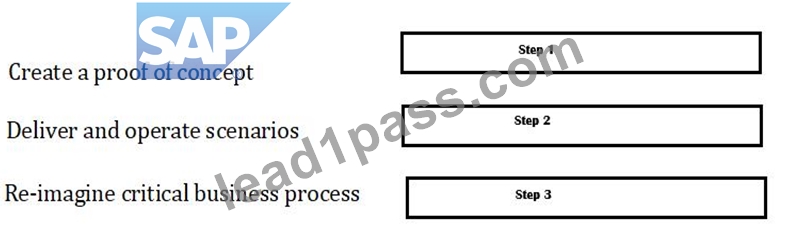
Answer:
Explanation: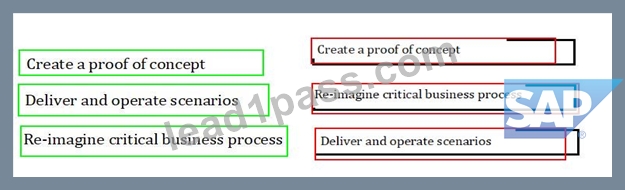
NEW QUESTION # 48
What are some activities SAP recommends customers consider when integrating agent AI systems into their operations? Note: There are 3 correct answers to this question.
- A. Maintain expert oversight over AI agent decisions
- B. Measure and evaluate AI agent performance
- C. Provide internal data for training
- D. Set up an AI agent governance board to prevent ethical issues
Answer: A,B,D
Explanation:
SAP recommends several activities for integrating AI agent systems, as outlined in SAP Business AI documentation. Setting up an AI agent governance board ensures ethical AI use by establishing policies to prevent bias and ensure compliance. Measuring and evaluating AI agent performance helps organizations assess effectiveness, optimize outcomes, and ensure alignment with business goals. Maintaining expert oversight over AI agent decisions ensures human accountability, allowing experts to validate and guide AI outputs. While providing internal data for training is relevant, SAP emphasizes using pre-existing, secure data models over custom training to maintain compliance and efficiency. These activities support responsible and effective AI integration.
NEW QUESTION # 49
(What are some benefits of SAP Signavio's AI-assisted performance indicator recommender? Note: There are 3 correct answers to this question.)
- A. Cross-system KPI standardization across a company's divisions and departments
- B. Self-service approach to define an initial process monitoring framework
- C. Instant recommendations based on best practices
- D. Simple connection between the business problem, the affected process, and the relevant metric to be measured
- E. Automated creation of custom KPI dashboards
Answer: B,C,D
Explanation:
Comprehensive and Detailed Explanation From Exact Extract: The benefits of SAP Signavio's AI-assisted performance indicator recommender include providing a simple connection between business problems, processes, and metrics for targeted monitoring; enabling a self-service approach to establish process monitoring frameworks; and delivering instant recommendations based on best practices to accelerate process improvement.
Exact extracts supporting this:
Simple connection: "Leverage the simplified connection between the business problem, the affected process, and the relevant metric ..."community.sap.com Self-service approach: "The AI-assisted performance indicators recommender capability provides process owners and analysts with instant, curated recommendations on the process ..."learning.sap.com (Implying self-service through analyst access.) Instant recommendations: "Instant recommendations based on best practices."learning.sap.com "An AI-assisted performance indicators recommender delivers instant recommendations on the most relevant process performance indicators (PPIs) ..."news.sap.com Other options are incorrect because:
Option B: While recommendations aid monitoring, automated dashboard creation is not a specified benefit; focus is on indicator suggestions.
Option D: Standardization may occur indirectly, but the recommender emphasizes instant, tailored recommendations rather than cross-system uniformity.
Reference from Positioning SAP Business AI Solutions as part of SAP Business Suite documents or Study Guide: From SAP News "New Process AI Capabilities for SAP Signavio" and SAP Help Portal "AI-Assisted Performance Indicators Recommender." These highlight the recommender's role in process intelligence within SAP Signavio, positioned as part of AI-enhanced transformation in the SAP Business Suite, as per C_BCBAI_2502 materials and learning journeys on generative AI in Signavio.
NEW QUESTION # 50
What is the semantic backbone of the AI Foundation that seamlessly links and contextualizes enterprise data for AI insights?
- A. Document grounding
- B. SAP Knowledge Graph
- C. SAP Document AI
- D. Joule Studio
Answer: B
Explanation:
The SAP Knowledge Graph serves as the semantic backbone of SAP's AI Foundation, enabling seamless linking and contextualization of enterprise data for AI-driven insights. According to SAP Business AI documentation, the SAP Knowledge Graph integrates data from multiple SAP and third-party systems, creating a structured, interconnected data model that disambiguates terms and links concepts to entities. This facilitates contextual insights by providing a unified view of enterprise data, enhancing AI applications' ability to deliver relevant and accurate recommendations. SAP Document AI focuses on document processing, Joule Studio is a low-code development environment, and document grounding is a process, not a component. The Knowledge Graph's ability to ground AI insights in domain-specific knowledge ensures robust and meaningful outcomes for businesses.
NEW QUESTION # 51
What enables SAP's Suite as a Service approach? Note: There are 3 correct answers to this question.
- A. Scalable intelligence
- B. Harmonized data
- C. Embedded AI
- D. Integrated applications
Answer: B,C,D
Explanation:
SAP's Suite as a Service approach is enabled by integrated applications, harmonized data, and embedded AI, as outlined in SAP Business AI documentation. Integrated applications ensure seamless connectivity across SAP's suite, enabling unified workflows and consistent user experiences. Harmonized data provides a single, standardized data model across applications, ensuring data consistency and enabling AI-driven insights. Embedded AI integrates intelligent capabilities directly into SAP applications, enhancing automation, analytics, and decision-making. These components collectively deliver a cohesive, cloud-based service model that drives efficiency and innovation. Scalable intelligence, while important, is not explicitly listed as a core enabler of this approach, and coordinated automation is a benefit rather than a foundational element.
Reference:
---
NEW QUESTION # 52
(What are some data sources Joule allows users to use? Note: There are 3 correct answers to this question.)
- A. Developer tutorials
- B. SAP Help
- C. SAP Learning
- D. Linkedin Learning
- E. Stack Overflow
Answer: A,B,C
Explanation:
Comprehensive and Detailed Explanation From Exact Extract: Joule, as an AI copilot, allows users to access and retrieve information from sources such as developer tutorials for technical guidance, SAP Help for product documentation and support, and SAP Learning for educational content and journeys. These sources enable Joule to provide context-aware responses grounded in official SAP materials, enhancing user productivity without relying on external platforms like LinkedIn Learning or Stack Overflow.
Exact extracts supporting this:
Joule is "integrated into SAP solutions for business-relevant processes" and can "retrieve information" from SAP ecosystems, including learning and help resources.learning.sap.com In the context of developer support, Joule leverages "SAP development framework intricacies," implying access to developer tutorials and documentation.news.sap.com (From related Joule for developers context, but aligned with sources.) Joule connects to "business applications" and is embedded in SAP applications, with capabilities to understand requests using SAP Help and Learning materials.help.sap.com community.sap.com Other options are incorrect because:
Option C: LinkedIn Learning is an external platform not integrated with Joule; Joule focuses on SAP-internal sources for trusted, business-grounded information.
Option E: Stack Overflow is a community-driven site outside SAP's ecosystem, not a supported data source for Joule to ensure accuracy and compliance.
Reference from Positioning SAP Business AI Solutions as part of SAP Business Suite documents or Study Guide: Derived from SAP Help Portal "Joule Capabilities" and SAP Community topics on Joule, which emphasize integration with SAP Help, developer resources, and SAP Learning for contextual assistance. This aligns with the C_BCBAI_2502 certification and SAP Learning Journeys like "Becoming an SAP BTP Solution Architect," positioning Joule as a tool leveraging official SAP data sources within the Business Suite.
NEW QUESTION # 53
Which of the following capabilities are offered by Joule for Consultants? Note: There are 2 correct answers to this question.
- A. SAP Fiori apps smart help
- B. Code intelligence
- C. Process automation
- D. Project lifecycle support
Answer: A,D
Explanation:
Joule provides targeted capabilities for consultants to streamline their work within SAP ecosystems. Project lifecycle support enables consultants to manage project phases, from planning to execution, by providing AI-driven insights and recommendations, as outlined in the SAP Business AI documentation. SAP Fiori apps smart help enhances consultants' ability to navigate and utilize Fiori apps efficiently, offering contextual guidance and support within the SAP environment. While code intelligence and process automation are valuable AI features, they are not specifically highlighted as consultant-focused capabilities in SAP's Joule documentation. These features empower consultants to deliver high-value services by improving efficiency and accuracy in SAP-related tasks.
Reference:
# SAP Business AI Questions (Batch 2 of 5)
NEW QUESTION # 54
(What are some key differentiators of SAP Business AI? Note: There are 3 correct answers to this question.)
- A. AI Foundation
- B. Large Foundation Models
- C. Predictive Analytics
- D. Ecosystem of Innovation
- E. Embedded AI
Answer: A,D,E
Explanation:
Comprehensive and Detailed Explanation From Exact Extract: Key differentiators of SAP Business AI include embedded AI directly integrated into business applications for seamless use, an AI Foundation providing the underlying infrastructure and tools in SAP BTP, and an Ecosystem of Innovation through partnerships and open standards for collaborative advancements. These set SAP apart by focusing on integration, foundational support, and ecosystem-driven innovation.
Exact extracts supporting this:
Embedded AI: "Embedded AI: Our relevant, reliable, and responsible SAP Business AI is ... key differentiators."learning.sap.com AI Foundation: "For that, we established an AI foundation."learning.sap.com "SAP's main differentiators are... deep domain and industry expertise."community.sap.com (Foundation as base.) Ecosystem of Innovation: "Maximize the value of AI across your business with a single AI interface that seamlessly integrates data and workflows across your SAP and non-SAP applications."sap.com Implies ecosystem.
Other options are incorrect because:
Option C: Predictive analytics is a capability but not a key differentiator; focus is on embedded and foundational aspects.
Option D: SAP integrates large foundation models from partners but does not claim them as differentiators; emphasis is on business grounding.
Reference from Positioning SAP Business AI Solutions as part of SAP Business Suite documents or Study Guide: From SAP Learning course "Discovering SAP Business AI," units on market point of view and role of Business AI, highlighting embedded AI, foundation, and ecosystem as differentiators, per C_BCBAI_2502 materials.
NEW QUESTION # 55
What enables SAP's Suite as a Service approach? Note: There are 3 correct answers to this question.
- A. Scalable intelligence
- B. Coordinated automation
- C. Harmonized data
- D. Embedded AI
- E. Integrated applications
Answer: B,C,E
NEW QUESTION # 56
How can SAP Knowledge Graph provide context to AI agents? Note: There are 2 correct answers to this question.
- A. By validating assumptions and deriving logical conclusions from structured relationships.
- B. By disambiguating terms, linking concepts to entities, and grounding user conversations in domain-specific knowledge.
- C. By using advanced analytics and machine learning capabilities.
- D. By connecting data from multiple SAP applications and third-party systems.
Answer: B,D
NEW QUESTION # 57
......
SAP C-BCBAI-2509 Pre-Exam Practice Tests | Lead1Pass: https://www.lead1pass.com/SAP/C-BCBAI-2509-practice-exam-dumps.html
C-BCBAI-2509 practice test questions, answers, explanations: https://drive.google.com/open?id=14hTW686UYX35HBdLu4RChK9Ltkiamgum