

Pass Your Next Salesforce-MuleSoft-Developer-I Certification Exam Easily & Hassle Free
Free Salesforce Salesforce-MuleSoft-Developer-I Exam Question Practice Exams
Salesforce Salesforce-MuleSoft-Developer-I Exam Syllabus Topics:
| Topic | Details |
|---|---|
| Topic 1 |
|
| Topic 2 |
|
| Topic 3 |
|
| Topic 4 |
|
| Topic 5 |
|
| Topic 6 |
|
| Topic 7 |
|
| Topic 8 |
|
| Topic 9 |
|
| Topic 10 |
|
| Topic 11 |
|
NEW QUESTION # 12
What is the correct Syntax to add a customer ID as a URI parameter in the HTTP listener's path attribute?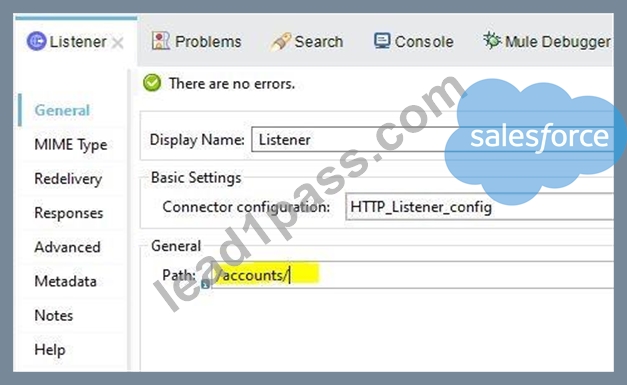
- A. $[customerID]
- B. #[customerID]
- C. (customerID)
- D. {customerID}
Answer: D
Explanation:
URL parameters are always accessed using { } like => {customerID}
NEW QUESTION # 13
Refer to the exhibit.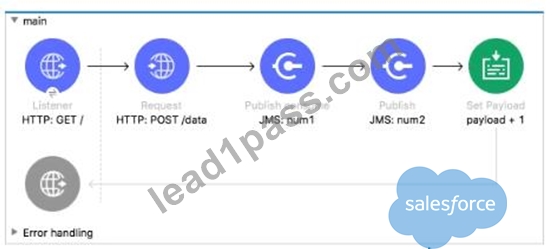
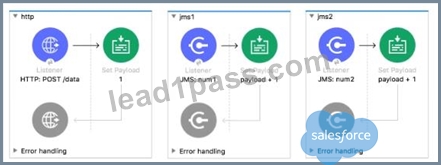

What payload is returned from a request to http//localhost.8081/
Refer to the exhibits, what payload is returned from a request to http://localhost;8081/?
- A. 0
- B. 1
- C. 2
- D. 3
Answer: C
Explanation:
The flow can be described as below. 1) First HTTP POST requets is made in which paylaod is set to 1 and it gets returned to our mail flow. 2) Second call is initiated for JMS Publish Consume JMS: num1 which add 1 to the payload which makes it as 2. Note that pubih consume is a synchronous operation. Hence paylaod is returned to main flow. 3) Third call is initiated for JMS Publish JMS: num2 which add 1 to the payload . Note that pubih is asynchronous operation. Hence paylaod is never returned to main flow. So payload in main flow is still 2. 4) Finally Set Payload increments payload by 1 making payload as 3 which is returned by the flow. Hence option 3 is the correct answer.
NEW QUESTION # 14
As a part of requirement , application property defined below needs to be accessed as dataweave expression. What is the correct expression to map it to port value?
- A. Application property cannot be accessed in Dataweave
- B. { port : p('db.port')}
- C. { port : {db:port}}
- D. { port : p['db.port']}
Answer: B
Explanation:
Option 1 is the correct syntax
NEW QUESTION # 15
Refer to the exhibits.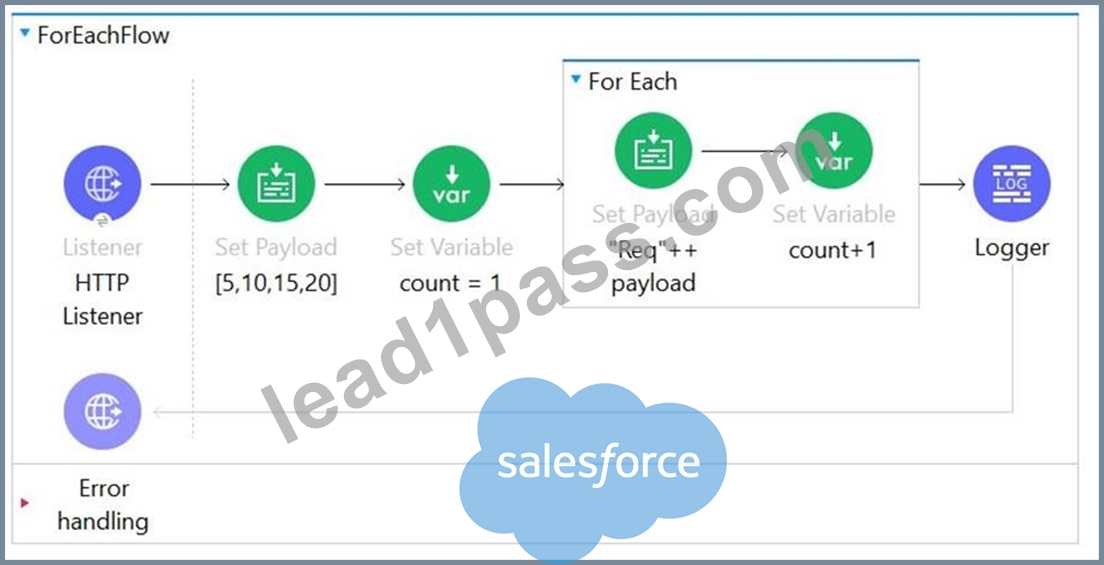
What payload and variable are logged at the end of the main flow?
- A. [[5, 10, 15, 20], 5]
- B. [[5, 10, 15, 20], 1]
- C. [[Req5, Req10, Req15, Req20], 5]
- D. [Req5Req10,Req15Req20, 5]
Answer: A
Explanation:
Correct answer is [[5, 10, 15, 20], 5]
Key thing to note here is that any changes made to payload in for each loop are not available outside for each scope where as variable value updated in for each loop is visible out side for each loop too.
In this example , sequence can be described as follows
1) Payload is set to the value [5, 10, 15, 20]
2) Variable is set to the value of 1
3) For each loop is executed four times and in each loop payload value is updated to append "Req" and variable is count is increased by 1
4) Once control comes out of for each , payload changes made within for each are not visible. Hence payload at this point of time is equal to payload available before entering for each loop which was [5, 10, 15, 20]. Similarly variable value updated in for each loop is also available outside hence variable value is 5 as it was updated in loop.
5) Hence correct answer is [[5, 10, 15, 20], 5]
For Each Scope
The For Each scope splits a payload into elements and processes them one by one through the components that you place in the scope. It is similar to a for-each/for loop code block in most programming languages and can process any collection, including lists and arrays. The collection can be any supported content type, such as application/json, application/java, or application/xml.
General considerations about the For Each scope:
By default, For Each tries to split the payload. If the payload is a simple Java collection, the For Each scope can split it without any configuration. The payload inside the For Each scope is each of the split elements. Attributes within the original message are ignored because they are related to the entire message.
For Each does not modify the current payload. The output payload is the same as the input.
For non-Java collections, such as XML or JSON, use a DataWeave expression to split dat a. Use the Collection field for this purpose.
NEW QUESTION # 16
A Utlility.dwl is located in a Mule project at src/main/resources/modules. The Utility.dwl file defines a function named encryptString that encrypts a String What is the correct DataWeave to call the encryptString function in a Transform Message component?
- A. 1. %dw 2.0
2. output application/json
3. import modules::Utility
4. ---
5. encryptString( "John Smith" ) - B. 1. %dw 2.0
2. output application/json
3. import modules.Utility
4. ---
5. encryptString( "John Smith" ) - C. 1. %dw 2.0
2. output application/json
3. import modules::Utility
4. ---
5. Utility::encryptString( "John Smith" ) - D. 1. %dw 2.0
2. output application/json
3. import modules.Utility
4. ---
5. Utility.encryptString( "John Smith" )
Answer: A
Explanation:
Correct answer is
%dw 2.0
output application/json
import modules::Utility
---
Utility::encryptString( "John Smith" )
DataWeave 2.0 functions are packaged in modules. Before you begin, note that DataWeave 2.0 is for Mule 4 apps. For Mule 3 apps, refer to DataWeave Operators in the Mule 3.9 documentation. For other Mule versions, you can use the version selector for the Mule Runtime table of contents.
Functions in the Core (dw::Core) module are imported automatically into your DataWeave scripts. To use other modules, you need to import the module or functions you want to use by adding the import directive to the head of your DataWeave script, for example:
import dw::core::Strings
import camelize, capitalize from dw::core::Strings
import * from dw::core::Strings
The way you import a module impacts the way you need to call its functions from a DataWeave script. If the directive does not list specific functions to import or use * from to import all functions from a function module, you need to specify the module when you call the function from your script. For example, this import directive does not identify any functions to import from the String module, so it calls the pluralize function like this: Strings::pluralize("box").
Transform
%dw 2.0
import dw::core::Strings
output application/json
---
{ 'plural': Strings::pluralize("box") }
NEW QUESTION # 17
Refer to the exhibits.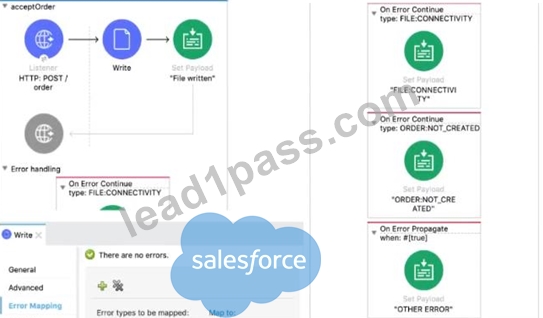
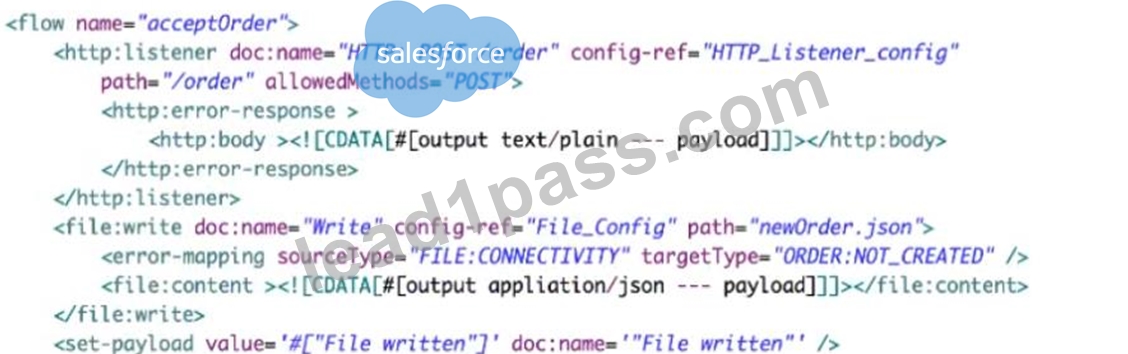
A web client sends a POST request with the payload {"oid": "1000", "itemid": "AC200", "qty": "4" } to the Mule application. The File Write operation throws a FILE:CONNECTIVITY error.
What response message is returned to the web client?
- A. "ORDER:NOT_CREATED"
- B. "OTHER ERROR"
- C. ''FILE:CONNECnvnY'
- D. "File written"
Answer: A
NEW QUESTION # 18
What are the latest specification of RAML available?
- A. 1.2
- B. 0
- C. 0.8
- D. 1
Answer: B
Explanation:
The current version of the RAML specification is 1.0
You can check RAML version in RAML definition by referring to first comment. See highlighted part in below image.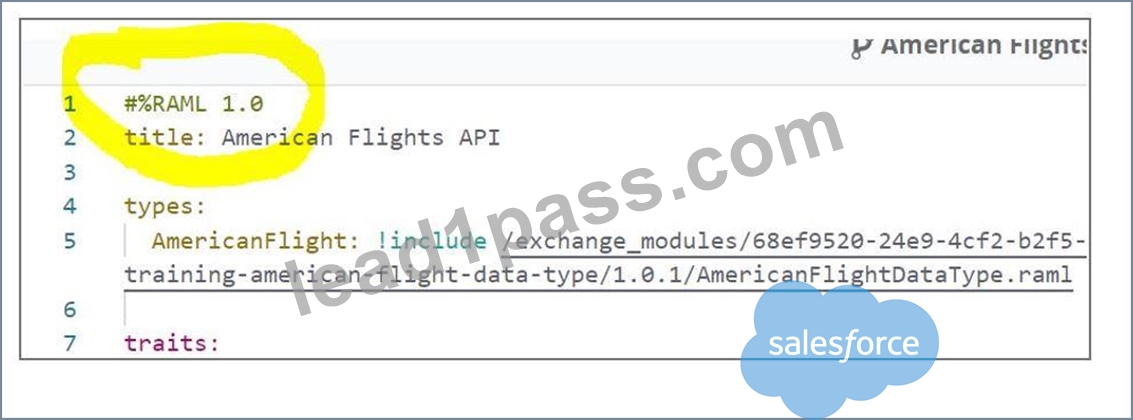
NEW QUESTION # 19
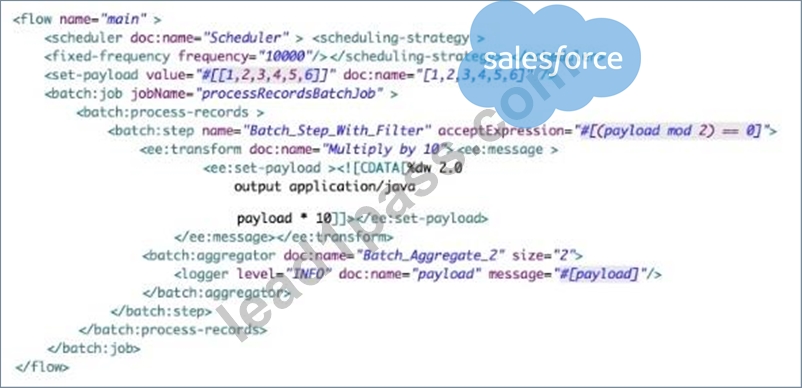
Refer to the exhibit. The Batch Job processes, filters and aggregates records, What is the expected output from the Logger component?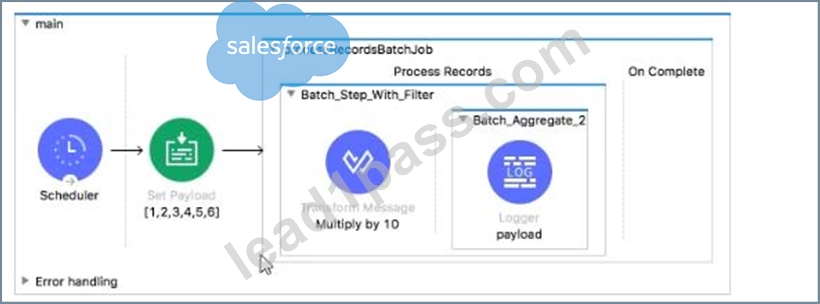
- A. [20, 40, 60]
- B. [20. 40] [60]
- C. [10. 20, 30. 40, 50, 60]
- D. [10. 20] [30, 40] [50, 60]
Answer: B
Explanation:
* Batch scope has filter criteria which says paylod mod 2 = 0 whch means only 2, 4 and 6 will be in batch scope.
* So payload for each of these will be incremented by 10.
* Aggregator has batch size defined as 2. So it will process in batch of two records.
* Hence option 3 is correct answer.
[20,40]
[60]
Behavior with aggregator configured with fixed size
In this scenario, the batch step sends the processed records to an aggregator, which starts processing the records and buffering them until the configured aggregator's size is reached. After that, the aggregator sends the aggregated records to the stepping queue.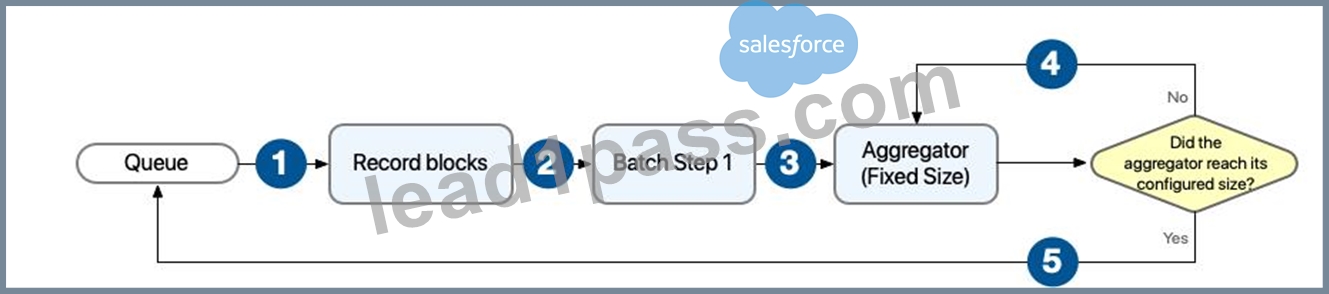
The batch job builds record blocks of the configured block size and sends them to their corresponding batch step for processing. Each batch step receives one or more record blocks and starts processing them in parallel. After the batch step processes a record, the batch step sends the record to the aggregator for further processing. The aggregator continues processing records until the number of aggregated records reaches the configured aggregator's size.
https://docs.mulesoft.com/mule-runtime/4.3/batch-processing-concept
NEW QUESTION # 20
Refer to the exhibits.
The mule application implements a REST API that accepts GET request from two URL's which are as follows
1) http://acme.com/order/status
2) http://acme.com/customer/status
What path value should be set in HTTP listener configuration so that requests can be accepted for both these URL's using a single HTTP listener event source?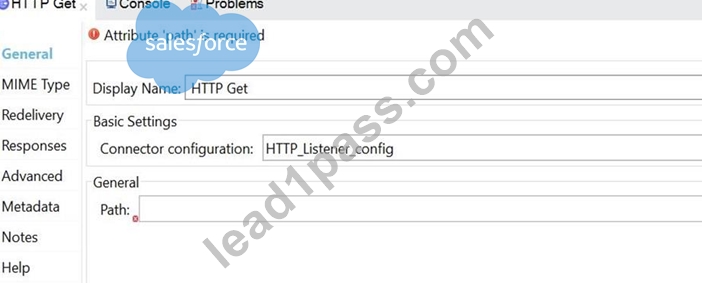
- A. ?[order,customer]/status
- B. *status
- C. */status
- D. *[order,customer]/status
Answer: C
Explanation:
Correct answer is */status as it is the correct way to use wildcards while configuring path value in HTTP listener
NEW QUESTION # 21
Refer to the exhibits.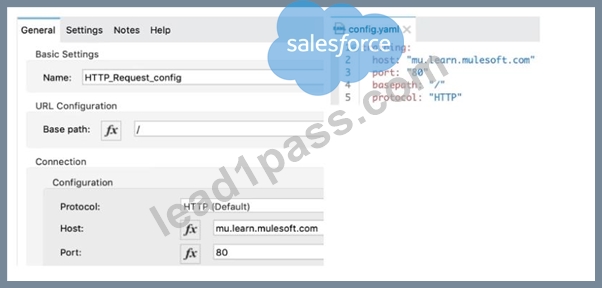
A Mule application has an HTTP Request that is configured with hardcoded values. To change this, the Mule application is configured to use a properties file named config.yaml.
what valid expression can the HTTP Request host value be set to so that it is no longer hardcoded?
- A. #[training.host]
- B. #[training:host]
- C. ${training:host}
- D. ${training.host}
Answer: D
Explanation:
Correct answer is ${training.host}
-------------------------------------------------------------------------------------------------------------------------------------------------- How to Configure Properties to Mule 4.X Platform?
1) Go to /src/main/resources project directory.
2) Create a configuration file with the name configuration.yaml inside the newly created config folder.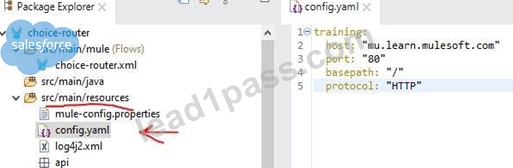
3) Go To Project > Global Element > Create > General >select the configuration.yaml file create in step- 2)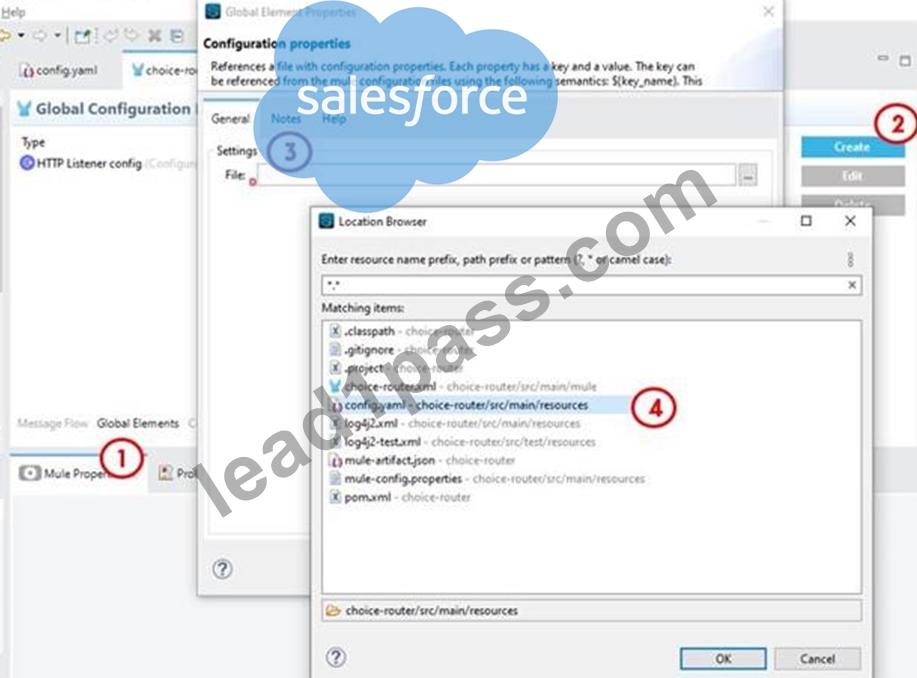
4) To verify develop a simple flow with HTTP listener which has above entries. Put the logger that prints the values on console.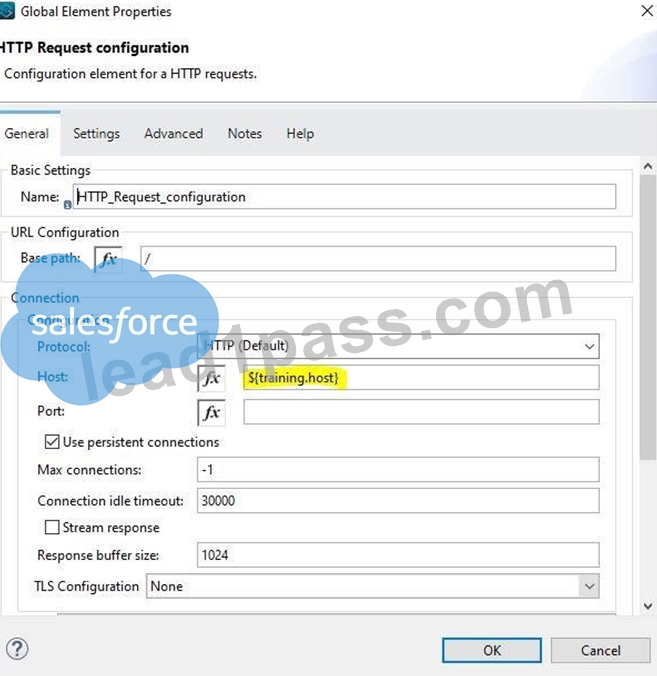
5) Additional info: Similarly, when you want to access this port in DataWeave you need to use p function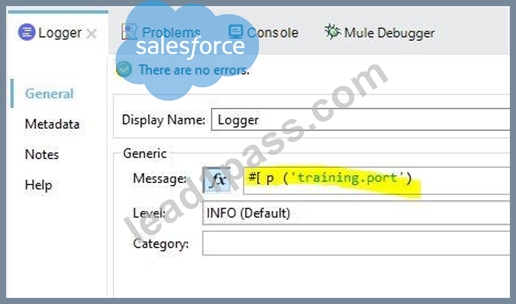
NEW QUESTION # 22
Refer to the exhibits. The Mule application does NOT define any global error handlers.
A web client sends a POST request to the Mule application with this input payload. The File Write operation throws a FILE: CONNECTIVITY error.
What response message is returned to the web client?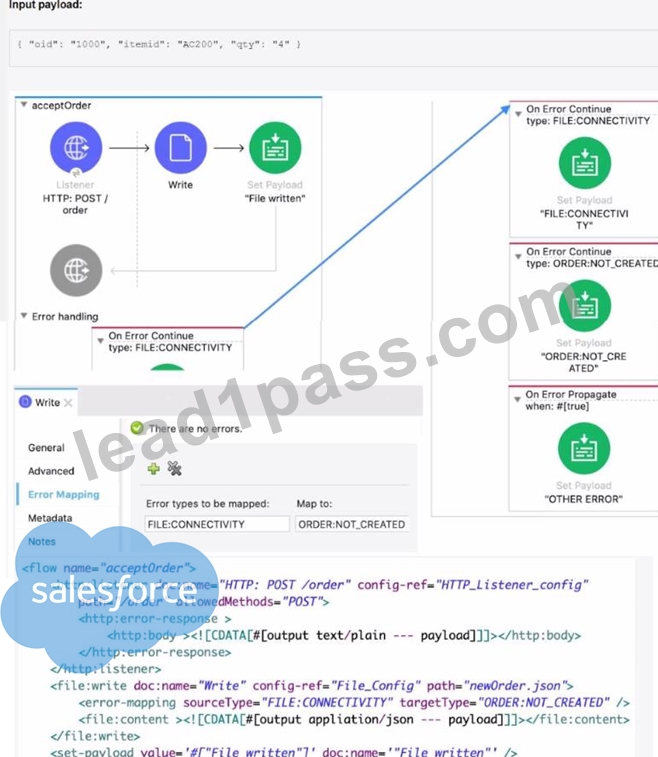
- A. "ORDER: NOT CREATED"
- B. "OTHER ERROR"
- C. "FILE: CONNECTMTV
- D. "File written"
Answer: A
NEW QUESTION # 23
Refer to the exhibits.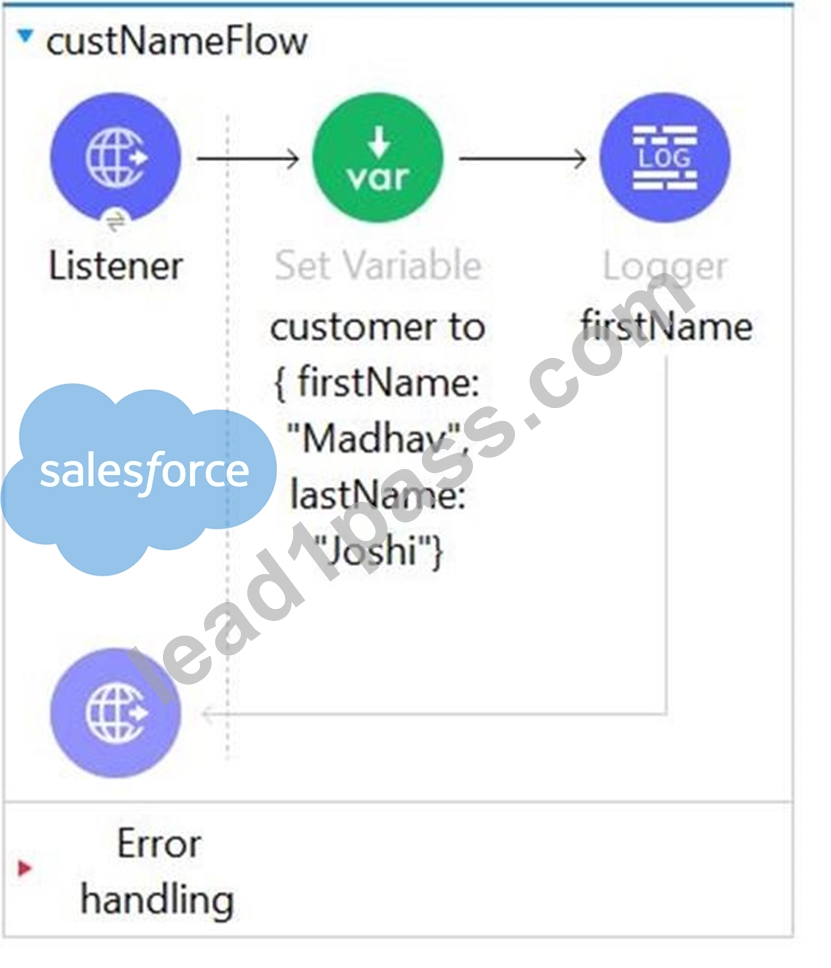

Set paylaod transformer is set the firstName and lastName of the customer as shown in below images.
What is the correct Dataweave expression which can be added in message attribute of a Logger activity to access firstName (which in this case is Madhav) from the incoming event?
- A. customer.firstName
- B. vars."customer"."firstName"
- C. vars."customer.firstName"
- D. firstName
Answer: B
Explanation:
Correct answer is vars."customer"."firstName"
Please note that you can also access firstName using this syntax vars.customer.firstName.
Mule Ref Doc : Variables in Mule Apps | MuleSoft Documentation
NEW QUESTION # 24
An SLA based policy has been enabled in API Manager. What is the next step to configure the API proxy to enforce the new SLA policy?
- A. Restart the API proxy to clear the API policy cache
- B. Add new environment variables and restart the API proxy
- C. Add new property placeholders and redeploy the API proxy
- D. Add required headers to the RAML specification and redeploy the new API proxy
Answer: D
Explanation:
Correct answer is Add required headers to RAML specification and redeploy new API proxy MuleSoft Doc Ref : https://docs.mulesoft.com/api-manager/2.x/tutorial-manage-an-api Steps are as below :
Add the Required RAML Snippet
SLA-based rate limiting requires adding a RAML or OAS snippet to your API. This procedure demonstrates adding a RAML snippet.
Specify the client ID and secret as query parameters.
Add a section called traits: at the RAML root level to define query parameters:
traits:
- client-id-required:
queryParameters:
client_id:
type: string
client_secret:
type: string
Add the client-id-required trait to every method that requires these query parameters:
/users:
get:
is: [client-id-required]
description: Gets a list of JSONPlaceholder users.
Step 2 : Add the SLA Tier in API Manager
Step 3 : Apply the policy and redeploy
NEW QUESTION # 25
According to Semantic Versioning, which version would you change for incompatible API changes?
- A. MINOR
- B. PATCH
- C. MAJOR
- D. No change
Answer: C
Explanation:
Correct answer is MAJOR
MAJOR version when you make incompatible API changes, MINOR version when you add functionality in a backwards compatible manner, and PATCH version when you make backwards compatible bug fixes.
For details refer to this documentation : https://semver.org/
NEW QUESTION # 26
Does a root element required when creating a XML response using Dataweave?
- A. Depends on requirement
- B. Always required
- C. Not required
- D. None of these
Answer: B
Explanation:
Root element is always required while creating XML response in DataWeave transformation
NEW QUESTION # 27
An API implementation has been deployed to CloudHub and now needs to be governed. IT will not allocate additional vCore for a new Mule application to act as an API proxy.
What is the next step to preseive the current vCore usage, but still allow the Mule application to be managed by API Manager?
- A. Modify the API implementation to use auto-discovery to register with API Manager
- B. Register the same API implementation in Runtime Manager to connect to API Manager
- C. Upload the Mule application's JAR file to the API instance in API Manager
- D. Deploy the same API implementation behind a VPC and configure the VPC to connect to API Manager
Answer: A
Explanation:
Correct answer is Modify the API implementation to use auto-discovery to register with API Manager API Autodiscovery Configuring autodiscovery allows a deployed Mule runtime engine (Mule) application to connect with API Manager to download and manage policies and to generate analytics data. Additionally, with autodiscovery, you can configure your Mule applications to act as their own API proxy.
When autodiscovery is correctly configured in your Mule application, you can say that your application's API is tracked by (green dot) or paired to API Manager. You can associate an API in a Mule setup with only one autodiscovery instance at a given time.
MuleSoft Doc Ref : https://docs.mulesoft.com/api-manager/2.x/api-auto-discovery-new-concept
NEW QUESTION # 28
A flow needs to combine and return data from two different data sources. It contains a Database SELECT operation followed by an HTTP Request operation.
What is the method to capture both payloads so the payload from the second request does not overwrite that from the first?
- A. Save the payload from the Database SELECT operation to a variable
- B. Put the Database SELECT operation inside a Message Enricher scope
- C. Put the Database SELECT operation inside a Cache scope
- D. Nothing, previous payloads are combined into the next payload
Answer: A
Explanation:
Correct answer is Save the payload from the Database SELECT operation to a variable Response from HTTP request will override the payload and hence response of database SELECT can be lost. Best way to preserve is to assign payload of first operation to variable using TransformMessage.
NEW QUESTION # 29
A web client sends a request to http;//localhost:8081?dept=sales. What is the correct DataWeave expression to access the value of dept?
- A. message.queryParams.dept
- B. vars.dept
- C. attributes.dept
- D. attributes.queryParams.dept
Answer: D
NEW QUESTION # 30
Which of the below is not the mandatory configurations for HTTP Listener?
- A. HTTP port in Connector Configuration
- B. HTTP host in Connector Configuration
- C. Allowed methods
- D. Path
Answer: C
Explanation:
Allowed methods is an optional configuration. If nothing is specified then all HTTP methods are supported.
Rest all are mandatory.
NEW QUESTION # 31
Which Mule component provides a real-time, graphical representation of the APIs and mule applications that are running and discoverable?
- A. API Notebook
- B. Anypoint Visualizer
- C. API Manager
- D. Runtime Manager
Answer: B
NEW QUESTION # 32
Refer to the exhibits.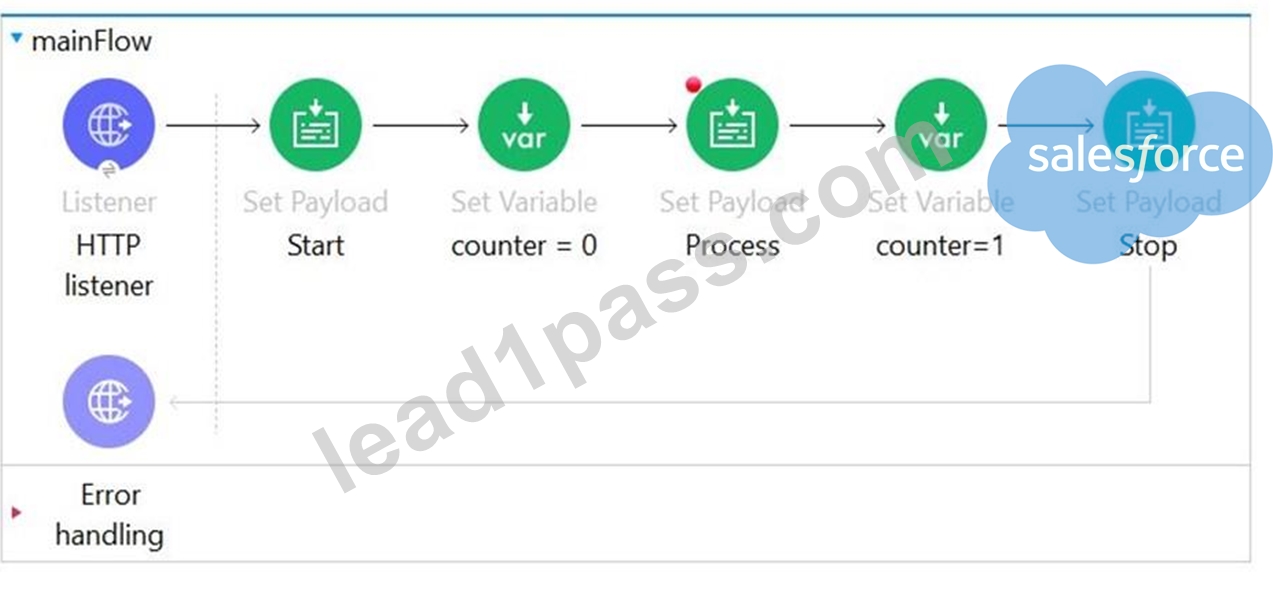
The mule application is debugged in Anypoint Studio and stops at the breakpoint as shown in below exhibit.
What is the value of the payload displayed in the debugger at this breakpoint?
- A. Process
- B. Start
- C. Payload is always empty at the breakpoint
- D. Finished
Answer: B
Explanation:
Setting Breakpoints
To set breakpoints, right-click a building block, then select Toggle Breakpoint.
Studio applies a red dot to the building block's icon on the canvas.
When you run your application in Debug mode, Studio stops the flow execution at the breakpoint you have set, allowing you to check the Mule Event content in the Mule Debugger View.
Mule Ref Doc : Setting Breakpoints | MuleSoft Documentation
NEW QUESTION # 33
Which of the below functionality is provided by zip operator in DataWeave?
- A. Used for sending attachments
- B. All of the above
- C. Merges elements of two lists (arrays) into a single list
- D. Minimize the size of long text using encoding.
Answer: C
Explanation:
Correct answer is Merges elements of two lists (arrays) into a single list MuleSoft Doc Reference : https://docs.mulesoft.com/mule-runtime/4.3/dw-core-functions-zip
NEW QUESTION # 34
The new RAML spec has been published to Anypoint Exchange with client credentials.
What is the next step to gain access to the API?
- A. Request access to the API in Anypoint Exchange
- B. Create a new client application
- C. Email the owners of the API
- D. No additional steps needed
Answer: A
Explanation:
Correct answer is Request access to the API in Anypoint Exchange. This way we can get clientId and Client secret which we can use to access the API
NEW QUESTION # 35
......
Ace Salesforce-MuleSoft-Developer-I Certification with 237 Actual Questions: https://www.lead1pass.com/Salesforce/Salesforce-MuleSoft-Developer-I-practice-exam-dumps.html
PASS Salesforce Salesforce-MuleSoft-Developer-I EXAM WITH UPDATED DUMPS: https://drive.google.com/open?id=1qJekYrMWA5Mydq7aRsG_7Ow_G8FRl0rK