

[May 01, 2026] JN0-683 Exam Brain Dumps - Study Notes and Theory
Pass Juniper JN0-683 Test Practice Test Questions Exam Dumps
NEW QUESTION # 34
Click the Exhibit button. Connections between hosts connected to Leaf-1 and Leaf-2 are not working correctly.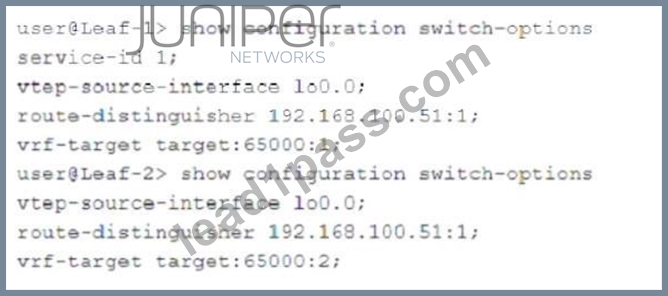
Referring to the exhibit, which two configuration changes are required to solve the problem?
(Choose two.)
- A. Configure the set switch-options vtep-source-interface irb.0parameter on Leaf-
1. - B. Configure the set switch-options service-id 1parameter on Leaf-2.
- C. Configure the set switch-options route-distinguisher 192.168.100.50:1 parameter on Leaf-1.
- D. Configure the set switch-options vrf-target target:65000:1parameter on Leaf-2.
Answer: B,D
Explanation:
Configure the set switch-options vrf-target target:65000:1 parameter on Leaf-2: The vrf- target parameter on Leaf-2 must match the vrf-target on Leaf-1 to ensure that both leaves use the same routing information for their respective VRFs. In the configuration, Leaf-1 has vrf-target target:65000:1, while Leaf-2 has vrf-target target:65000:2. These must be consistent to allow proper communication and routing between the leaves.
Configure the set switch-options service-id 1 parameter on Leaf-2: The service-id configuration should be consistent across all leaf nodes to ensure that they are part of the same VXLAN service. Leaf-1 is configured with service-id 1, so Leaf-2 should be configured with the same service-id 1 to ensure consistency in the VXLAN deployment.
NEW QUESTION # 35
Exhibit.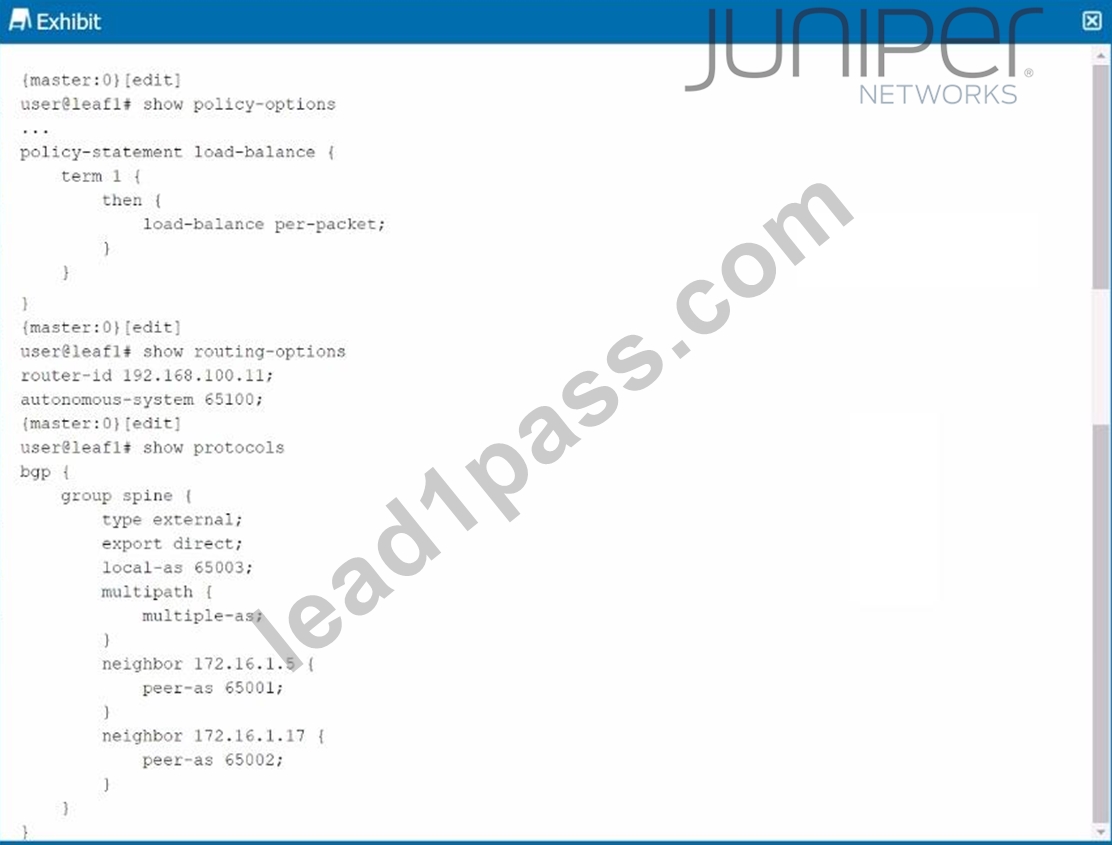
You are troubleshooting an IP fabric (or your data center. You notice that your traffic is not being load balanced to your spine devices from your leaf devices. Referring to the configuration shown in the exhibit, what must be configured to solve this issue?
- A. The load-balance policy must be applied to the forwarding table under the routing-options hierarchy.
- B. The load-balance policy must have a from statement that matches on protocol bgp.
- C. The load-balance policy must be applied as an export policy to your BGP
- D. The multipast multiple -as configuration must be configured for each peer in the BGP spine group.
Answer: A
Explanation:
Step 1: Understand the Configuration in the Exhibit
The exhibit provides three configuration snippets from a leaf device (user@leaf#):
* Policy Options:
user@leaf# show policy-options
policy-statement load-balance {
term 1 {
then {
load-balance per-packet;
}
}
}
* A policy named load-balance is defined, which applies the load-balance per-packet action. In Juniper terminology, per-packet actually means per-flow load balancing (a common point of confusion). This policy is intended to enable load balancing across multiple paths.
* Routing Options:
user@leaf# show routing-options
router-id 192.168.100.11;
autonomous-system 65100;
* The router ID is set to 192.168.100.11, and the autonomous system (AS) number is 65100. There' s no mention of applying the load-balance policy here, which is a clue to the issue.
* BGP Configuration:
user@leaf# show protocols
bgp {
group spine {
type external;
export direct;
local-as 65003;
multipath {
multiple-as;
}
neighbor 172.16.1.5 {
peer-as 65001;
}
neighbor 172.16.1.17 {
peer-as 65002;
}
}
}
* BGP is configured with an external group spine, where the leaf device (local AS 65003) peers with spine devices (AS 65001 and 65002).
* The multipath multiple-as statement is enabled, which allows BGP to install multiple paths for the same prefix in the routing table, even if the paths come from different AS numbers. This is a prerequisite for load balancing in a multi-AS environment like an IP fabric.
* The export direct policy is applied, which likely exports directly connected routes to the spine devices.
Step 2: Identify the Problem
The issue is that traffic from the leaf to the spine devices is not being load-balanced, despite the presence of a load-balance policy and BGP multipath. For load balancing to work in this scenario:
* BGP multipath ensures multiple paths are installed in the routing table.
* The load-balance per-packet policy is meant to distribute traffic across those paths.
* However, the load-balance policy is defined but not applied anywhere in the configuration shown. For load balancing to take effect, the policy must be applied in the correct context.
Step 3: Evaluate the Options
Let's go through each option to determine the correct solution:
* A. The load-balance policy must be applied to the forwarding table under the routing-options hierarchy.
* In Junos, to enable load balancing across multiple paths for forwarding, the load-balance policy must be applied at the forwarding table level. This is done under the routing-options hierarchy using the forwarding-table export statement. For example:
set routing-options forwarding-table export load-balance
* This ensures that the load-balancing policy is applied to the forwarding table, allowing traffic to be distributed across multiple equal-cost paths installed by BGP.
* B. The multipath multiple-as configuration must be configured for each peer in the BGP spine group.
* The multipath multiple-as statement is already configured under the spine group, and it applies to all neighbors in that group (172.16.1.5 and 172.16.1.17). There's no need to configure it per peer, as the group-level configuration is sufficient. This option is incorrect because the required setting is already in place.
* C. The load-balance policy must be applied as an export policy to your BGP.
* Applying the load-balance policy as a BGP export policy (e.g., export load-balance under the BGP group) would affect the routes advertised to the spine devices. However, the load-balance per-packet action is a forwarding action, not a route advertisement action. Applying it as a BGP export policy would not achieve the desired load balancing for traffic forwarding and is incorrect.
* D. The load-balance policy must have a from statement that matches on protocol bgp.
* The load-balance policy currently applies the load-balance per-packet action unconditionally (no from statement). Adding a from protocol bgp condition would make the policy apply only to BGP routes, but this is unnecessary in this context. The policy needs to be applied to the forwarding table to affect traffic, not modified with a from statement. This option doesn't address the core issue of applying the policy.
Step 4: Determine the Correct Answer
The key issue is that the load-balance policy is defined but not applied. For load balancing to work, it must be applied to the forwarding table under routing-options. This matchesOption A:
* A. The load-balance policy must be applied to the forwarding table under the routing-options hierarchy.
Step 5: Provide Official Juniper Documentation Reference
Since I don't have direct access to Juniper's proprietary documents, I can provide an explanation based on standard Junos documentation practices and publicly available resources, such as the Juniper TechLibrary, which is the official source for Junos configuration guides.
In Juniper's official documentation, specifically in theJunos OS Routing Protocols and Policies Configuration Guide, the process for enabling load balancing is described as follows:
* Load Balancing in Junos: To enable per-flow load balancing across multiple paths, you must define a policy with the load-balance per-packet action and apply it to the forwarding table. The relevant configuration hierarchy is:
routing-options {
forwarding-table {
export <policy-name>;
}
}
* Explanation from Documentation: The load-balance per-packet action (which performs per-flow balancing) requires the policy to be applied at the forwarding-table level to influence how traffic is distributed across multiple paths in the forwarding table. Without this, even if BGP installs multiple paths (via multipath), the forwarding engine will not load-balance traffic.
This aligns with the JNCIP-DC exam objectives, which include understanding how to configure and troubleshoot load balancing in an IP fabric, such as applying policies for traffic distribution.
NEW QUESTION # 36
You are designing an IP fabricfora large data center, and you are concerned about growth and scalability.
Which two actions would you take to address these concerns? (Choose two.)
- A. Use OFX5700 Series devices as the super spines.
- B. Design a three-stage Clos IP fabric.
- C. Use EX4300 Series devices as the spine devices.
- D. Design a five-stage Clos IP fabric.
Answer: A,D
NEW QUESTION # 37
You are asked to deploy 100 QFX Series devices using ZTP Each OFX5120 requires a different configuration. In this scenario, what are two components that you would configure on the DHCP server?
(Choose two.)
- A. the management IP address for each OFX5120
- B. the MAC address for each OFX5120
- C. the IP address of the FTP server
- D. the MAC address of the FTP server
Answer: A,B
NEW QUESTION # 38
Which two statements are correct about an IP fabric? (Choose two.)
- A. The multipath multiple-as statement is required to enable ECMP if every device has a different AS number.
- B. All leaf devices can use the same AS number in an IP fabric without making any adjustments to the EBGP configuration
- C. EBGP is only required to route most routing information to external devices outside the fabric.
- D. Only a single point to point EBGP session is required between peers in an IP fabric.
Answer: A,D
Explanation:
When each device in the IP fabric has a different AS number, the BGP "multipath multiple-as" statement must be enabled to allow ECMP (Equal-Cost Multi-Path) across EBGP peers with different ASNs.
EBGP sessions in an IP fabric are established as single point-to-point sessions between directly connected devices, typically leaf-to-spine, allowing for scalable and straightforward peering.
NEW QUESTION # 39
Exhibit.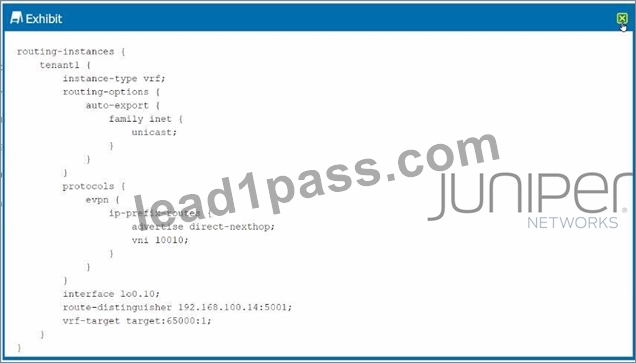
You want to enable the border leaf device to send Type 5 routes of local networks to the border leaf device in another data center. What must be changed to the configuration shown in the exhibit to satisfy this requirement?
- A. Change: 5001 in the route-distinguisher to : 10010.
- B. Move vrf-target target: 65000:1 to the evpn hierarchy.
- C. Add a VLAN configuration with an 13-interface to the tenant1 routing instance.
- D. Add encapsulation vxlan to the evpn hierarchy.
Answer: B
Explanation:
In this scenario, you want the border leaf device to advertise Type 5 EVPN routes to another border leaf in a different data center. Type 5 routes in EVPN are used to advertise IP prefixes, which means that for proper route advertisement, you need to configure the correct settings within the evpn hierarchy.
Step-by-Step Analysis:
* Understanding EVPN Type 5 Routes:
* EVPN Type 5 routes are used to advertise IP prefixes across EVPN instances, which allow different data centers or networks to exchange routing information effectively.
* VRF Target Setting:
* The vrf-target configuration is crucial because it defines the export and import policies for the VRF within the EVPN instance. For EVPN Type 5 routes to be advertised to other border leaf devices, the vrf-target needs to be correctly configured under the evpn hierarchy, not just within the routing instance.
Command to solve this:
move vrf-target target:65000:1 to evpn
* Other Options:
* Option B:Adding a VLAN configuration would not address the requirement to advertise Type 5 routes.
* Option C:Adding VXLAN encapsulation may be necessary for other scenarios but does not directly address the Type 5 route advertisement.
* Option D:Changing the route-distinguisher will differentiate routes but does not impact the advertisement of Type 5 routes to other data centers.
By moving the vrf-target to the evpn hierarchy, you enable the proper route advertisement, ensuring that the Type 5 routes for local networks are shared with other data center border leaf devices. This is aligned with best practices for multi-data center EVPN implementations, which emphasize the correct placement of routing policies within the EVPN configuration.
NEW QUESTION # 40
Which two statements are true about IP fabrics using unnumbered BGP? (Choose two.)
- A. Unnumbered BGP peering automatically provisions IPv6 peering.
- B. Unnumbered BGP peering automatically provisions IPv4 peering.
- C. Unnumbered BGP requires that family inet6 is configured on each interface.
- D. Unnumbered BGP requires that family inet is configured on each interface.
Answer: A,C
Explanation:
BGP unnumbered peering uses only link-local IPv6 addresses on interfaces to automatically discover and establish BGP peer sessions. No routable IP addresses are required on the underlay interfaces.
You must configure the interfaces with family inet6 to enable the link-local IPv6 addresses used for peering.
The BGP peering session is dynamically created based on interface names, which simplifies the configuration significantly compared to manual peering with routable IP addresses.
The peer IP and remote AS numbers are automatically configured for BGP unnumbered peering.
This means unnumbered BGP automatically provisions IPv6 peering using the link-local addresses.
It also supports IPv4 route exchange over the IPv6 next-hop established by unnumbered BGP.
https://www.juniper.net/documentation/us/en/software/nce/nce-225-bgp-unnumbered/index.html
NEW QUESTION # 41
Click the Exhibit button. You are troubleshooting a DCI connection to another data center. The BGP session to the provider is established, but the session to Border-Leaf-2 is not established.
Referring to the exhibit, which configuration change should be made to solve this problem?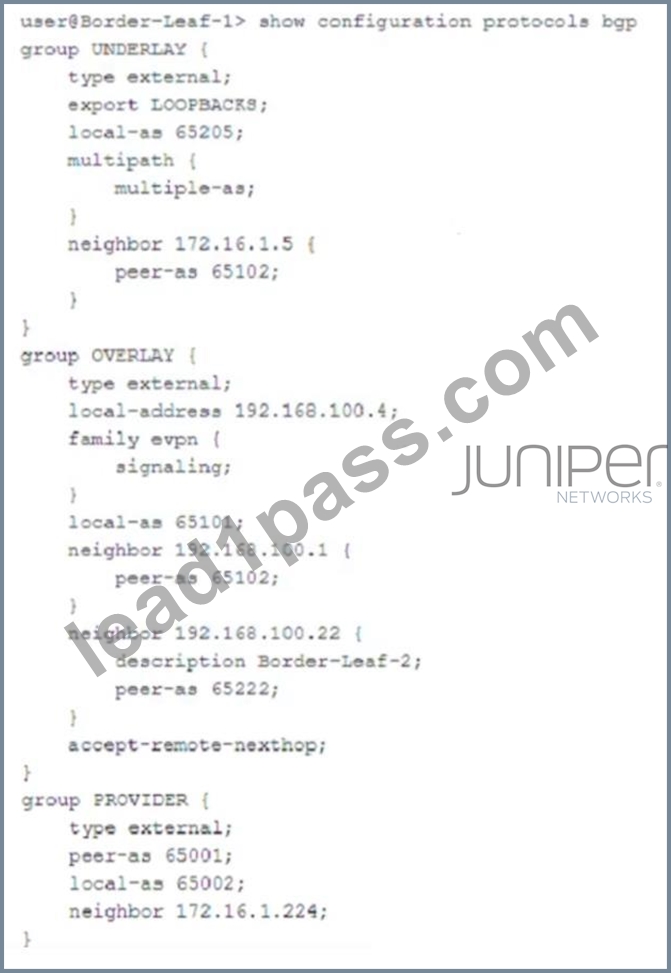
- A. set protocols bgp group overlay export loopbacks
- B. delete protocols bgp group OVERLAY accept-remote-nexthop
- C. delete protocols bgp group UNDERLAY advertise-external
- D. set protocols bgp group PROVIDER export LOOPBACKS
Answer: B
Explanation:
The "accept-remote-nexthop" statement allows the router to accept prefixes with a next hop that is not directly connected, which can cause BGP neighbor sessions to fail if not needed or properly supported.
Removing "accept-remote-nexthop" from the OVERLAY group is a common fix to resolve BGP session establishment issues with EVPN neighbors.
NEW QUESTION # 42
You want to ensure thatVXLAN traffic from the xe-0/0/12 interlace is being encapsulatedby logical vlep.
32770 and sent to a remote leaf device in this scenario, which command would you use to verify that traffic is flowing?
- A. show interfaces vtep.32770 detail
- B. show interface terse vtep.32770
- C. monitor traffic interface xe-0/0/12
- D. show interfaces terse vtep.32770 statistics
Answer: D
Explanation:
* VXLAN Traffic Verification:
* To ensure VXLAN traffic from the xe-0/0/12 interface is correctly encapsulated by the logical vtep.32770 and sent to a remote leaf device, it is essential to monitor the relevant interface statistics.
* The command show interfaces terse vtep.32770 statistics provides a concise overview of the traffic statistics for the specific VTEP interface, which can help verify whether traffic is being correctly encapsulated and transmitted.
* Explanation:
* This command is particularly useful for quickly checking the traffic counters and identifying any potential issues with VXLAN encapsulation or transmission.
* It allows you to confirm that traffic is flowing as expected, by checking the transmitted and received packet counters.
Data Center References:
* Monitoring interface statistics is a crucial step in troubleshooting and validating network traffic, particularly in complex overlay environments like EVPN-VXLAN.
NEW QUESTION # 43
In your EVPN-VXAN environment, you want to prevent a multihomed server from receiving multiple copies of BUM traffic in active/active scenarios. Which EVPN route type would satisfy this requirement?
- A. Type 7
- B. Type 8
- C. Type 5
- D. Type 4
Answer: D
Explanation:
In an EVPN-VXLAN environment with active-active multihoming, a multihomed server connected to multiple leaf switches can receive duplicate copies of BUM (Broadcast, Unknown Unicast, and Multicast) traffic. To prevent this, Type 4 (Ethernet Segment Route) is used.
EVPN Type 4 routes are responsible for DF (Designated Forwarder) election, which ensures that only one leaf switch forwards BUM traffic to the multihomed server. This prevents duplicate frames and optimizes network efficiency.
NEW QUESTION # 44
Which two statements are true about EVPN routes for Data Center Interconnect? (Choose two.)
- A. Type 5 EVPN routes require a VXLAN tunnel to the protocol next hop.
- B. Type 5 EVPN routes do not require a VXLAN tunnel to the protocol next hop.
- C. Type 2 EVPN routes do not require a VXLAN tunnel to the protocol next hop.
- D. Type 2 EVPN routes require a VXLAN tunnel to the protocol next hop.
Answer: B,C
Explanation:
* Type 2 EVPN Routes:
* Type 2 routesadvertise MAC addresses within an EVPN instance and are used primarily for Layer 2 bridging. These routes do not require a VXLAN tunnel to the protocol next hop because they operate within the same Layer 2 domain.
* Type 5 EVPN Routes:
* Type 5 routesare used to advertise IP prefixes (Layer 3 routes) within EVPN. Similar to Type 2 routes, they do not require a VXLAN tunnel to the protocol next hop because they represent L3 routes, which are managed at the routing layer without the need for VXLAN encapsulation.
Conclusion:
* Option B:Correct-Type 2 routes do not need a VXLAN tunnel to the next hop, as they are used for Layer 2.
* Option D:Correct-Type 5 routes also do not need a VXLAN tunnel because they operate at Layer 3, handling IP prefixes.
NEW QUESTION # 45
Referring to the exhibit, why is the active source field blank for the entry that uses the
00:0c:29:e8:b7:39 MAC address?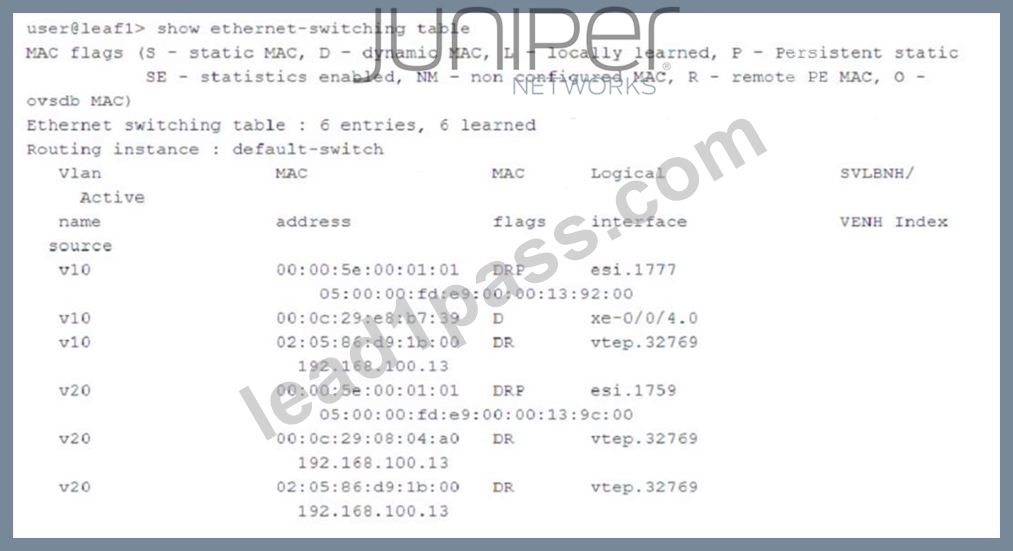
- A. The EVPN route for this host does not have a valid next hop.
- B. The ARP lookup for this host has failed.
- C. The host for this entry is locally connected to leaf1.
- D. This entry is associated with a multicast EVPN route.
Answer: C
Explanation:
In an Ethernet switching table, if a MAC address is learned on a local interface (e.g., xe-0/0/4.0), the active source will be blank since the source is local and not learned via EVPN from another VTEP or remote site.
Remote entries (learned via VXLAN/EVPN) typically display the VTEP information as the active source; local entries do not populate this field.
NEW QUESTION # 46
What are two ways in which an EVPN-signaled VXLAN is different from a multicast-signaled VXLAN? (Choose two.)
- A. An EVPN-signaled VXLAN is less resource intensive.
- B. An EVPN-signaled VXLAN can perform autodiscovery of VTEPs using IS-IS.
- C. An EVPN-signaled VXLAN can perform autodiscovery of VTEPs using BGP.
- D. An EVPN-signaled VXLAN features slower and more complete convergence.
Answer: A,C
NEW QUESTION # 47
Your organization is implementing EVPN-VXLAN and requires multiple overlapping VLAN-IDs.
You decide to use a routing-instance type mac-vrfto satisfy this request.
Which two statements are correct in this scenario? (Choose two.)
- A. Host-facing interfaces must be configured using a service-provider style configuration.
- B. The routing-instance service type can be VLAN-based.
- C. Host-facing interfaces must be configured using enterprise-style configuration.
- D. Spine-facing interfaces must be configured using an enterprise-style configuration.
Answer: A,B
Explanation:
Host-facing interfaces must be configured using a service-provider style configuration When using MAC-VRF routing instances to support overlapping VLAN IDs, host-facing interfaces need service-provider style (unit with VLAN tagging inside a logical interface). This allows the same VLAN ID to exist in multiple VRFs without conflict.
The routing-instance service type can be VLAN-based
MAC-VRF instances can be VLAN-based, which maps a VLAN to the routing instance for L2 segregation.
NEW QUESTION # 48
A local VTEP has two ECMP paths to a remote VTEP.
Which two statements are correct when load balancing is enabled in this scenario? (Choose two.)
- A. The inner packet fields are used in the hash for load balancing.
- B. The source port in the UDP header is used to load balance VXLAN traffic.
- C. The inner packet fields are not used in the hash for load balancing.
- D. The destination port in the UDP header is used to load balance VXLAN traffic.
Answer: A,B
Explanation:
The source port in the UDP header is used to load balance VXLAN traffic: In an ECMP (Equal-Cost Multi-Path) scenario with VXLAN, the source port in the UDP header is one of the fields used to hash the traffic and determine which path to use. This helps distribute traffic across multiple equal-cost paths between VTEPs.
The inner packet fields are used in the hash for load balancing: For VXLAN traffic, the inner packet fields (such as the inner source and destination IP addresses, and sometimes the inner VLAN) are included in the hash calculation to determine the forwarding path. This allows for more effective load balancing across the available paths.
NEW QUESTION # 49
......
Juniper JN0-683 Exam Syllabus Topics:
| Topic | Details |
|---|---|
| Topic 1 |
|
| Topic 2 |
|
| Topic 3 |
|
Verified JN0-683 dumps Q&As - JN0-683 dumps with Correct Answers: https://www.lead1pass.com/Juniper/JN0-683-practice-exam-dumps.html
The Best JNCIP-DC Study Guide for the JN0-683 Exam: https://drive.google.com/open?id=1FesY4Yn8mWhwdYoMKc27CgHaeaeeIefJ