

[Jun-2026] Download Real CompTIA 220-1201 Exam Dumps Test Engine Exam Questions
New 220-1201 exam dumps Use Updated CompTIA Exam
NEW QUESTION # 40
Users in a 200-person call center report that phone calls experience severe performance degradation on busy days. The technician confirms:
* Upload and download speeds are 50Mbps during a speed test.
* VoIP call prioritization settings are properly configured for the VLAN that the call center uses.
Which of the following is most likely the cause of this issue?
- A. The call center's VLAN is not configured to allow voice traffic.
- B. The switchports dedicated to the call center are flapping.
- C. The QoS is not configured correctly on the router.
- D. The bandwidth dedicated to the call center is insufficient.
Answer: D
Explanation:
Voice over IP (VoIP) traffic is highly sensitive to latency, jitter, and packet loss, especially in large environments such as a 200-person call center. Although the technician confirms that VoIP prioritization (QoS) is configured correctly and speed tests show 50 Mbps upload and download speeds, overall available bandwidth can still be insufficient during peak usage.
Speed tests measure raw throughput at a point in time and do not reflect real-world congestion caused by hundreds of simultaneous calls, application usage, and data transfers. On busy days, the cumulative bandwidth demand likely exceeds the available capacity, leading to degraded call quality despite correct VLAN and QoS settings.
If QoS were misconfigured or the VLAN did not allow voice traffic, call issues would be consistent at all times, not only during peak periods. Flapping switchports would cause intermittent connectivity drops rather than predictable performance degradation correlated with high usage.
CompTIA highlights that bandwidth limitations are a common root cause of VoIP performance problems in high-density environments, even when prioritization is properly implemented.
References:
CompTIA A+ Core 1 (220-1201) Official Study Guide - Networking Performance, QoS, and VoIP
NEW QUESTION # 41
Which of the following will most likely be used in a testing environment to execute unauthorized or experimental code without affecting production systems?
- A. Virtual machines
- B. Application gateways
- C. Load balancers
- D. Hybrid cloud
Answer: A
Explanation:
CompTIA A+ strongly emphasizes that virtual machines (VMs) are ideal for testing potentially unsafe software, malware samples, or experimental code because they isolate the environment from the host system. VMs allow snapshots, cloning, and rollback functionality, which makes them essential in development, QA, and cybersecurity environments where code might be unstable or harmful.
Hybrid cloud refers to infrastructure strategy, not code execution isolation. Load balancers distribute production traffic but have no testing or sandboxing purpose. Application gateways filter traffic but do not provide execution environments.
Virtual machines create a safe sandbox where failure, infection, or corruption is contained. This is covered in the Virtualization and Cloud Computing domain of the CompTIA A+ exam, making VMs the correct tool for executing unauthorized code safely.
NEW QUESTION # 42
A customer is using port 110 for email. However, the customer wants to upgrade to a more secure connection that automatically synchronizes with the server. Which of the following should the customer use?
- A. SFTP
- B. HTTPS
- C. IMAP
- D. SMTP
Answer: C
Explanation:
IMAP provides secure email access that keeps messages synchronized between the client and the mail server, allowing changes to be reflected automatically across devices while offering better security than legacy POP3 on port 110.
NEW QUESTION # 43
A company wants to share application resources with another business. Which of the following should the company implement?
- A. Rapid elasticity
- B. Community cloud
- C. File synchronization
- D. Dedicated resources
Answer: B
Explanation:
A community cloud allows multiple organizations with shared requirements to share application resources and infrastructure while maintaining common policies and objectives.
NEW QUESTION # 44
A company purchases a SOHO router for a small office. The new router does not have DHCP.
Which of the following address types should the company use so that all computers can communicate on the network?
- A. Public
- B. Static
- C. Dynamic
- D. IPv6
Answer: B
Explanation:
Without DHCP, the router cannot automatically assign IP addresses to devices. Each computer must be manually configured with an IP address, subnet mask, and default gateway, which requires the use of static addressing so all systems can communicate on the network.
NEW QUESTION # 45
A technician connects a network printer to a SOHO router. The technician configures several workstations to send print jobs to the printer's network address. After several days, users report that they are no longer able to use the printer. Which of the following should the technician use to resolve the issue and prevent it from reoccurring?
- A. USB cable
- B. Network gateway
- C. APIPA
- D. Static IP
Answer: D
Explanation:
The most effective solution to resolve this issue and prevent it from happening again is to assign the printer a static IP address. According to CompTIA Core 1 (220-1201) networking and printer configuration objectives, network printers should use static IP addresses to ensure consistent accessibility by client devices.
In this scenario, the printer was initially reachable using its assigned network address, but after several days it became unavailable. This commonly occurs when the printer is configured to receive its IP address via DHCP. When the DHCP lease expires or the printer is rebooted, the router may assign a different IP address, causing all workstations configured with the old address to lose connectivity.
By configuring a static IP address (or DHCP reservation), the printer's IP address remains constant, ensuring that all workstations can reliably send print jobs without interruption.
A network gateway is used to route traffic between networks and does not address printer addressing issues. A USB cable would eliminate network printing entirely and is not appropriate for a SOHO network environment. APIPA addresses indicate a DHCP failure and would worsen connectivity rather than fix it.
CompTIA strongly emphasizes using static IP addressing for shared network devices such as printers to ensure stability and prevent recurring access problems.
References:CompTIA A+ Core 1 (220-1201) Official Study Guide - Network Printing, DHCP, and IP Addressing
NEW QUESTION # 46
A salesperson is unable to use a personal device to access emails and calendar features at a client site but was able to use the device while at the office. Which of the following policies has been enforced on the salesperson's mobile device?
- A. MOW
- B. MFA
- C. MAN
- D. MAM
Answer: D
Explanation:
Mobile Application Management (MAM) enforces policies restricting access to apps and services based on location, ensuring security at external sites.
Why Not A (MOW): "Mobile Only Workplace" (MOW) is not a recognized term in this context.
Why Not B (MAN): Metropolitan Area Network (MAN) is unrelated to mobile device policies.
Why Not C (MFA): Multi-Factor Authentication secures user accounts but does not enforce app restrictions.
CompTIA A+ Exam Reference: Core 2 (220-1102), Section 2.7, mobile device security policies.
NEW QUESTION # 47
A customer has contacted you about building two new desktops. The first desktop will be a gaming workstation. The customer requirements include:
Playing the newest games at a high frame rate
Fast game load times
Enough storage to have several games installed at once
High-end audio
No concern about cost
Running the current Windows OS
The second workstation will be a family workstation. The requirements include:
Capability for word processing, videoconferencing, and basic web surfing Minimal cost, as long as it meets the requirements Running the current Windows OS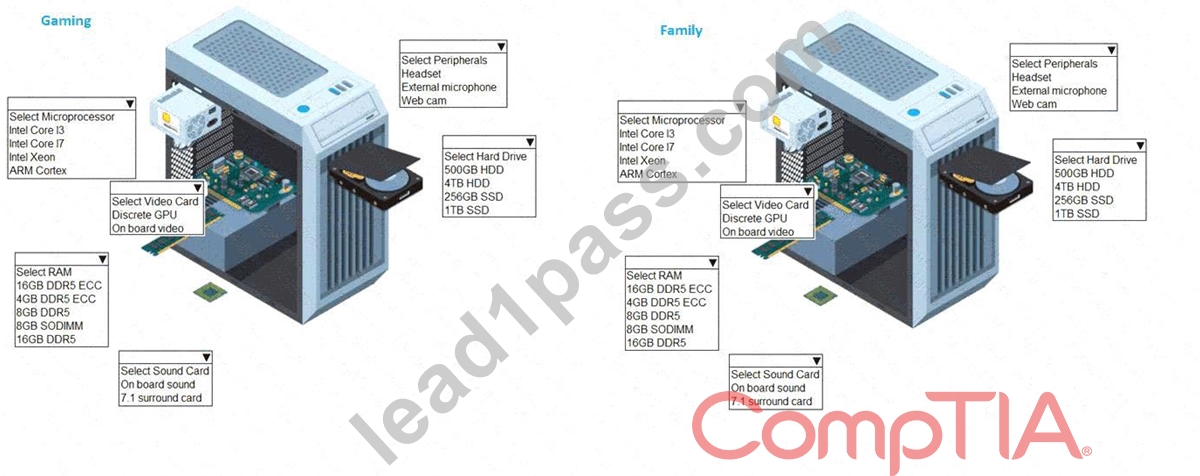
Answer:
Explanation: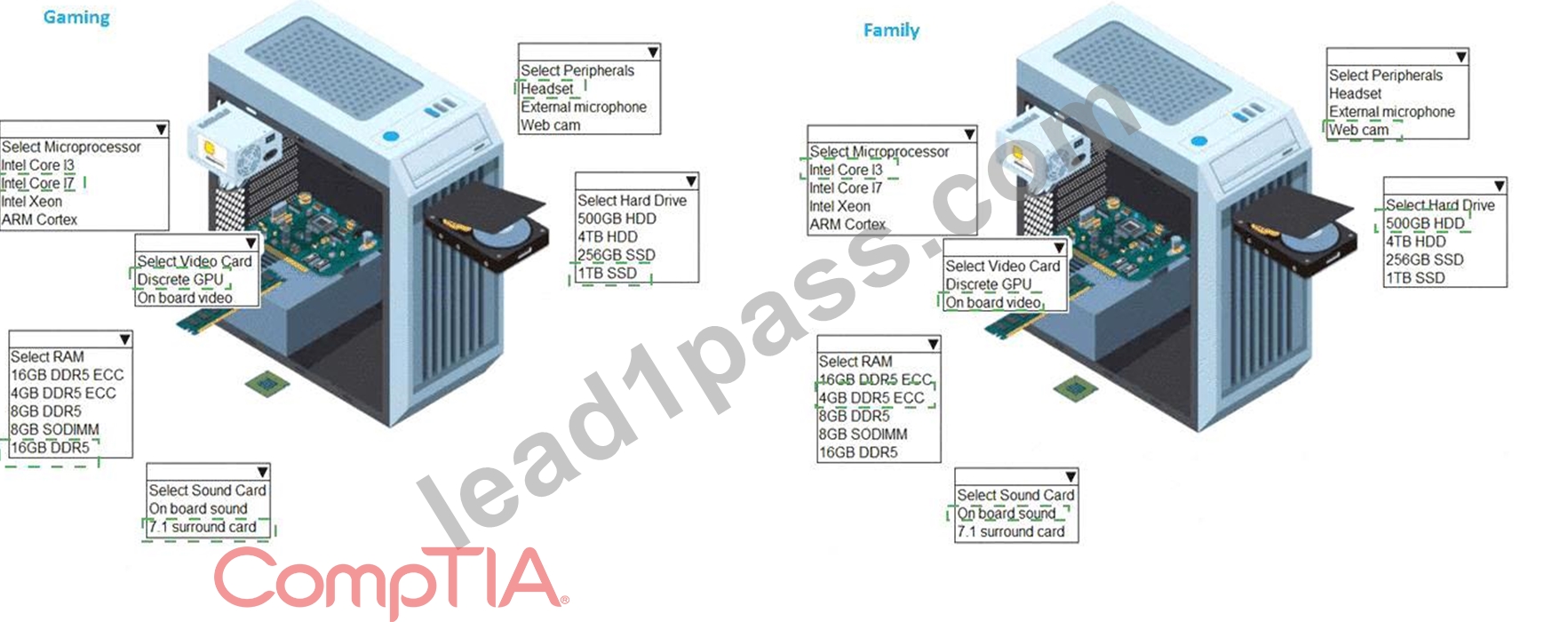
Explanation:
A computer tower with a hard drive and a hard drive AI-generated content may be incorrect.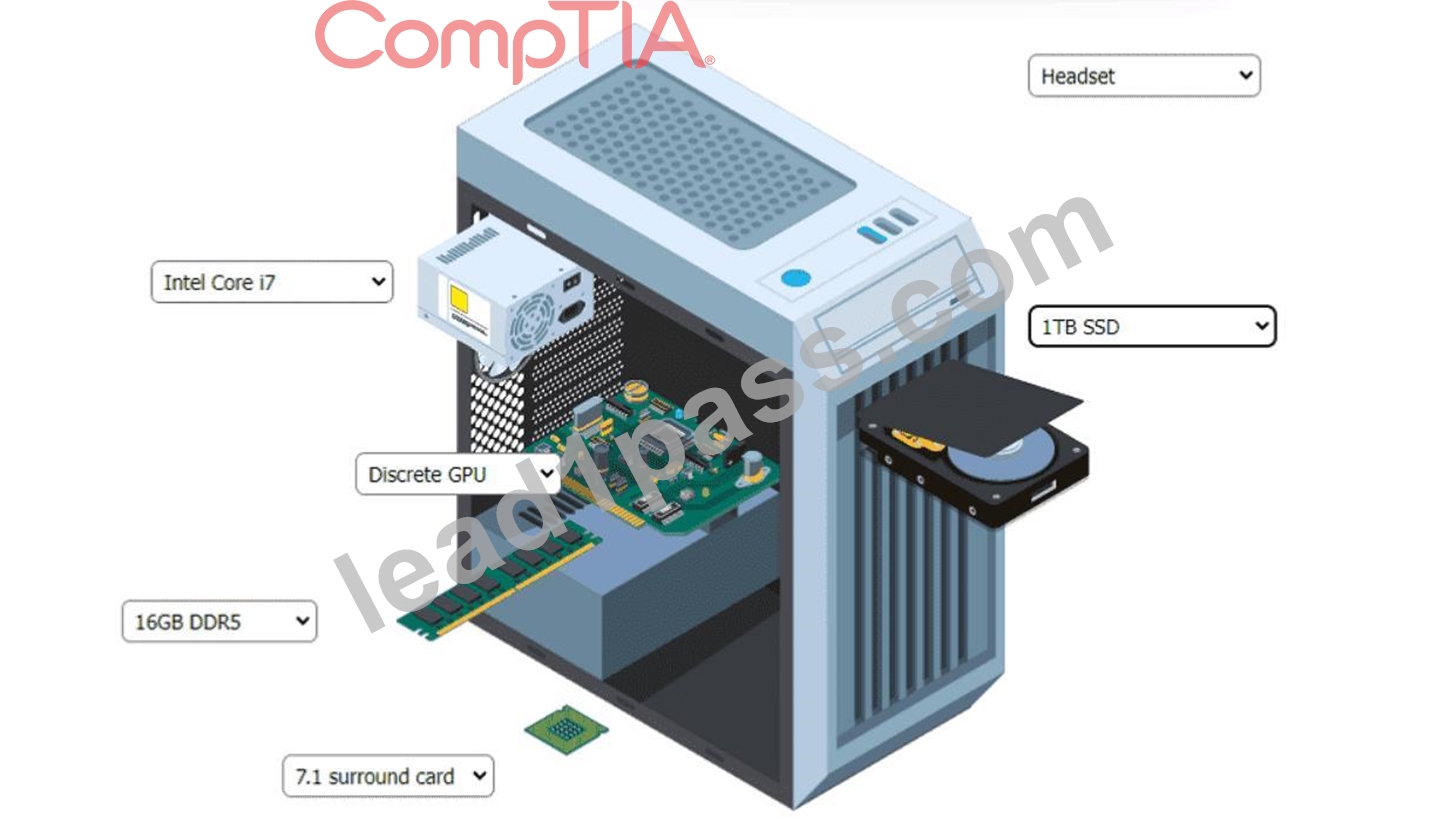
A computer tower with a computer and a hard drive AI-generated content may be incorrect.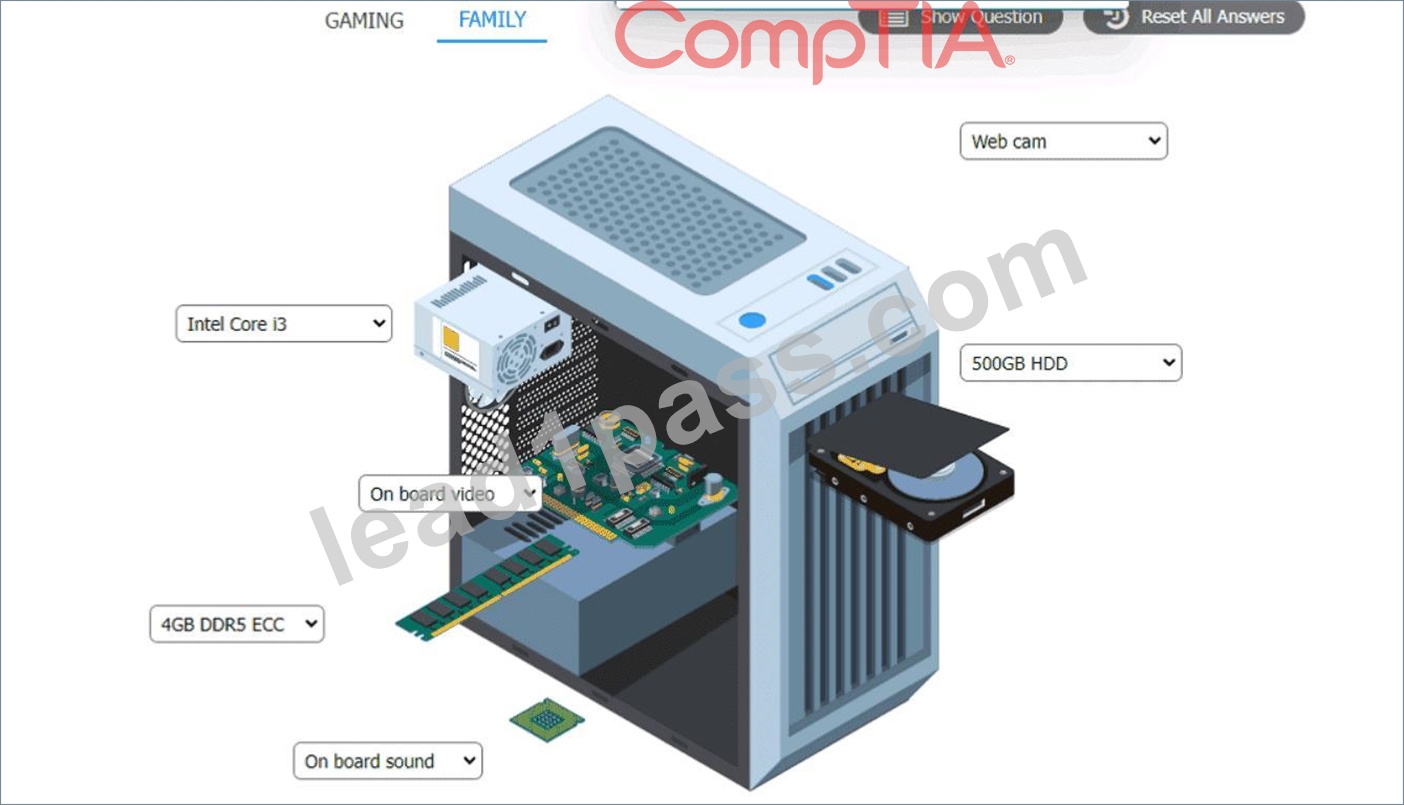
NEW QUESTION # 48
A technician needs to select PC components with a minimal number of visible internal cables.
Which of the following should the technician use?
- A. Modular power supply
- B. SATA drive connections
- C. Liquid cooling
- D. Wireless NIC
Answer: A
Explanation:
A modular power supply allows a technician to connect only the power cables that are needed, reducing clutter and improving airflow. This is ideal when aiming for a clean build with minimal visible internal cables.
NEW QUESTION # 49
A user on the edge of a building reports slow Wi-Fi and intermittent drops. Which action will solve the issue?
- A. Install additional wireless APs around the location
- B. Upgrade laptop to Wi-Fi 6 NIC
- C. Enable the 5GHz band
- D. Run ipconfig /flushdns
Answer: A
Explanation:
Wireless coverage issues at the physical edges of a building are typically caused by weak RF signal strength. The CompTIA A+ study material says the best solution is to add additional wireless access points (APs) or implement a mesh system to extend coverage and eliminate dead zones.
Enabling 5GHz often worsens the issue because 5GHz has shorter range. Wi-Fi 6 NIC upgrades improve performance but do not increase signal reach. Flushing DNS does not affect wireless coverage.
Installing more APs ensures stronger coverage, better signal-to-noise ratio, and stable connectivity aligning with CompTIA's wireless troubleshooting best practices.
NEW QUESTION # 50
After a user builds their first PC, the user needs to install the operating system from a USB drive. Which of the following should the user configure next?
- A. Secure Boot
- B. PXE boot
- C. Boot order
- D. BIOS password
Answer: C
Explanation:
Comprehensive and Detailed Explanation From Exact Extract (Aligned With CompTIA A+ 220-1201 Study Guide) When installing an operating system from external media (USB flash drive), the motherboard firmware must be instructed to check that device before checking the internal storage.
The CompTIA A+ official objectives describe that technicians must know how to access UEFI/BIOS settings and configure boot priority. Installing an OS from USB requires:
* Entering UEFI/BIOS setup
* Navigating to the Boot or Startup menu
* Setting the USB drive as the first boot device
* Saving and exiting to allow the computer to boot from the USB installer This process is specifically referenced in CompTIA A+ material under "BIOS/UEFI settings," where boot sequence / boot order is a fundamental configuration needed for OS installation.
Thus, the next step after assembling the PC is to modify the boot order to allow the system to boot from the USB installation media.
Why the other options are incorrect
A). BIOS password
Used for system access security; has no relevance to installing an OS from USB.
B). PXE boot
Used for network-based installations, not USB installations.
C). Secure Boot
Controls OS signature validation; not required to be changed for USB installation and is not the next required step.
Final Answer: D
NEW QUESTION # 51
A customer built a computer for gaming, sourcing individual components and then assembling the system.
The OS starts up, but within a few minutes the machine locks up. The customer brought the computer to a technician to diagnose the issue.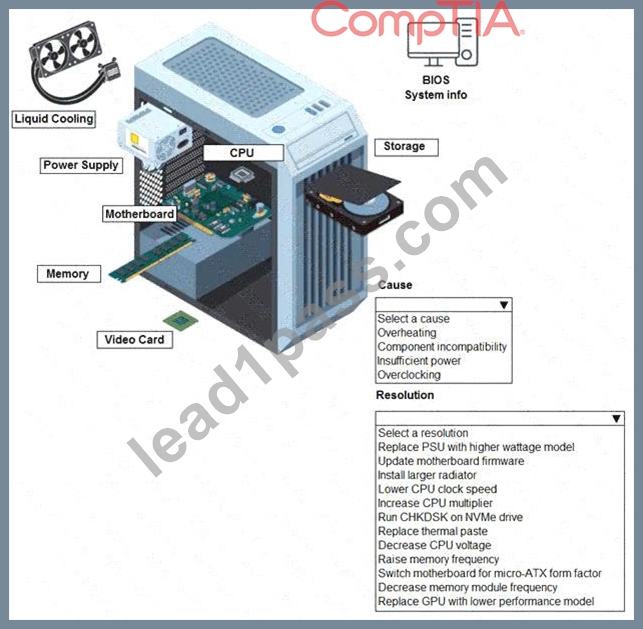
Answer:
Explanation: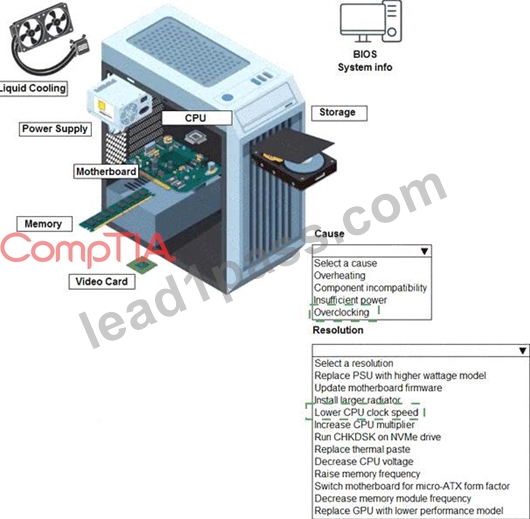
Explanation:
correct answer is "Overclocking" and "Reduce CPU Clock speed"
CPU is at 4.5 Ghz when normal is 3.2 Ghz. Overclocking too much can cause freezes, and this is a gaming computer sothe user probably took it too far. http://blog.logicalincrements.com/2018/12/4-troubleshooting- tips-overclocking-pc/
NEW QUESTION # 52
A user prints a spreadsheet in duplex mode. The spreadsheet is difficult to read because some of the columns spill onto the second side of the page. Which of the following should the user do to prevent the issue but still print on both sides of the page?
- A. Try a smaller font size in the spreadsheet.
- B. Turn off duplex printing.
- C. Change the page orientation.
- D. Use a different print driver.
Answer: C
NEW QUESTION # 53
Which of the following is the standard for Wi-Fi 7?
- A. 802.1X
- B. 802.15.1
- C. 802.11be
- D. 802.3at
Answer: C
Explanation:
The IEEE standard for Wi-Fi 7 is 802.11be, also known as Extremely High Throughput (EHT). According to CompTIA Core 1 (220-1201) networking standards objectives, each Wi-Fi generation corresponds to a specific IEEE 802.11 amendment. Wi-Fi 7 builds upon Wi-Fi 6/6E by offering significantly higher throughput, lower latency, and improved performance in high-density environments.
Option 802.11be is the only choice that represents a wireless LAN (WLAN) standard. 802.1X is an authentication framework used for network access control, not a Wi-Fi standard. 802.3at defines Power over Ethernet Plus (PoE+), which supplies electrical power over Ethernet cables. 802.15.1 is the IEEE standard for Bluetooth.
CompTIA expects candidates to recognize and differentiate wireless standards and their IEEE designations, especially newer technologies such as Wi-Fi 6, Wi-Fi 6E, and Wi-Fi 7. Identifying 802.11be as Wi-Fi 7 is essential for both exam success and real-world networking scenarios.
NEW QUESTION # 54
The Chief Information Security Officer asks a technician to inventory desktop PCs to determine which ones meet the requirements for Secure Boot. The technician must also configure the PCs for non-user-controllable keys. Which of the following are necessary to meet the enhanced security requirements? (Choose two.)
- A. TPM
- B. USB permissions
- C. UEFI
- D. VDI
- E. Disabled boot drive
- F. BIOS password
Answer: A,C
Explanation:
A Trusted Platform Module is required to securely store cryptographic keys that are not user- controllable, meeting enhanced security requirements. Unified Extensible Firmware Interface is required to support Secure Boot functionality, which verifies the integrity of the boot process using trusted keys.
NEW QUESTION # 55
A network administrator must ensure that a printer will still be assigned a specific IP address even if all addresses are depleted. Which of the following network configuration concepts is this describing?
- A. VLAN
- B. Reservation
- C. Lease
- D. Exclusion
Answer: B
Explanation:
Comprehensive and Detailed Explanation From Exact Extract:
A DHCP reservation binds a specific MAC address to an IP address so the device always receives the same IP from the DHCP server. This ensures network devices like printers maintain consistent connectivity and availability even when the IP pool is low.
#Reference: "CompTIA A+ Complete Study Guide" by Quentin Docter - Chapter 18, page 1252.
NEW QUESTION # 56
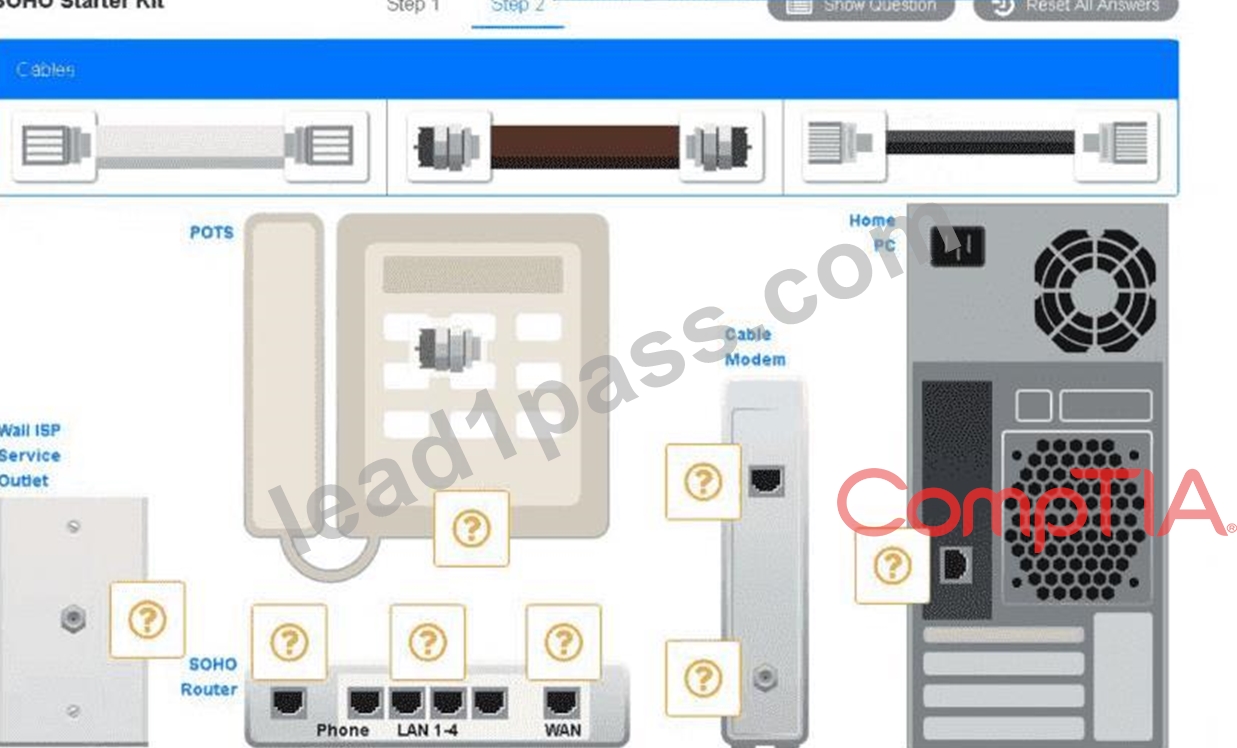
A small ISP has hired a new technician Joe, the new technician, is being trained to configure customers* home networks The trailing instructor gives me technician a starter kit with cables, cable ends, and other network equipment and asks mm to build a working network.
The computer should be connected to have internet connectivity and the phone should be connected to have a dial tone.
INSTRUCTIONS
Use the appropriate cables. cable ends, tools and equipment to configure the network ana connect an components accordingly There are 3 steps and the simulation starts on step 1.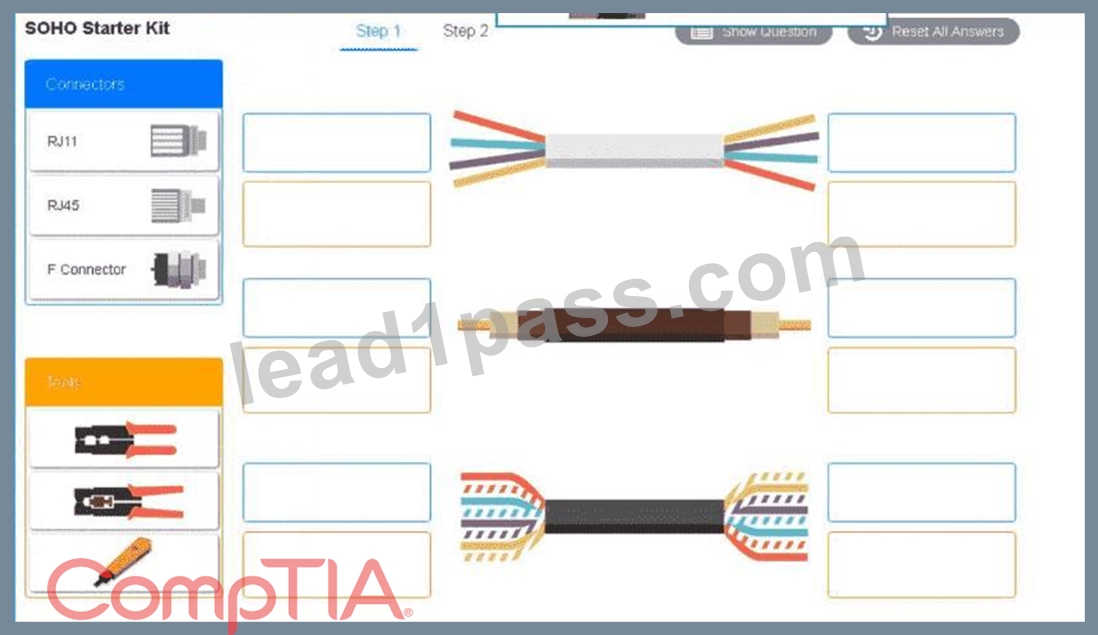
Answer:
Explanation:
See the answer below in explanation part.
Explanation:
Answer of both steps below.
A group of wires with different colors AI-generated content may be incorrect.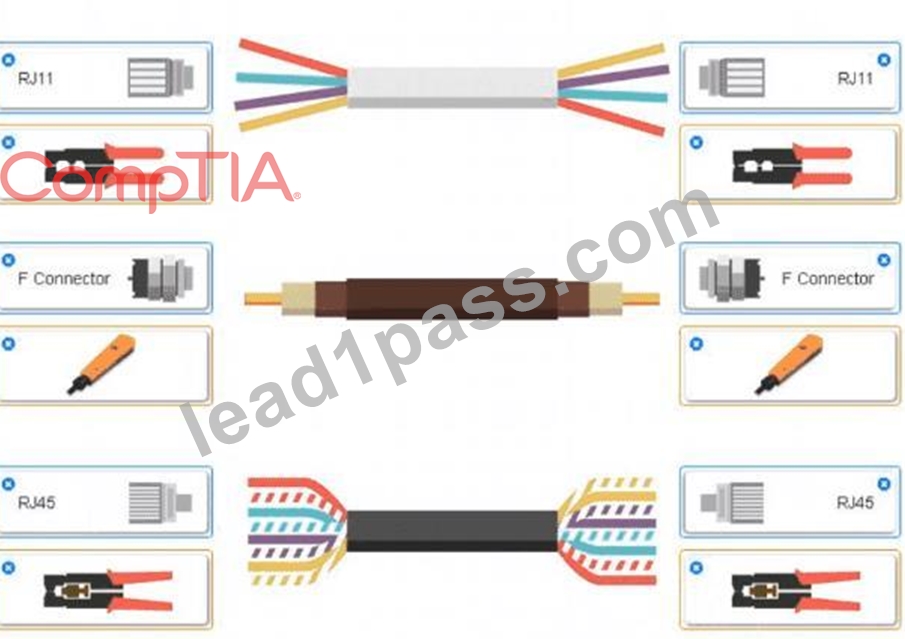
A screenshot of a computer AI-generated content may be incorrect.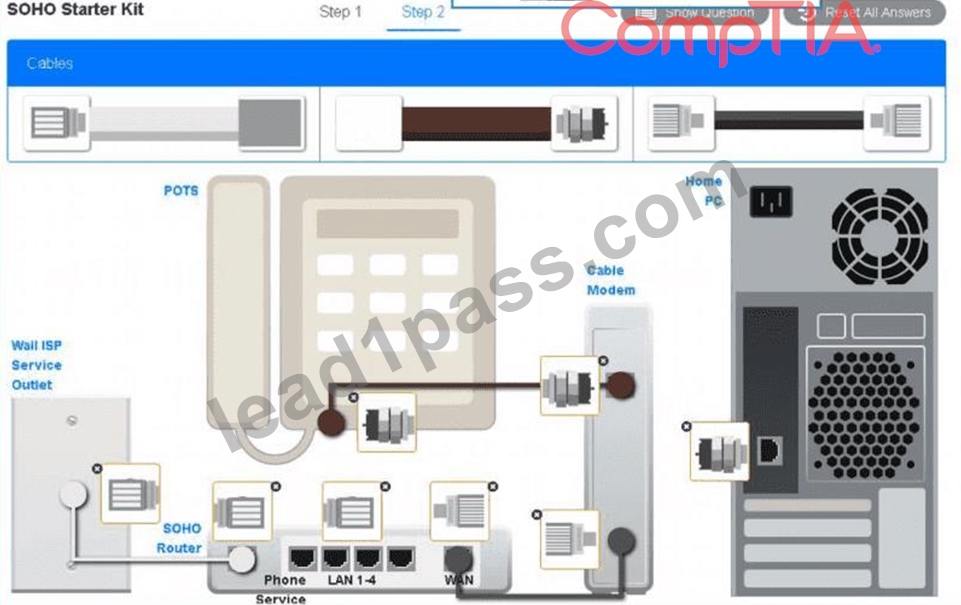
NEW QUESTION # 57
......
Pass Your 220-1201 Dumps as PDF Updated on 2026 With 500 Questions: https://www.lead1pass.com/CompTIA/220-1201-practice-exam-dumps.html
Verified 220-1201 Dumps Q&As - 220-1201 Test Engine with Correct Answers: https://drive.google.com/open?id=17XjQaYt0g-8x9vFNIJ8OabjVqv95kziP