

[Jan-2026] Download Real 2V0-11.24 Exam Dumps for candidates. 100% Free Dump Files
Prepare Important Exam with 2V0-11.24 Exam Dumps(2026)
VMware 2V0-11.24 Exam Syllabus Topics:
| Topic | Details |
|---|---|
| Topic 1 |
|
| Topic 2 |
|
| Topic 3 |
|
| Topic 4 |
|
NEW QUESTION # 46
In a case study, a company wants to automate the deployment of a workload domain using APIs. What is the first step they should take?
- A. Install Tools
- B. Validate Requirements
- C. Configure Network
- D. Review API Documentation
Answer: D
Explanation:
Understanding the API documentation is critical for effective usage.
Installing tools should come after understanding the APIs.
Network configuration comes later in the process.
Requirements must be validated before API calls are made.
NEW QUESTION # 47
What is an important step when scaling a vSphere cluster?
- A. Check Network Traffic
- B. User Role Review
- C. Validate Compliance
- D. Assess Resource Availability
Answer: D
Explanation:
Network traffic should be reviewed but is less critical for scaling.
Reviewing user roles is not a primary concern in scaling.
Assessing resource availability is crucial to ensure sufficient capacity.
Compliance checks are important but secondary to resource assessments.
NEW QUESTION # 48
What is the primary purpose of deploying VMware Aria Suite Lifecycle using SDDC Manager?
- A. Backup Solutions
- B. Automated Management
- C. Performance Monitoring
- D. User Configuration
Answer: B
Explanation:
Backup solutions are handled separately from lifecycle management.
It does not primarily focus on user configurations.
Performance monitoring is not the main focus of the Aria Suite Lifecycle.
It automates the management of lifecycle operations for VMware components.
NEW QUESTION # 49
Which Add-On would you consider to improve the lifecycle management of your VMware environment?
- A. vSAN
- B. Aria Operations
- C. vRealize Lifecycle Manager
- D. NSX-T
Answer: C
Explanation:
Aria Operations focuses on monitoring, not lifecycle management.
It helps manage the lifecycle of various VMware components.
NSX-T is for networking, not lifecycle management.
vSAN is for storage management and does not provide lifecycle management.
NEW QUESTION # 50
Which of the following is a critical step in preparing to deploy VMware Aria Suite Lifecycle?
- A. Backup Configuration
- B. Configure Networking
- C. Install Components
- D. Validate Requirements
Answer: D
Explanation:
Validating hardware and software requirements is essential.
Backup configuration occurs after deployment preparation.
Installing components happens after validating requirements.
Network configuration is important but secondary to validation.
NEW QUESTION # 51
What is a significant benefit of scaling VMware Cloud Foundation horizontally (adding more hosts) versus vertically (adding more resources to existing hosts)?
- A. Increased Complexity
- B. Higher Costs
- C. Simplified Management
- D. Improved Performance
Answer: D
Explanation:
Horizontal scaling improves performance by distributing workloads.
Horizontal scaling can simplify management by distributing resources.
It does not necessarily add complexity if managed properly.
It may not always lead to higher costs; it often saves money.
NEW QUESTION # 52
Which tool is most effective for monitoring network performance in vSphere?
- A. vSphere Client
- B. NSX Manager
- C. SDDC Manager
- D. vRealize Operations
Answer: D
Explanation:
The vSphere Client provides basic monitoring capabilities for networking.
SDDC Manager is primarily for lifecycle management.
vRealize Operations is designed for comprehensive performance monitoring.
NSX Manager focuses on configurations rather than performance metrics.
NEW QUESTION # 53
How often should the VMware Compatibility Guide be reviewed during deployment planning?
- A. Before Each Upgrade
- B. Only at Deployment
- C. Never
- D. Once a Year
Answer: A
Explanation:
The guide should be checked before each upgrade to ensure compatibility.
It should be reviewed regularly, especially before deployment.
Annual reviews are not sufficient; changes happen frequently.
It should always be consulted to avoid issues.
NEW QUESTION # 54
What is the primary purpose of deploying a Virtual Infrastructure (VI) workload domain using SDDC Manager?
- A. Security Policies
- B. Resource Allocation
- C. Backup Management
- D. Compliance
Answer: B
Explanation:
Compliance needs are addressed but are not the primary focus.
To allocate resources for workloads efficiently.
It does not handle backup management directly.
Security policies are managed separately from workload domain deployment.
NEW QUESTION # 55
A specific VM is unable to communicate with other VMs in the same network. An administrator needs to identify and resolve the network connectivity issue.
What three steps should the administrator follow? (Choose three.)
- A. Use the ESXi command line to check the status of the VM Kernel adapter
- B. Verify that the VM is connected to the correct port group
- C. Check the network adapter settings in vCenter Server
- D. Verify the port group settings and VLAN configuration
- E. Restart the VM to reset its network connections
Answer: B,C,D
Explanation:
Port group settings and VLAN configurations need to be correct for VMs to communicate with each other on the same network. Ensuring they are properly configured is essential.
It's important to check that the VM is connected to the correct port group that matches the network configuration of the other VMs.
The network adapter settings in vCenter Server should be reviewed to ensure there are no misconfigurations that could prevent network communication.
NEW QUESTION # 56
What is the first step in the installation process of VMware Cloud Foundation?
- A. Deploy NSX
- B. Install vCenter
- C. Configure vSAN
- D. Validate Requirements
Answer: D
Explanation:
Validating hardware and software requirements is critical.
NSX deployment comes after validating requirements.
Installing vCenter is not the first step; it follows validation.
vSAN configuration is done later in the process.
NEW QUESTION # 57
In the context of VMware Cloud Foundation, what is a primary consideration when selecting a backup method?
- A. Storage Type
- B. Backup Frequency
- C. User Permissions
- D. Recovery Time Objective
Answer: D
Explanation:
Storage type is important but not the primary consideration.
Recovery time objectives must be defined to select appropriate methods.
User permissions are managed separately from backup considerations.
Backup frequency is essential but follows recovery objectives.
NEW QUESTION # 58
Match each vSphere HA host state issue with its troubleshooting step.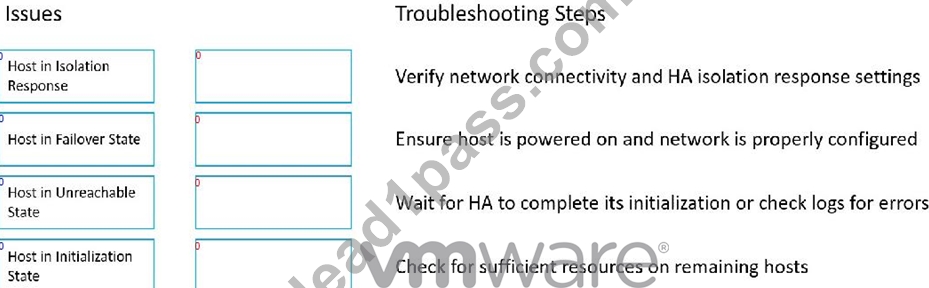
Answer:
Explanation: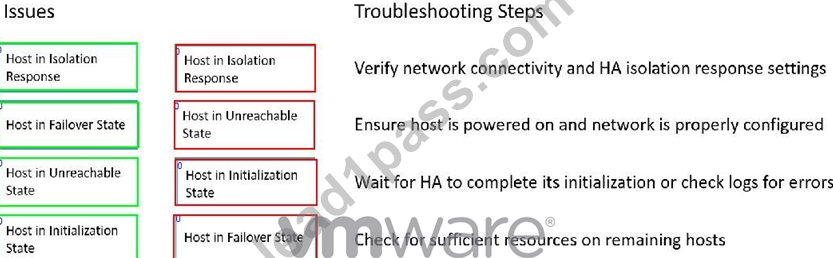
NEW QUESTION # 59
What type of deployment method is recommended for a VI workload domain using SDDC Manager?
- A. Hybrid Deployment
- B. Manual Deployment
- C. Automated Deployment
- D. Offline Deployment
Answer: C
Explanation:
Offline deployment is not practical for this scenario.
Manual deployment can be error-prone and inefficient.
Automated deployment simplifies the process and reduces errors.
Hybrid methods are generally not used for deploying workload domains.
NEW QUESTION # 60
How can you ensure security when using VMware Cloud Foundation APIs?
- A. API Key Rotation
- B. Use HTTPS
- C. User Authentication
- D. Plain Text
Answer: B
Explanation:
User authentication is also important for secure API usage.
Plain text communication should be avoided to maintain security.
Regular rotation of API keys enhances security.
HTTPS should be used to encrypt data in transit between API calls.
NEW QUESTION # 61
What is the first step to take when a VM is experiencing network connectivity issues?
- A. Review Host Logs
- B. Check VM Network Settings
- C. Inspect Physical Network
- D. Validate NSX Configuration
Answer: B
Explanation:
NSX configurations should be checked but come after VM settings.
Host logs may provide context but should be secondary to network checks.
Checking the physical network may be needed later.
Verifying the VM's network settings can help identify issues.
NEW QUESTION # 62
How can VMware best practices help in preparing ESXi hosts?
- A. Unique Configurations
- B. Standardization
- C. Compliance
- D. Complexity Management
Answer: B
Explanation:
Best practices help standardize configurations across hosts.
Compliance is important but not the main focus of best practices.
Unique configurations are discouraged in best practices.
They do not simplify the complexity of configurations.
NEW QUESTION # 63
What is the first step to take when a vSAN datastore becomes inaccessible?
- A. Inspect VM Logs
- B. Review Network Settings
- C. Validate Disk Space
- D. Check Cluster Health
Answer: D
Explanation:
Disk space is important but not the immediate first check.
VM logs are less relevant for datastore accessibility issues.
Checking the health of the vSAN cluster can identify issues.
Network settings can be a factor but are secondary to cluster health.
NEW QUESTION # 64
What is a critical setting to verify if SDDC Manager cannot provision new workloads?
- A. User Roles
- B. Resource Availability
- C. Configuration Validity
- D. Network Configuration
Answer: B
Explanation:
Validating configurations is essential but comes after checking resources.
Ensuring sufficient resources are available is critical for provisioning.
Network configurations are important but secondary to resource checks.
User roles do not typically affect provisioning directly.
NEW QUESTION # 65
Which networking setting is critical to configure during the VMware Cloud Builder appliance deployment?
- A. VLAN Configuration
- B. IP Addressing
- C. Gateway Settings
- D. DNS Settings
Answer: D
Explanation:
Gateway settings must be correct but are secondary to DNS.
IP addressing must be configured but follows DNS settings.
Proper DNS settings ensure that the appliance can resolve network names.
VLAN settings are essential for segmentation but come later.
NEW QUESTION # 66
Which network configuration is crucial for deploying NSX as part of the management domain?
- A. Single Point of Failure
- B. DHCP Configuration
- C. VLAN Configuration
- D. IP Addressing
Answer: C
Explanation:
IP addressing must be configured but follows VLAN setup.
A single point of failure is not acceptable for NSX.
DHCP can be used but is not recommended for production environments.
Proper VLAN configuration is necessary for NSX functionality.
NEW QUESTION # 67
......
2V0-11.24 Questions - Truly Beneficial For Your VMware Exam: https://www.lead1pass.com/VMware/2V0-11.24-practice-exam-dumps.html
Pass Exam Questions Efficiently With 2V0-11.24 Questions: https://drive.google.com/open?id=1AY9Y2rt2Zejq0wlwJoaCmd5uqtYkbfed