

IICRC WRT Test Engine Practice Test Questions, Exam Dumps
100% Free WRT Daily Practice Exam With 87 Questions
NEW QUESTION # 51
What should a restorer do when there is contamination (e.g., Category 2, Category 3, Mold) on a water damage restoration project to protect workers and occupants?
- A. Use appropriate PPE, containment, or other engineering controls
- B. Fog a water-based disinfectant into the affected area
- C. Wipe down the contamination with detergent cleaner
- D. Call the insurance company and discuss costs
Answer: A
Explanation:
The IICRC WRT body of knowledge emphasizes that when contamination is present, the restorer's responsibility is toprotect workers and occupantsby implementing appropriate controls. This includes the use ofpersonal protective equipment (PPE),containment systems, andengineering or administrative controlsas dictated by the hazard assessment.
Category 2 and Category 3 water, as well as mold-contaminated environments, can expose individuals to microorganisms, allergens, and other harmful agents. The WRT manual reinforces the hierarchy of controls:
eliminate hazards when possible, isolate hazards through containment, and protect workers with PPE when hazards cannot be fully removed.
Fogging disinfectants or wiping surfaces does not eliminate airborne or surface hazards and may actually increase aerosolization if done improperly. Contacting the insurance company is an administrative step and does not mitigate health risks.
The WRT curriculum also aligns with OSHA principles, stressing that safety controls must be implemented beforeandduringrestoration activities. Proper containment and PPE selection are essential to prevent cross- contamination and protect both restoration personnel and building occupants.
NEW QUESTION # 52
What is recommended to minimize or control airborne contaminants during restoration?
- A. Install Air Filtration Devices (AFDs)
- B. Install low-grain refrigerant dehumidifiers (LGRs)
- C. Install an HVAC system for increased air circulation
- D. Install additional centrifugal-style air movers
Answer: A
Explanation:
The IICRC WRT body of knowledge recommends the use ofAir Filtration Devices (AFDs)to minimize and control airborne contaminants during restoration activities. AFDs equipped with HEPA filtration capture airborne particulates, including dust, microbial fragments, and other contaminants generated during mitigation.
The WRT manual explains that uncontrolled airborne contaminants can pose health risks to workers and occupants and can spread contamination to unaffected areas. AFDs reduce this risk by continuously filtering air and, when properly configured, creating negative pressure within containment zones.
Dehumidifiers manage moisture, not particulates. Air movers can increase aerosolization if used improperly.
HVAC systems are not designed for contamination control during restoration and may spread contaminants throughout the structure.
AFDs are therefore the recommended engineering control for airborne contaminant management under the WRT standard of care.
NEW QUESTION # 53
As the humidity ratio and dew point increase or decrease, what other psychrometric measurement also increases or decreases proportionally?
- A. Permeability
- B. Temperature
- C. Vapor pressure
- D. Dehumidification rate
Answer: C
Explanation:
The IICRC WRT body of knowledge explains thathumidity ratio, dew point, and vapor pressure are directly related psychrometric measurements. When humidity ratio increases or decreases, both dew point and vapor pressure change proportionally.
Vapor pressure represents the energy exerted by water vapor molecules in the air. As more moisture is added to the air (higher humidity ratio), vapor pressure increases; when moisture is removed, vapor pressure decreases. Dew point follows the same pattern because it reflects the temperature at which that vapor pressure results in saturation.
Temperature and permeability are not directly proportional to humidity ratio, and dehumidification rate is a performance outcome rather than a psychrometric property.
Because vapor pressure governs moisture movement between materials and air, its proportional relationship to humidity ratio and dew point makes it one of the most important measurements in WRT drying science.
NEW QUESTION # 54
If the ambient temperature is below 50°F, what is the most effective type of dehumidifier to use when drying a structure?
- A. Low-grain refrigerant dehumidifier
- B. Gas bypass dehumidifier
- C. Conventional dehumidifier
- D. Desiccant dehumidifier
Answer: D
Explanation:
The IICRC WRT body of knowledge states thatdesiccant dehumidifiersare the most effective option when ambient temperatures fall below approximately50°F. Refrigerant-based dehumidifiers rely on condensation at cold coils and become inefficient or inoperative at lower temperatures due to coil icing and reduced moisture removal capacity.
Desiccant systems remove moisture throughadsorption, a chemical bonding process that is not dependent on air temperature. This allows desiccants to perform effectively in cold environments where refrigerant units fail.
The WRT manual highlights desiccants as the preferred solution for cold structures, unheated buildings, winter losses, and Class 4 drying scenarios. Gas bypass and LGR units extend the operating range of refrigerants but still have temperature limitations.
Selecting the correct dehumidifier type based on ambient conditions is a core competency under the WRT standard and ensures efficient, defensible drying.
NEW QUESTION # 55
In addition to low-humidity air, what can a restorer do to dry restorable subfloor under ceramic tile flooring?
- A. Decrease dehumidifier output temperature
- B. Increase temperature of the wet materials
- C. Increase relative humidity
- D. Decrease speed of air filtration devices
Answer: B
Explanation:
The IICRC WRT body of knowledge explains that drying restorable subflooring beneath ceramic tile is challenging because tile and grout assemblies havelow permeability, restricting vapor movement. In such conditions, evaporation must be enhanced by manipulating the remaining controllable variables-most notably temperature.
Increasing the temperature of the wet materials raises the vapor pressure within the subfloor, which increases the vapor pressure differential between the material and the surrounding air. This differential is the primary driving force that moves moisture out of materials and into the air. The WRT manual emphasizes that warmer materials evaporate moisture more readily, provided ambient air vapor pressure remains lower.
Lowering dehumidifier output temperature or increasing relative humidity would reduce drying efficiency.
Air filtration devices address airborne particulates and do not directly influence evaporation. Therefore, controlled heat application-within safe limits-is a recommended strategy when drying beneath low- permeance floor coverings.
The WRT curriculum reinforces that effective drying requires managinghumidity, airflow, and temperature together, particularly when materials restrict vapor transmission.
NEW QUESTION # 56
SCENARIO: Use the diagram and information below to answer this question.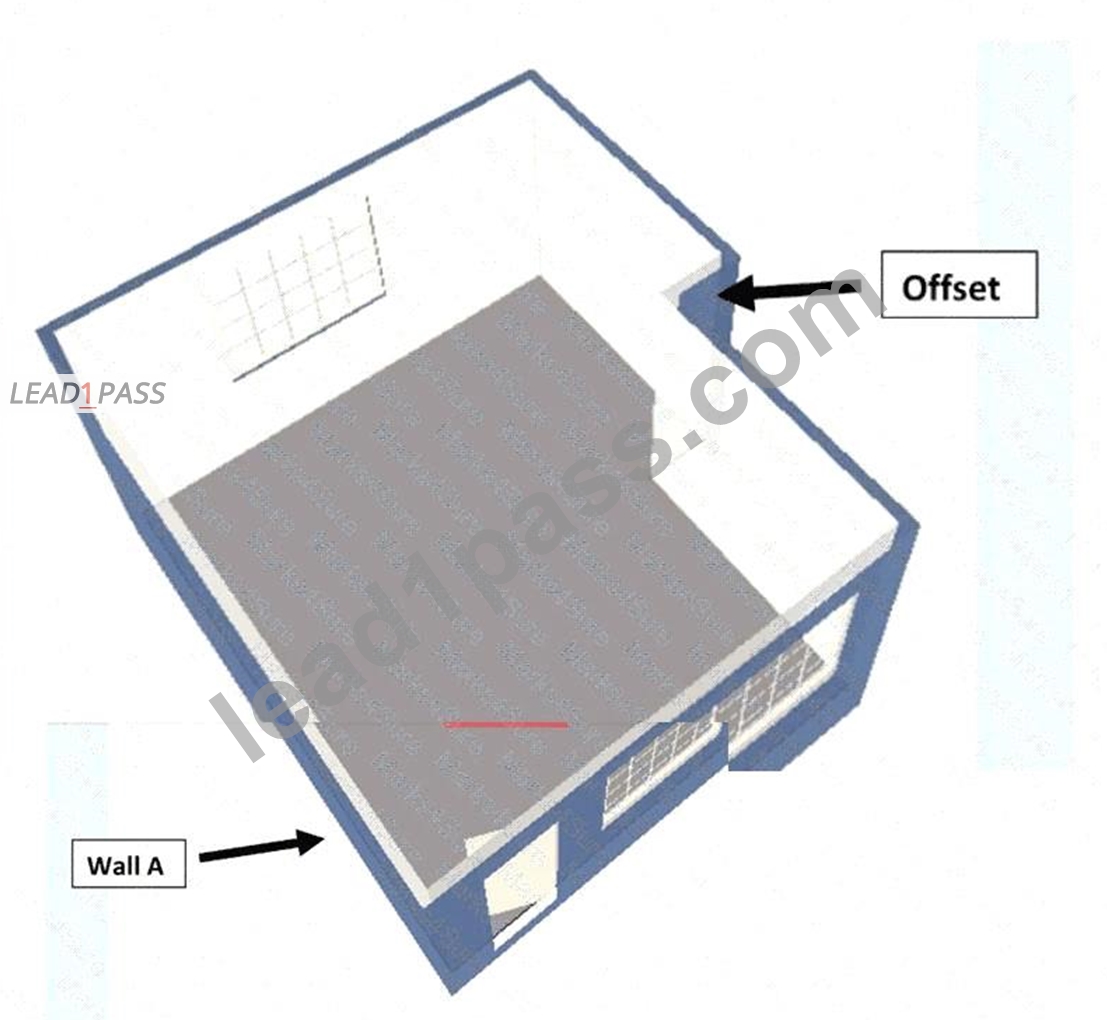
. The living room measures 20 feet x 16 feet, with an offset measuring 10 feet x 2 feet.
. The ceiling height is 8 feet.
. The entire floor area is wet, and moisture has been detected as high as 21 inches on all walls except Wall A.
. Water escaped from a broken pipe located behind Wall A. The entire area of wall A is wet.
. The ceiling is not affected.
Important information:
. The total square footage of the floor, including the offset, is 340 square feet
. The total square footage of Wall A after deducting the bottom 2 feet is 120 square feet (USE THE SCENARIO) What is the total number of airmovers a restorer should install?
- A. Low Range 8, High Range 11
- B. Low Range 5, High Range 8
- C. Low Range 7, High Range 10
- D. Total of 12
Answer: C
Explanation:
Based on IICRC WRT initial air mover placement guidelines:
* Floor area:340 sq ft # typically1 air mover per 50-70 sq ft
* Low range # 5-7
* High range # 7-9
* Wall drying required:
* All walls affected up to 21 inchesexcept Wall A
* Wall A fully wet(above 2 ft deduction = 120 sq ft requiring full wall drying)
* Offsets and irregular geometryincrease airflow demand.
When combining:
* Floor drying requirement
* Additional air movers forsignificantly wet walls
* One fully saturated wall (Wall A)
* One offset area
NEW QUESTION # 57
If indoor conditions are 90°F (32°C) and 60% relative humidity, at what surface temperature does condensation begin to occur?
- A. 58°F (14°C)
- B. 88°F (31°C)
- C. 74°F (23°C)
- D. 52°F (11°C)
Answer: C
Explanation:
Condensation occurs when a surface temperature reaches or drops below thedew point temperatureof the surrounding air. The IICRC WRT body of knowledge emphasizes that dew point-not relative humidity alone-determines when condensation will form.
At90°F and 60% RH, the corresponding dew point is approximately74°F. Any surface at or below this temperature will experience condensation as water vapor changes phase from gas to liquid.
This principle is critical in restoration drying because unintended condensation can re-wet materials and cause secondary damage. The WRT curriculum trains restorers to monitor both air dew point and material surface temperatures to prevent this condition.
Lower temperature options listed would represent colder surfaces but condensation would already occur once the surface reaches the dew point. Therefore, 74°F is the correct threshold.
NEW QUESTION # 58
Which term is defined as the process of water changing from a liquid to a gas?
- A. Sublimation
- B. Dehumidification
- C. Hydrostatic
- D. Evaporation
Answer: D
Explanation:
The IICRC WRT body of knowledge definesevaporationas the process by which water changes from a liquid state to a gaseous (vapor) state. This process is central to restorative drying because it is how moisture leaves wet materials.
The WRT manual explains that evaporation occurs at the surface of materials and is influenced by airflow, surface temperature, humidity, and vapor pressure differential. Evaporation alone does not remove moisture from the structure; it must be paired with dehumidification or ventilation to remove the vapor from the air.
Hydrostatic refers to water pressure, sublimation is the change from solid to gas, and dehumidification removes vapor from air-not liquid from materials. Understanding evaporation allows restorers to design drying systems that maximize moisture release while preventing condensation and secondary damage.
NEW QUESTION # 59
Which tool should be used to measure the moisture content of building materials?
- A. A thermal imaging camera
- B. A moisture meter
- C. A moisture sensor
- D. A thermo-hygrometer
Answer: B
Explanation:
The IICRC WRT body of knowledge identifies themoisture meteras the primary instrument used to measure moisture content or moisture level in building materials. Moisture meters-either penetrating or non- penetrating-provide quantitative or comparative data necessary to establish drying goals and verify drying progress.
Thermo-hygrometers measure air conditions, thermal cameras identify temperature anomalies, and moisture sensors are typically qualitative indicators. Only moisture meters are designed to measure moisture within materials accurately and repeatably.
The WRT manual emphasizes selecting the appropriate meter type for the material being tested and documenting readings consistently. Proper moisture measurement is essential for defensible drying documentation and confirmation of project completion.
NEW QUESTION # 60
What does a restorer need to know to determine the initial dehumidification capacity recommendation?
- A. Category of water, class of water, and type of subfloor of the affected area
- B. The number of air movers, category of water, and relative humidity
- C. Type, position, and grain depression of the dehumidifier
- D. Cubic footage of the affected area, class of water, and type of dehumidifier
Answer: D
Explanation:
According to the IICRC WRT body of knowledge, theinitial dehumidification capacity recommendationis determined by three primary factors:cubic footage of the affected area,class of water intrusion, andtype of dehumidifierbeing used. This calculation establishes a baseline moisture removal capability required to manage the anticipated evaporation load.
Cubic footage defines the volume of air within the drying chamber and directly influences how much moisture must be removed from the environment. Theclass of waterdescribes how much moisture has been absorbed by materials and the rate of evaporation expected. Higher classes (Class 3 and 4) require substantially more dehumidification capacity due to increased moisture loading and deeply absorbed water.
Thetype of dehumidifieris equally critical because different technologies (conventional refrigerant, LGR, desiccant) have vastly different operating ranges, efficiencies, and moisture removal characteristics. The WRT manual specifically differentiates capacity calculations for LGR versus desiccant systems, as they function under different psychrometric conditions.
Factors such as category of water, subfloor type, or air mover quantity influenceprocedural decisions, safety, and drying strategy-but they are not part of the initial capacity calculation. Likewise, grain depression is a performance outcome used for evaluation, not an input variable.
This structured approach ensures consistency, defensibility, and alignment with the ANSI/IICRC S500 Standard, enabling restorers to justify equipment placement using measurable, science-based criteria rather than guesswork or habit.
NEW QUESTION # 61
What should a technician do in a Category 3 water intrusion when high-risk individuals are present?
- A. Retain an Indoor Environmental Professional (IEP)
- B. Always perform a mold test to verify remediation effectiveness
- C. Install additional air movers and dehumidifiers
- D. Be primarily concerned with the dehumidifier's AHAM rating
Answer: A
Explanation:
The IICRC WRT body of knowledge states that whenhigh-risk individuals(such as the elderly, infants, immunocompromised persons, or those with respiratory conditions) are present during aCategory 3 water intrusion, anIndoor Environmental Professional (IEP)should be retained.
Category 3 water is grossly contaminated and poses significant health risks. The WRT manual explains that an IEP provides independent assessment, sampling strategies, and recommendations to protect occupant health and guide appropriate remediation decisions.
Increasing equipment or focusing on AHAM ratings does not address health risk evaluation. Mold testing is not automatically required and may not be appropriate during active mitigation.
Retaining an IEP ensures objective decision-making, regulatory alignment, and enhanced protection for vulnerable occupants, consistent with IICRC guidance.
NEW QUESTION # 62
Which best describes Category 2 water?
- A. Water that is grossly contaminated and can contain pathogenic, toxigenic, or other harmful agents
- B. Water that originates from a sanitary water source and does not pose substantial risk from ingestion or inhalation exposure
- C. Water that contains significant contamination and has the potential to cause discomfort or sickness if contacted or consumed by humans
- D. Water that originates from a sanitary source and flows into an uncontaminated building
Answer: C
Explanation:
The IICRC WRT body of knowledge definesCategory 2 wateras water that contains significant contamination and has the potential to cause discomfort or illness if contacted or consumed. This classification recognizes that while Category 2 water is not grossly contaminated like Category 3, it is no longer considered clean or sanitary.
Examples commonly cited in the WRT manual include dishwasher or washing machine discharge, toilet overflows with urine but no feces, and seepage due to hydrostatic pressure. These sources may contain microorganisms, nutrients for microbial growth, or other contaminants that pose health concerns.
The WRT standard emphasizes that Category 2 water presents anelevated health riskand requires enhanced controls compared to Category 1. This may include increased PPE, more aggressive cleaning, and careful evaluation of materials for restorability. Porous materials affected by Category 2 water may need to be removed depending on exposure time and degree of absorption.
Importantly, the WRT body of knowledge highlights that water candegrade in categoryover time if left untreated. Category 2 water can become Category 3 due to microbial amplification, reinforcing the importance of timely mitigation and proper classification during the initial inspection.
NEW QUESTION # 63
In order to maximize electrical safety, what shall mitigation equipment include?
- A. A grounded electrical plug
- B. Rubber feet to insulate mechanical components
- C. Water-resistant motor windings
- D. HEPA filters to trap contaminants
Answer: A
Explanation:
The IICRC WRT body of knowledge emphasizes that electrical safety is a critical concern during water damage restoration due to the presence of moisture, conductive surfaces, and temporary power distribution systems. To minimize the risk of electrical shock, fire, or equipment failure, mitigation equipment must include agrounded electrical plug.
Grounding provides a controlled path for electrical current in the event of a fault, preventing the buildup of dangerous voltage on equipment housings. The WRT curriculum aligns with OSHA electrical safety principles, which require grounding for portable electrical equipment used in wet or damp locations. This requirement is particularly relevant for air movers, dehumidifiers, and other powered drying equipment routinely deployed during mitigation.
While rubber feet and water-resistant motor windings may improve durability or reduce incidental exposure, they do not replace the fundamental safety function of grounding. HEPA filters address airborne particulate control and are unrelated to electrical safety.
The WRT manual reinforces that restorers must inspect electrical equipment prior to use, ensure proper grounding, and use GFCI-protected circuits where required. These measures collectively reduce the likelihood of electrical incidents and demonstrate compliance with accepted safety standards.
NEW QUESTION # 64
How often should a restorer record and monitor measurements during the drying process?
- A. Once bi-weekly
- B. Once a week
- C. Every other day
- D. At least daily
Answer: D
Explanation:
The IICRC WRT body of knowledge requires that restorersrecord and monitor drying measurements at least daily. Daily monitoring ensures that drying systems are functioning properly, drying goals are being approached, and adjustments can be made promptly if progress stalls.
Measurements typically include air temperature, relative humidity, humidity ratio, dew point, and moisture content or moisture levels of affected materials. The WRT manual emphasizes trend analysis-comparing daily readings to confirm consistent moisture reduction.
Infrequent monitoring increases the risk of unnoticed equipment failure, elevated humidity, condensation, or secondary damage. Weekly or bi-weekly monitoring does not meet the professional standard of care outlined in the ANSI/IICRC S500 Standard.
Daily documentation also supports defensibility by demonstrating continuous oversight and proactive management of the drying process. It provides transparency to materially interested parties and ensures accountability throughout the project lifecycle.
NEW QUESTION # 65
Which term describes the amount of moisture contained in an air sample as compared to the maximum amount the air sample could contain at that temperature?
- A. Absolute humidity
- B. Relative humidity
- C. Humidity ratio
- D. Dew point
Answer: B
Explanation:
Relative humidity (RH) is defined in the WRT body of knowledge as the amount of moisture contained in an air sample compared to the maximum amount that the same air sample could contain at that temperature (i.e., at saturation). The WRT manual explains RH as a percentage measure on the psychrometric chart- expressing the proportion of moisture present versus what the air could hold if saturated at that same temperature.
This definition is essential because RH is temperature-dependent: as air temperature changes, RH changes even if the actual moisture content (humidity ratio) stays the same. The WRT reference emphasizes that air can hold more water vapor as temperature increases; therefore, increasing temperature decreases RH (with no added moisture), while decreasing temperature increases RH.
In restoration practice, RH is used as a practical indicator of the drying environment and a predictor of moisture behavior in hygroscopic materials. The WRT manual notes that hygroscopic materials have an equilibrium moisture content primarily determined by RH: when RH is low, materials generally lose moisture; when RH is high-especially above about 60%-materials tend to gain significant moisture, increasing the likelihood of secondary damage.
Although restorers frequently track humidity ratio (GPP) and vapor pressure to quantify drying force, RH remains a core operational measurement because it is directly readable from a thermo-hygrometer and aligns with material response risk thresholds. Consequently, RH is the correct term for the described comparison-to- maximum-at-temperature concept, and it is one of the foundational psychrometric variables used in WRT to manage drying conditions and prevent secondary damage.
NEW QUESTION # 66
......
Use Valid New WRT Test Notes & WRT Valid Exam Guide: https://www.lead1pass.com/IICRC/WRT-practice-exam-dumps.html
WRT exam torrent IICRC study guide: https://drive.google.com/open?id=19nDxeoq8h2DLpSQ6ILdSKJLFN581Eaer