

Get Latest [Sep-2025] Conduct effective penetration tests using Lead1Pass CTFL4
Penetration testers simulate CTFL4 exam PDF
NEW QUESTION # 10
Which of the following statements about exploratory testing is true?
- A. In exploratory testing, testers usually produce scripted tests and establish bidirectional traceability between these tests and the items of the test basis
- B. Exploratory testing is an experience-based test technique in which testers explore the requirements specification to detect non testable requirements
- C. Exploratory testing is an experience-based test technique used by testers during informal code reviews to find defects by exploring the source code
- D. When exploratory testing is conducted following a session-based approach, the issues detected by the testers can be documented in session sheets
Answer: D
Explanation:
Exploratory testing is an experience-based test technique in which testers dynamically design and execute tests based on their knowledge, intuition, and learning of the software system, without following predefined test scripts or test cases. Exploratory testing can be conducted following a session-based approach, which is a structured way of managing and measuring exploratory testing. In a session-based approach, the testers perform uninterrupted test sessions, usually lasting between 60 and 120 minutes, with a specific charter or goal, and document the issues detected, the test coverage achieved, and the time spent in session sheets.
Session sheets are records of the test activities, results, and observations during a test session, which can be used for reporting, debriefing, and learning purposes. The other statements are false, because:
* Exploratory testing is not a test technique in which testers explore the requirements specification to detect non testable requirements, but rather a test technique in which testers explore the software system to detect functional and non-functional defects, as well as to learn new information, risks, or opportunities. Non testable requirements are requirements that are ambiguous, incomplete, inconsistent, or not verifiable, which can affect the quality and effectiveness of the testing process. Non testable requirements can be detected by applying static testing techniques, such as reviews or inspections, to the requirements specification, before the software system is developed or tested.
* Exploratory testing is not a test technique used by testers during informal code reviews to find defects by exploring the source code, but rather a test technique used by testers during dynamic testing to find defects by exploring the behavior and performance of the software system, without examining the source code. Informal code reviews are static testing techniques, in which the source code is analyzed by one or more reviewers, without following a formal process or using a checklist, to identify defects, violations, or improvements. Informal code reviews are usually performed by developers or peers, not by testers.
* In exploratory testing, testers usually do not produce scripted tests and establish bidirectional traceability between these tests and the items of the test basis, but rather produce unscripted tests and adapt them based on the feedback and the findings of the testing process. Scripted tests are tests that are designed and documented in advance, with predefined inputs, outputs, and expected results, and are executed according to a test plan or a test procedure. Bidirectional traceability is the ability to trace both forward and backward the relationships between the items of the test basis, such as the requirements, the design, the risks, etc., and the test artifacts, such as the test cases, the test results, the defects, etc.
Scripted tests and bidirectional traceability are usually associated with more formal and structured testing approaches, such as specification-based or structure-based test techniques, not with exploratory testing. References: ISTQB Certified Tester Foundation Level (CTFL) v4.0 sources and documents:
* ISTQB Certified Tester Foundation Level Syllabus v4.0, Chapter 2.2.3, Experience-based Test Design Techniques1
* ISTQB Glossary of Testing Terms v4.0, Exploratory Testing, Session-based Testing, Session Sheet, Non Testable Requirement, Static Testing, Informal Review, Dynamic Testing, Scripted Testing, Bidirectional Traceability2
NEW QUESTION # 11
Which of the statements correctly describes when a whole team approach may NOT be suitable?
- A. When the team dynamics need to be improved.
- B. When acceptance tests need to be created.
- C. When a high level of test independence may be required.
- D. When a test automation approach needs to be determined.
Answer: C
Explanation:
The whole team approach involves collaboration among all team members, including testers, developers, and business representatives, to achieve quality goals. However, this approach may not be suitable in situations where a high level of test independence is required. Test independence is essential in cases where unbiased testing is critical, such as in regulated environments or where high-risk systems are involved. This is because team members might unintentionally influence each other's work, leading to potential bias in testing outcomes.
NEW QUESTION # 12
Who of the following has the best knowledge to decide what tests in a test project should be automated?
- A. The development manager
- B. The developer
- C. The test leader
- D. The customer
Answer: C
Explanation:
The test leader is the person who is responsible for planning, monitoring, and controlling the test activities and resources in a test project. The test leader should have the best knowledge of the test objectives, scope, risks, resources, schedule, and quality criteria. The test leader should also be aware of the test automation criteria, such as the execution frequency, the test support, the team education, the roles and responsibilities, and the devs and testers collaboration1. Based on these factors, the test leader can decide which tests are suitable for automation and which are not, and prioritize them accordingly. The test leader can also coordinate with the test automation engineers, the developers, and the stakeholders to ensure the alignment of the test automation strategy with the test project goals and expectations. References = ISTQB Certified Tester Foundation Level (CTFL) v4.0 Syllabus, Chapter 2, Section 2.3.1, Page 152; ISTQB Glossary of Testing Terms v4.0, Page 403; ISTQB Certified Tester Foundation Level (CTFL) v4.0Syllabus, Chapter 6, Section
6.1.1, Page 514; Top 8 Test Automation Criteria You Need To Fulfill - QAMIND1
NEW QUESTION # 13
Which of the following statements refers to good testing practice to be applied regardless of the chosen software development model?
- A. Test levels should be defined such that the exit criteria of one level are part of the entry criteria for the next level
- B. Test objectives should be the same for all test levels, although the number of tests designed at various levels can vary significantly
- C. Tests should be written in executable format before the code is written and should act as executable specifications that drive coding
- D. Involvement of testers in work product reviews should occur as early as possible to take advantage of the early testing principle
Answer: D
Explanation:
The statement that refers to good testing practice to be applied regardless of the chosen software development model is option D, which says that involvement of testers in work product reviews should occur as early as possible to take advantage of the early testing principle. Work product reviews are static testing techniques, in which the work products of the software development process, such as the requirements, the design, the code, the test cases, etc., are examined by one or more reviewers, with or without the author, to identify defects, violations, or improvements. Involvement of testers in work product reviews can provide various benefits for the testing process, such as improving the test quality, the test efficiency, and the test communication. The early testing principle states that testing activities should start as early as possible in the software development lifecycle, and should be performed iteratively and continuously throughout the lifecycle. Applying the early testing principle can help to prevent, detect, and remove defects at an early stage, when they are easier, cheaper, and faster to fix, as well as to reduce the risk, the cost, and the time of the testing process. The other options are not good testing practices to be applied regardless of the chosen software development model, but rather specific testing practices that may or may not be applicable or beneficial for testing, depending on the context and the objectives of the testing activities, such as:
* Tests should be written in executable format before the code is written and should act as executable specifications that drive coding: This is a specific testing practice that is associated with test-driven development, which is an approach to software development and testing, in which the developers write automated unit tests before writing the source code, and then refactor the code until the tests pass. Test- driven development can help to improve the quality, the design, and the maintainability of the code, as well as to provide fast feedback and guidance for the developers. However, test-driven development is not a good testing practice to be applied regardless of the chosen software development model, as it may not be feasible, suitable, or effective for testing in some contexts or situations, such as when the requirements are unclear, unstable, or complex, when the test automation tools or skills are not available or adequate, when the testing objectives or levels are not aligned with the unit testing, etc.
* Test levels should be defined such that the exit criteria of one level are part of the entry criteria for the next level: This is a specific testing practice that is associated with sequential software development models, such as the waterfall model, the V-model, or the W-model, in which the software development and testing activities are performed in a linear and sequential order, with well-defined phases, deliverables, and dependencies. Test levels are the stages of testing that correspond to the levels of integration of the software system, such as component testing, integration testing, system testing, and acceptance testing. Test levels should have clear and measurable entry criteria and exit criteria, which are the conditions that must be met before starting or finishing a test level. In sequential software development models, the exit criteria of one test level are usually part of the entry criteria for the next test level, to ensure that the software system is ready and stable for the next level of testing. However, this is not a good testing practice to be applied regardless of the chosen software development model, as it may not be relevant, flexible, or efficient for testing in some contexts or situations, such as when the software development and testing activities are performed in an iterative and incremental order, with frequent changes, feedback, and adaptations, as in agile software development models, such as Scrum, Kanban, or XP, when the test levels are not clearly defined or distinguished, or when the test levels are performed in parallel or concurrently, etc.
* Test objectives should be the same for all test levels, although the number of tests designed at various levels can vary significantly: This is a specific testing practice that is associated with uniform software development models, such as the spiral model, the incremental model, or the prototyping model, in which the software development and testing activities are performed in a cyclical and repetitive manner, with similar phases, deliverables, and processes. Test objectives are the goals or the purposes of testing, which can vary depending on the test level, the test type, the test technique, the test environment, the test stakeholder, etc. Test objectives can be defined in terms of the test basis, the test coverage, the test quality, the test risk, the test cost, the test time, etc. Test objectives should be specific, measurable, achievable, relevant, and time-bound, and they should be aligned with the project objectives and the quality characteristics. In uniform software development models, the test objectives may be the same for all test levels, as the testing process is repeated for each cycle or iteration, with similar focus, scope, and perspective of testing. However, this is not a good testing practice to be applied regardless of the chosen software development model, as it may not be appropriate, realistic, or effective for testing in some contexts or situations, such as when the software development and testing activities are performed in a hierarchical and modular manner, with different phases, deliverables, and dependencies, as in sequential software development models, such as the waterfall model, the V-model, or the W-model, when the test objectives vary according to the test levels, such as component testing, integration testing, system testing, and acceptance testing, or when the test objectives change according to the feedback, the learning, or the adaptation of the testing process, as in agile software development models, such as Scrum, Kanban, or XP, etc.References: ISTQB Certified Tester Foundation Level (CTFL) v4.0 sources and documents:
* ISTQB Certified Tester Foundation Level Syllabus v4.0, Chapter 1.1.1, Testing and the Software Development Lifecycle1
* ISTQB Certified Tester Foundation Level Syllabus v4.0, Chapter 1.2.1, Testing Principles1
* ISTQB Certified Tester Foundation Level Syllabus v4.0, Chapter 1.2.2, Testing Policies, Strategies, and Test Approaches1
* ISTQB Certified Tester Foundation Level Syllabus v4.0, Chapter 1.3.1, Testing in Software Development Lifecycles1
* ISTQB Certified Tester Foundation Level Syllabus v4.0, Chapter 2.1.1, Test Planning1
* ISTQB Certified Tester Foundation Level Syllabus v4.0, Chapter 2.1.2, Test Monitoring and Control1
* ISTQB Certified Tester Foundation Level Syllabus v4.0, Chapter 2.1.3, Test Analysis and Design1
* ISTQB Certified Tester Foundation Level Syllabus v4.0, Chapter 2.1.4, Test Implementation1
* ISTQB Certified Tester Foundation Level Syllabus v4.0, Chapter 2.1.5, Test Execution1
* ISTQB Certified Tester Foundation Level Syllabus v4.0, Chapter 2.1.6, Test Closure1
* ISTQB Glossary of Testing Terms v4.0, Work Product Review, Static Testing, Early Testing, Test- driven Development, Test Level, Entry Criterion, Exit Criterion, Test Objective, Test Basis, Test Coverage, Test Quality, Test Risk, Test Cost, Test Time2
NEW QUESTION # 14
Which of the following statements is true?
- A. In Agile software development, work product documentation tends to be lightweight and manual tests tend to be often unscripted as they are often produced using experience-based test techniques
- B. Both in Agile software development and in sequential development models, such as the V-model, test levels tend to overlap since they do not usually have defined entry and exit criteria
- C. In Agile software development, the first iterations are exclusively dedicated to testing activities, as testing will be used to drive development, which will be performed in the subsequent iterations
- D. Sequential development models impose the use of systematic test techniques and do not allow the use of experience-based test techniques
Answer: A
Explanation:
This answer is correct because in Agile software development, work product documentation, such as user stories, acceptance criteria, or test cases, tends to be lightweight and concise, as the focus is on working software and frequent communication rather than comprehensive documentation. Manual tests tend to be often unscripted, as they are often produced using experience-based test techniques, such as error guessing or exploratory testing, which rely on the tester's skills, knowledge, and creativity to find defects and provide feedback. References: ISTQB Foundation Level Syllabus v4.0, Section 3.1.1.2, Section 3.2.1.2
NEW QUESTION # 15
Following a risk-based testing approach you have designed 10 tests to cover a product risk with a high-risk level. You want to estimate, adopting the three-point test estimation technique, the test effort required to reduce the risk level to zero by executing those 10 tests. You made the following three initial estimates:
* most optimistic = 6 person hours
* most likely = 30 person hours
* most pessimistic = 54 person hours
Based only on the given information, which of the following answers about the three-point test estimation technique applied to this problem is true?
- A. The final estimate is between 22 person hours and 38 person hours
- B. The final estimate is between 6 person hours and 54 person hours
- C. The final estimate is exactly 30 person hours because the technique uses the initial most likely estimate as the final estimate
- D. The final estimate is exactly 30 person hours because the technique uses the arithmetic mean of the three initial estimates as the final estimate
Answer: A
Explanation:
The three-point test estimation technique is a method of estimating the test effort based on three initial estimates: the most optimistic, the most likely, and the most pessimistic. The technique uses a weighted average of these three estimates to calculate the final estimate, which is also known as the expected value. The formula for the expected value is:
Expected value = (most optimistic + 4 * most likely + most pessimistic) / 6 Using the given values, the expected value is:
Expected value = (6 + 4 * 30 + 54) / 6 Expected value = 30 person hours However, the expected value is not the only factor to consider when estimating the test effort. The technique also calculates the standard deviation, which is a measure of the variability or uncertainty of the estimates.
The formula for the standard deviation is:
Standard deviation = (most pessimistic - most optimistic) / 6
Using the given values, the standard deviation is:
Standard deviation = (54 - 6) / 6 Standard deviation = 8 person hours
The standard deviation can be used to determine a range of possible values for the test effort, based on a certain level of confidence. For example, using a 68% confidence level, the range is:
Expected value ± standard deviation
Using the calculated values, the range is:
30 ± 8 person hours
Therefore, the final estimate is between 22 person hours and 38 person hours, which is option A.
References: ISTQB Certified Tester Foundation Level Syllabus v4.01, Section 2.3.2, page 24-25; ISTQB Glossary v4.02, page 33.
NEW QUESTION # 16
The following diagram displays the logical dependencies between requirements and the individual requirement priorities. For example, "R2->R3" means that R3 is dependent on R2. Priority is indicated by the number next to the letter "P" i.e. P1 has a higher priority than P2.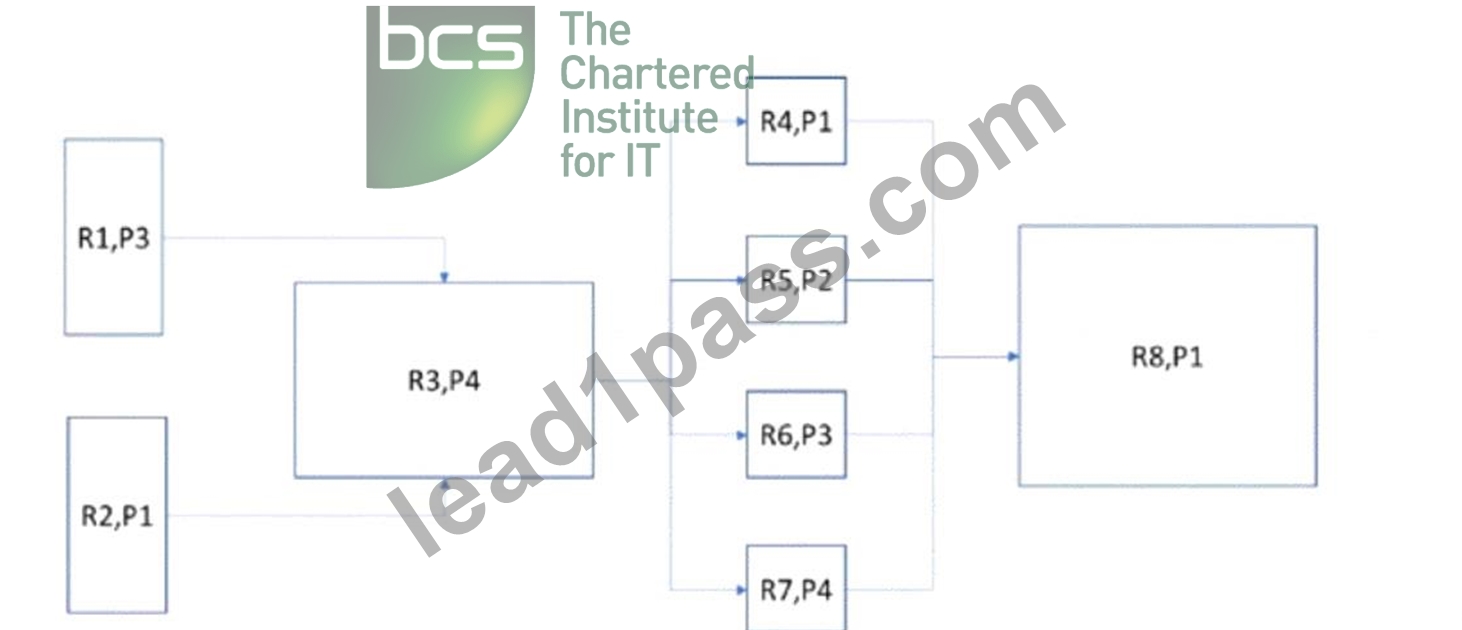
Which one of the following options best describes the test execution sequence using both requirement dependency and priority
- A. R1, R2, R3, R4, R5, R6, R7, R8.
- B. R2, R4. R8, R5, R1, R6, R3, R7.
- C. R2. R1, R3. R4. R5, R6. R7, R8.
- D. . R2, R1,R3,R7,R6,R5,R4,R8.
Answer: D
Explanation:
The correct test execution sequence should consider both the dependencies between the requirements and their priorities. According to the diagram, the sequence begins with R2 (P1) as it is a prerequisite for R3 (P4).
Then R1 (P3) can be tested. R3 follows as it depends on R2. Next, R7 (P4) should be tested before R6 (P3) and R5 (P2), as indicated by their dependencies. Finally, R4 (P1) and R8 (P1) can be tested. Therefore, the best sequence is R2, R1, R3, R7, R6, R5, R4, R8.Reference:ISTQB CTFL Syllabus V4.0, Section 5.1.5
NEW QUESTION # 17
Which one of the following statements IS NOT a valid objective of testing?
- A. To evaluate work products such as requirements, user stories, design, and code.
- B. To find all defects in a product, ensuring the product is defect free.
- C. To build confidence in the level of quality of the test object.
- D. To find failures and defects
Answer: B
NEW QUESTION # 18
Which of the following statements about the shift-left approach is FALSE?
- A. The shift-left approach can only be implemented with test automation
- B. The shift-left approach in testing is compatible with DevOps practices.
- C. The shift-left approach can involve security vulnerabilities
- D. The shift-left approach can be supported by static analysis tools.
Answer: A
Explanation:
In a formal review process, the recorder's role is typically responsible for documenting the findings of the review team, including action items, decisions, and recommendations. This ensures that there is an accurate record of what was discussed and agreed upon, facilitating follow-up and continuous improvement. Therefore, statement C is correct as per the ISTQB CTFL syllabus.
NEW QUESTION # 19
The fact that defects are usually not evenly distributed among the various modules that make up a software application, but rather their distribution tend to reflect the Pareto principle:
- A. is expressed by the testing principle referred to as Tests wear out'
- B. is a false myth
- C. is expressed by the testing principle referred to as 'Bug prediction'
- D. is expressed by the testing principle referred to as 'Defects cluster together'
Answer: D
Explanation:
The fact that defects are usually not evenly distributed among the various modules that make up a software application, but rather their distribution tend to reflect the Pareto principle, is expressed by the testing principle referred to as 'Defects cluster together'. This principle states that a small number of modules contain most of the defects detected, or that a small number of causes are responsible for most of the defects. This principle can be used to guide the test analysis and design activities, by prioritizing the testing of the most critical or risky modules, or by applying more rigorous test techniques to them. Therefore, option C is the correct answer.
References: ISTQB Certified Tester Foundation Level Syllabus v4.01, Section 1.2.1, page 11; ISTQB Glossary v4.02, page 16.
NEW QUESTION # 20
Consider the following examples of risks identified in different software development projects:
[I]. The contrast color ratio for both normal text and large text of a website does not comply with the applicable accessibility guidelines, making it difficult for many users to read the content on the pages
[II]. A development vendor fails to deliver their software system on time, causing significant delays to system integration testing activities that have been planned as part of a development project for a system of systems
[III]. People in the test team do not have sufficient skills to automate tests at the test levels required by the test automation strategy which does not allow production of an effective regression test suite
[IV]. In a web application, data from untrusted sources is not subject to proper input validation, making the application vulnerable to several security attacks Which of the following statements is true?
- A. [I] and [III] are product risks; [II] and [IV] are project risks
- B. [I] and [IV] are product risks. [II] and [III] are project risks
- C. [IV] is a product risk; [I]. [II] and [III] are project risks
- D. [II], [III] and [IV] are product risks; [I] is a project risk
Answer: B
Explanation:
This answer is correct because product risks are risks that affect the quality of the software product, such as defects, failures, or non-compliance with requirements or standards. Project risks are risks that affect the project's schedule, budget, resources, or scope, such as delays, cost overruns, skill gaps, or scope changes. In this case, [I] and [IV] are product risks, as they relate to the accessibility and security of the software product, which are quality attributes. [II] and [III] are project risks, as they relate to the delivery time and the test automation skills of the test team, which are project factors. References: ISTQB Glossary of Testing Terms v4.
0, ISTQB Foundation Level Syllabus v4.0, Section 2.1.1.1
NEW QUESTION # 21
Which of the following statements is NOT true about Configuration management and software testing?
- A. When testers report defects, they need to reference version-controlled items.
- B. Version controlled test ware increases the chances of finding defects in the software under test.
- C. Configuration management supports the build process, which is essential for delivering a test release into the test environment.
- D. Configuration management helps maintain consistent versions of software artifacts.
Answer: B
NEW QUESTION # 22
Which one of the following statements correctly describes the term 'debugging'?
- A. Debugging is of no relevance in Agile development.
- B. There is no difference between debugging and testing.
- C. Debugging is a confirmation activity that checks whether fixes resolved defects.
- D. Debugging is the development activity that finds, analyses and fixes defects.
Answer: D
NEW QUESTION # 23
Which ONE of the following options CORRECTLY describes one of the seven principles of the testing process?
- A. Exhaustive testing can only be carried out using behavior-based techniques.
- B. It is impossible to test all possible combinations of inputs and preconditions of a system.
- C. Automated testing enables exhaustive testing.
- D. The objective of testing is to implement exhaustive testing and execute as many test cases as possible.
Answer: B
Explanation:
Comprehensive and Detailed In-Depth Explanation:Exhaustive testing (testing all input combinations) is practically impossible except in trivial cases (C). Instead, testers focus on risk-based, prioritized, and efficient test techniques. The seven principles of testing in the ISTQB syllabus highlight that exhaustive testing is infeasible, and therefore, techniques such as equivalence partitioning, boundary value analysis, and risk-based testing are used to optimize test coverage.
NEW QUESTION # 24
Use Scenario 1 "Happy Tomatoes" (from the previous question).
Using theBoundary Value Analysis (BVA)technique (in its two-point variant), identify the set of input values that provides the HIGHEST coverage.
- A. {6,7,8,21,22,29,31}
- B. {7,8,21,22,29,30}
- C. {7,8,22,23,29,30}
- D. {6,7,21,22,29,30}
Answer: B
Explanation:
Comprehensive and Detailed In-Depth Explanation:Boundary Value Analysis (BVA)focuses on test cases at the edges of partitions because defects often occur at boundaries. The temperature ranges are:
* #7 (Too cold # W)
* [8-21] (Standstill # X)
* [22-29] (Ideal # Y)
* #30 (Too hot # Z)
Atwo-point BVAmeans testing both thelower and upper boundary valuesof each partition.The correct selection{7,8,21,22,29,30}includes:
* 7 # Boundary of Too Cold (W)
* 8 # Lower boundary of Standstill (X)
* 21 # Upper boundary of Standstill (X)
* 22 # Lower boundary of Ideal (Y)
* 29 # Upper boundary of Ideal (Y)
* 30 # Lower boundary of Too Hot (Z)
This ensures maximum boundary coverage.
NEW QUESTION # 25
Which of the following statements best describes how configuration management supports testing?
- A. Configuration management is an approach to interoperability testing where tests are executed in the cloud, as the cloud can provide cost-effective access to multiple configurations of the test environments
- B. Configuration management helps ensure that all relevant project documentation and software items are uniquely identified in all their versions and therefore can be unambiguously referenced in test documentation
- C. Configuration management is an administrative discipline that includes change control, which is the process of controlling the changes to identified items referred to as Configuration Items'
- D. Configuration management helps reduce testing effort by identifying a manageable number of test environment configurations in which to test the software, out of all possible configurations of the environment in which the software will be released
Answer: B
Explanation:
This answer is correct because configuration management is a process of establishing and maintaining consistency of a product's performance, functional, and physical attributes with its requirements, design, and operational information throughout its life. Configuration management helps ensure that all relevant project documentation and software items are uniquely identified in all their versions and therefore can be unambiguously referenced in test documentation. This supports testing by providing traceability, consistency, and control over the test artifacts and the software under test. Reference: : ISTQB Glossary of Testing Terms v4.0, : ISTQB Foundation Level Syllabus v4.0, Section 2.2.2.2
NEW QUESTION # 26
A Test Manager conducts risk assessment for a project. One of the identified risks is: The sub-contractor may fail to meet his commitment". If this risk materializes. it will lead to delay in completion of testing required for the current cycle.
Which of the following sentences correctly describes the risk?
- A. It is no longer a risk for the Test Manager since an independent party (the sub-contractor) is now managing it
- B. It is a object risk since successful completion of the object depends on successful and timely completion of the tests
- C. It is a product risk since any risk associated with development timeline is a product risk.
- D. It is a product risk since default on part of the sub-contractor may lead to delay in release of the product
Answer: D
Explanation:
* A product risk is a risk that affects the quality or timeliness of the software product being developed or tested1. Product risks are related to the requirements, design, implementation, verification, and maintenance of the software product2.
* The risk of the sub-contractor failing to meet his commitment is a product risk, as it could cause a delay in the completion of the testing required for the current cycle, which in turn could affect the release date of the product. The release date is an important aspect of the product quality, as it reflects the customer satisfaction and the market competitiveness of the product3.
* The other options are not correct because:
* A. It is not true that any risk associated with development timeline is a product risk. Some risks could be project risks, which are risks that affect the management or control of the software project, such as budget, resources, schedule, or communication1. For example, a risk of losing a key project stakeholder is a project risk, not a product risk.
* B. It is not true that the risk is no longer a risk for the Test Manager since an independent party is managing it. The Test Manager is still responsible for ensuring that the testing activities are completed according to the test plan and the quality objectives4. The Test Manager should monitor and control the sub-contractor's performance and communicate with him regularly to identify and mitigate any potential issues or deviations5.
* C. It is not clear what is meant by "object" in this option, but it could be interpreted as the software system under test or the test object6. In any case, the risk is not an object risk, as it does not affect the successful completion of the object, but rather the successful completion of the testing of the object. An object risk could be a risk that affects the functionality, reliability, usability, efficiency, maintainability, or portability of the software system under test2. For example, a risk of the software system having a high complexity or a low testability is an object risk, not a product risk.
References =
* 1 ISTQB Certified Tester Foundation Level Syllabus v4.0, 2023, p. 97
* 2 ISTQB Certified Tester Foundation Level Syllabus v4.0, 2023, p. 98
* 3 ISTQB Certified Tester Foundation Level Syllabus v4.0, 2023, p. 99
* 4 ISTQB Certified Tester Foundation Level Syllabus v4.0, 2023, p. 100
* 5 ISTQB Certified Tester Foundation Level Syllabus v4.0, 2023, p. 101
* 6 ISTQB Certified Tester Foundation Level Syllabus v4.0, 2023, p. 102
NEW QUESTION # 27
A company wants to reward each of its salespeople with an annual bonus that represents the sum of all the bonuses accumulated for every single sale made by that salesperson. The bonus for a single sale can take on the following four values: 3%, 5%, 7% and 10% (the percentage refers to the amount of the single sale).
These values are determined on the basis of the type of customer (classified as "Basic" or "Premium") to which such sale was made, and on the amount of such sale classified into the following three groups G1, G2 and G3:
* [G1]: less than 300 euros
* [G2]: between 300 and 2000 euros
* [G3]: greater than 2000 euros
Which of the following is the minimum number of test cases needed to cover the full decision table associated with this scenario?
- A. 0
- B. 1
- C. 2
- D. 3
Answer: B
Explanation:
The minimum number of test cases needed to cover the full decision table associated with this scenario is 6.
This is because the decision table has 4 conditions (type of customer and amount of sale) and 4 actions (bonus percentage). The conditions have 2 possible values each (Basic or Premium, and G1, G2 or G3), so the total number of combinations is 2 x 2 x 2 x 2 = 16. However, not all combinations are valid, as some of them are contradictory or impossible. For example, a sale cannot be both less than 300 euros and greater than 2000 euros at the same time. Therefore, we need to eliminate the invalid combinations and keep only the valid ones. The valid combinations are:
Type of customer
Amount of sale
Bonus percentage
Basic
G1
3%
Basic
G2
5%
Basic
G3
7%
Premium
G1
5%
Premium
G2
7%
Premium
G3
10%
These 6 combinations cover all the possible values of the conditions and actions, and they are the minimum number of test cases needed to cover the full decision table.
References: ISTQB Certified Tester Foundation Level (CTFL) v4.0 sources and documents,
NEW QUESTION # 28
Exploratory testing is an experience-based test technique
- A. That can be organised into sessions guided by test charters outlining test objectives that will guide the testers' exploration
- B. Where a developer and a tester work together on the same workstation while the developer actively writes code, the tester explores the code to find defects.
- C. Where a team of testers explores all possible test techniques in order to determine the most suitable combination of these techniques to apply for a test project.
- D. That aims at finding defects by designing tests that exercise all possible combinations of input values and preconditions
Answer: A
Explanation:
Exploratory testing is an experience-based test technique where testers actively engage with the software, learning about its behavior while simultaneously designing and executing tests. According to the ISTQB CTFL syllabus, exploratory testing can be structured into sessions guided by test charters, which outline the test objectives and provide direction for the testers' exploration. This method is particularly useful in situations where test documentation is limited or where rapid feedback is needed. Thus, option B correctly describes how exploratory testing can be organized.
NEW QUESTION # 29
Which of the following are the phases of the ISTQB fundamental test process?
- A. Test planning. Test specification and design. Test implementation and execution. Evaluating exit criteria and reporting. Retesting and test closure activities
- B. Test planning and control, Test analysis and design, Test implementation and execution, Evaluating ex t criteria and reporting. Test closure activities
- C. Test planning, Test analysis and design. Test implementation and control. Checking test coverage and reporting, Test closure activities
- D. Test planning and control, Test specification and design. Test implementation and execution, Evaluating test coverage and reporting, Retesting and regression testing, Test closure activities
Answer: B
Explanation:
The ISTQB fundamental test process consists of five main phases, as described in the ISTQB Foundation Level Syllabus, Version 4.0, 2018, Section 2.2, page 15:
* Test planning and control: This phase involves defining the test objectives, scope, strategy, resources, schedule, risks, and metrics, as well as monitoring and controlling the test activities and results throughout the test process.
* Test analysis and design: This phase involves analyzing the test basis (such as requirements, specifications, or user stories) to identify test conditions (such as features, functions, or scenarios) that need to be tested, and designing test cases and test procedures (such as inputs, expected outcomes, and execution steps) to cover the test conditions. This phase also involves evaluating the testability of the test basis and the test items (such as software or system components), and selecting and implementing test techniques (such as equivalence partitioning, boundary value analysis, or state transition testing) to achieve the test objectives and optimize the test coverage and efficiency.
* Test implementation and execution: This phase involves preparing the test environment (such as hardware, software, data, or tools) and testware (such as test cases, test procedures, test data, or test scripts) for test execution, and executing the test procedures or scripts according to the test plan and schedule. This phase also involves logging the outcome of test execution, comparing the actual results with the expected results, and reporting any discrepancies as incidents (such as defects, errors, or failures).
* Evaluating exit criteria and reporting: This phase involves checking if the planned test activities have been completed and the exit criteria (such as quality, coverage, or risk levels) have been met, and reporting the test results and outcomes to the stakeholders. This phase also involves making recommendations for the release or acceptance decision based on the test results and outcomes, and identifying any residual risks (such as known defects or untested areas) that need to be addressed or mitigated.
* Test closure activities: This phase involves finalizing and archiving the testware and test environment for future reuse, and evaluating the test process and the test project against the test objectives and the test plan. This phase also involves identifying any lessons learned and best practices, and communicating the findings and suggestions for improvement to the relevant parties.
References = ISTQB Certified Tester Foundation Level Syllabus, Version 4.0, 2018, Section 2.2, page 15; ISTQB Glossary of Testing Terms, Version 4.0, 2018, pages 37-38; ISTQB CTFL 4.0 - Sample Exam - Answers, Version 1.1, 2023, Question 88, page 32.
NEW QUESTION # 30
Which two of the following statements describe the advantages provided by good traceability between the test basis and test work products?
I . Analyzing the impact of changes.
ii . A measure of code quality.
iii . Accurate test estimation.
iv . Making testing auditable.
Select the correct answer:
- A. i and iii
- B. ii and iii
- C. i and ii
- D. i and iv
Answer: D
Explanation:
Good traceability between the test basis and test work products provides several advantages: i. Analyzing the impact of changes: Traceability allows for easy identification of which parts of the test work products will be affected by changes in the requirements or design, facilitating impact analysis. iv . Making testing auditable: Traceability ensures that there is a clear connection between the requirements and the test cases, which makes the testing process auditable and provides evidence that all requirements have been tested.
NEW QUESTION # 31
Select which of the following statements describe the key principles of software testing?
i. Testing shows the presence of defects, not their absence.
ii. Testing everything Is possible.
iii. Early testing Is more expensive and is a waste of time.
iv. Defects cluster together.
v. Testing is context dependent.
vi. Beware of the pesticide paradox.
vii. Absence of errors is a fallacy.
Select the correct answer:
- A. i, iv, v, vi and vii
- B. ii, iii, iv, v and vi
- C. I, ii, v. vi and vii
- D. iii. iv, v. vi and vii
Answer: A
Explanation:
The key principles of software testing include: i. Testing shows the presence of defects, not their absence. iv.
Defects cluster together. v. Testing is context dependent. vi. Beware of the pesticide paradox. vii. Absence of errors is a fallacy. These principles highlight the importance of recognizing the limitations and context of testing, as well as the potential for repeated tests to become less effective.
NEW QUESTION # 32
Which of the following coverage criteria results in the highest coverage for state transition based test cases?
- A. Covering only start and end states
- B. Can't be determined
- C. Covering all states at least once
- D. Covering all transitions at least once
Answer: D
Explanation:
Covering all transitions at least once is the highest coverage criterion for state transition based test cases, because it ensures that every possible change of state is tested at least once. This means that all the events that trigger the transitions, as well as the actions and outputs that result from the transitions, are verified. Covering all transitions at least once also implies covering all states at least once, but not vice versa. Therefore, option D is not the highest coverage criterion. Option C is the lowest coverage criterion, because it only tests the initial and final states of the system or component, without checking the intermediate states or transitions. Option A is incorrect, because the coverage criteria for state transition based test cases can be determined and compared based on the number of transitions and states covered. Reference = CTFL 4.0 Syllabus, Section 4.2.3, page 49-50.
NEW QUESTION # 33
......
Tested Material Used To CTFL4 Test Engine: https://www.lead1pass.com/BCS/CTFL4-practice-exam-dumps.html
Steps Necessary To Pass The CTFL4 Exam: https://drive.google.com/open?id=1nj3U9gDvjHpI_J2w6zx3Ab6CyejzSXui