

Get 100% Success with Latest Java and Middleware 1Z1-591 Exam Dumps Jan 16, 2026
The Best 1Z1-591 Exam Study Material and Preparation Test Question Dumps
NEW QUESTION # 67
Cache in OBIEE is used to_____. Select the two correct answers.
- A. improve performance of Dashboards and Analysis
- B. decrease query response time
- C. improve Analysis data quality
- D. create Aggregate tables
- E. eliminate Write Back Capabilities
Answer: A,B
Explanation:
Decrease query response time which will improve performance for Dashboards and Analysis.
NEW QUESTION # 68
A company's Database Administrator has divided the region table into two tables so that the region "West" is in one table and all the other regions are in another single table. What kind of partition is being used?
- A. Mixed
- B. Time-based
- C. Fact-based
- D. Complex
Answer: D
Explanation:
Explanation
You have three sort of fragmentation:
Fact-based / Dimension-based fragmentation
Content-based / Value-based fragmentation
Level-based fragmentation / aggregate navigation
You can combine the techniques above to construct powerful design that are known as Complex partitioning / fragmentation. When you fragment a dimension, you are automatically in a complex fragmentation.
NEW QUESTION # 69
Under what circumstances would you model within the BI environment to include transactional data directly?
- A. When the customer is not prepared to spend budget on data-warehousing
- B. When the complexity of operational schema does not allow modeling in the BI repository
- C. When it is not possible to query against a transactional system
- D. When the customer needs near real-time data to support decision making in a fast changing environment
Answer: D
NEW QUESTION # 70
One of the initial phases in OBIEE implementation is the Discovery phase where the project team focuses on a few activities. Which option is not one of them?
- A. Technical Requirements Definition
- B. Business RequirementsDefinition
- C. Data Quality Assessment
- D. DashboardTesting
Answer: A
NEW QUESTION # 71
To add multiple sources to on existing logical table dimension in the Business Model and Mapping layer, the source of the data must first exist in which option?
- A. Web Catalog
- B. Presentation Layer
- C. Business Aggregate Layer
- D. Physical Layer
Answer: D
Explanation:
Explanation/Reference:
Note:
At the highest level, an OBIEE Metadata Repository includes three layers of information:
1. First, a Physical layer is defined. The metadata layer identifies the source data.
2.Second, a Business Model and Mapping layer is defined. This metadata layer organizes the physical layer into logical categories and records the appropriate metadata for access to the source data.
3.Finally, the Presentation layer is defined. This metadata layer exposes the business model entities for end-user access.
NEW QUESTION # 72
An organization has re-implemented one of its systems but has not moved history. One database has data for all years up to 2010 and the other has data for years from 2011 to the present. The organization needs data from the years 2010 and 2011 on a single report. How can you model this in the RPD?
- A. By creating two logical table sources and checking the "This Source should be combined with other sources at this level" box leaving the Fragmentation content area blank.
- B. By creating joins in the physical model so it looks like a single table
- C. By creating two logical table sources, that specify in Content tab using the Fragmentation content areas to specify the years for each source
- D. By creating one logical table sources and checking the "This Source should be combined with other sources at this level" box
- E. By creating two Logical Fact Tables for each database
Answer: C
Explanation:
Explanation/Reference:
Note: This source should be combined with other sources at this level (check box) Description: Check this box when data sources at the same level of aggregation do not contain overlapping information. In this situation, all sources must be combined to get a complete picture of information at this level of aggregation.
Note 2: To use a source correctly, the Analytics Server has to know what each source contains in terms of the business model. Therefore, you need to define aggregation content for each logical table source of a fact table.
The aggregation content rule defines at what level of granularity the data is stored in this fact table.
Use the Content tab of the Logical Table Source dialog box to define any aggregate table content definitions, fragmented table definitions for the source, and Where clauses (if you want to limit the number of rows returned).
Reference: Siebel Business Analytics Server Administration Guide > Creating and Administering the Business Model and Mapping Layer in a Repository > Creating and Administering Logical Table Sources (Mappings) > Defining Content of Logical Table Sources
NEW QUESTION # 73
One benefit of adding a second table source that is joined to the first table source in the Physical Layer by a foreign key relationship is that______.
- A. Two SQL queries are performed to get data from both tables
- B. No SQL queries are performed against the source tables
- C. Multiple SQL queries are performed
- D. A single SQL query is performed to get data from both tables
Answer: D
Explanation:
A single query can be performed accessing data from both tables through a join on the columns in the foreign key relation.
NEW QUESTION # 74
Which option describes how OBIEE Integrates with Planning?
- A. Planning is not a supported OBIEE source.
- B. OBIEE integrates with Planning directly through relational database access.
- C. OBIEE primarily accesses Planning using standard Essbase integration techniques.
- D. OBIEE provides complete access to all Planning data through the Analytic Data Model (ADM) layer.
Answer: C,D
Explanation:
Explanation/Reference:
A:
* Combining Relational and OLAP Data Sources: Oracle's Common Enterprise Information Model allows users to combine data from a relational system and an OLAP source in a single calculation. For example, a user can compare sales forecasts from an Oracle CRM System with budget data from an Oracle Essbase planning application. To clients of the Common Enterprise Information Model, the forecast and budget data appear to be from the same logical source.
* The Essbase server provides advanced multi-user read and write capabilities, including data update and multi-user recalculation. Business users with front-end tools can write data back to a server and recalculate the data on a server using calculation scripts-key functionality to support sophisticated modeling and planning applications.
* Using aggregate storage, Essbase serves a wide range of analytic needs-financial analysis, planning, budgeting, sales analysis, marketing analysis, supply-chain analysis, and profitability analytics-all from a single analytic infrastructure.
B:
Note: The Analytic Data Model (ADM) is an API used to access OLAP data and metadata. ADM is similar to JDBC, providing a single common API that hides most differences between OLAP data sources.
Note 2: Data model for business intelligence
The most important component of business intelligence is the concept of 'data model'. data model determinde what kind of analysis that end user could do with the data. It is also an independant concept that could span across different vendor 's product.
Unlike data model of the transaction system, the typical analytic data model is often denormalized and store extra data for analytic query and better query performance while transaction data model use is often normalized and optimized for a few data read and write, which is implemented by jointing many tables.
The most common used analytic data model in business intelligence is call the 'Star schema' data model.
With the Oracle business intelligence system, We could define star schema and dimension data model in the 'logical layer' in the admin tools. The data model in OBIEE could span different data source in physical layer, which means OBIEE have the capability of building one logical data model which is actually connect to different database in the backend
NEW QUESTION # 75
Identify the correct mode to use when opening the web catalog while performing security settings modifications and migrations.
- A. UnManaged
- B. Offline
- C. Online
- D. Managed
Answer: C
Explanation:
In online mode, you connect to a catalog on a running web server. In this mode your permissions are applied, you can select a locale, and you can see the effects of any localization on the catalog. You can see only those objects for which you have the appropriate permissions. Both Presentation Services and the web server must be running for you to open catalogs in online mode.
Use online mode when you want to make minor incremental changes or additions to the catalog, such as changes to permissions, updates to a single object, or migration of new objects to a production environment.
Note:
* You can open a catalog in one of two modes - online or offline. Both modes can operate against an actual production catalog, with no need for any downtime.
* Repository changes can be done in either online
or offline mode. Online mode is when BI Server
is actively reading the repository file (when a
user is logged in). Offline is when BI Server is
idle. Best practice is to develop in Offline mode.
Minor changes can be made when in online
mode.
NEW QUESTION # 76
What would you use to customize the text elements that appear on BI Analysis, Delivers and Dashboard pages?
- A. XMLMessage Files
- B. BI Presentation services web template
- C. DHMLMessage files
- D. Cascading Style Sheets
Answer: D
Explanation:
You can control the way that the interface for Oracle BI EE is displayed to users by creating skins and styles.
While skins and styles are typically used to customize the look and feel of analyses and dashboards by providing logos, color schemes, fonts, table borders, and other elements, they can also be used to control the position and justification of various elements by including specialized style tags in the relevant style sheet (.css) file.
You can check the directory skin location with a right click on a OBIEE dashboard page, select show source code and search "custom.css".
NEW QUESTION # 77
The Consistency Checker checks______.
- A. For objects deleted from the database
- B. The validity of objects outside the metadata using the connection
- C. Mappings to the physical objects
- D. Syntax errors in derived logical columns
Answer: C
Explanation:
Explanation/Reference:
Consistency check is one of the process to check whether a repository is yielding proper results in Answer reports. It checks whether;
* All logical columns are mapped correctly to physical columns (B).
* All logical dimension tables have a logical key.
* There are at least two logical tables in the business model; one is a logical fact table, the other is logical dimension table with join condition.
* There are no circular logical join relationships.
* A presentation catalog exists for the business model.
NEW QUESTION # 78
How will you model a Type II Slowly-Changing Dimension?
- A. Overwrite an existing dimension table record with the changed record
- B. Do Nothing
- C. Add a new row to the dimension table with a new key for the changed record
- D. Add an additional column to the dimension table to capture a version of change
Answer: C
Explanation:
Dimensional Modeling - Slowly Changing Dimensions
*Type 1 - Overwrite Original Value A change does not require tracking
*Type 2 - Add a new record With Type II SCD, a new version of the dimension record (row) is created, and the existing version is marked as history. Each row does not correspond to a different instance of an entity but a different "state", a "snapshot" of the instance at a point in time.
Note: Tracking changes in dimension is referred in datawarehousing as slowly changing dimensions.
In the source system a lot of changes are daily made :
new customers are added,
addresses are modified,
new regional hierarchies are implemented,
or simply the product descriptions and packaging change.
These sorts of changes need to be reflected in the dimension tables and in several cases, the
history of the changes also needs to be tracked.
By remembering history, we are then able to look at historical data and compare it to their current
situation.
NEW QUESTION # 79
If a customer is planning on building a data warehouse, how would you describe data warehousing to the customer?
- A. Data warehouse projects are usually implemented within two weeks.
- B. The data in the data warehouse describes events and statuses of business processes, products and services, goals and organizational units, and generally mirrors every aspect of the structure and behavior of the organization.
- C. Application based data warehouses can be bought off the shelf and used without any tweaking.
- D. Data warehouses can only be based on multidimensional data modeling.
Answer: B
Explanation:
A data warehouse is a database used for reporting and data analysis. It is a central repository of data which is created by integrating data from multiple disparate sources. Data warehouses store current as well as historical data and are commonly used for creating trending reports for senior management reporting such as annual and quarterly comparisons.
NEW QUESTION # 80
Which option describes how OBIEE Integrates with Planning?
- A. Planning is not a supported OBIEE source.
- B. OBIEE integrates with Planning directly through relational database access.
- C. OBIEE primarily accesses Planning using standard Essbase integration techniques.
- D. OBIEE provides complete access to all Planning data through the Analytic Data Model (ADM) layer.
Answer: C,D
Explanation:
Explanation/Reference:
A:
* Combining Relational and OLAP Data Sources: Oracle's Common Enterprise Information Model allows users to combine data from a relational system and an OLAP source in a single calculation. For example, a user can compare sales forecasts from an Oracle CRM System with budget data from an Oracle Essbase planning application. To clients of the Common Enterprise Information Model, the forecast and budget data appear to be from the same logical source.
* The Essbase server provides advanced multi-user read and write capabilities, including data update and multi-user recalculation. Business users with front-end tools can write data back to a server and recalculate the data on a server using calculation scripts-key functionality to support sophisticated modeling and planning applications.
* Using aggregate storage, Essbase serves a wide range of analytic needs-financial analysis, planning, budgeting, sales analysis, marketing analysis, supply-chain analysis, and profitability analytics-all from a single analytic infrastructure.
B:
Note: The Analytic Data Model (ADM) is an API used to access OLAP data and metadata. ADM is similar to JDBC, providing a single common API that hides most differences between OLAP data sources.
Note 2: Data model for business intelligence
The most important component of business intelligence is the concept of 'data model'. data model determinde what kind of analysis that end user could do with the data. It is also an independant concept that could span across different vendor 's product.
Unlike data model of the transaction system, the typical analytic data model is often denormalized and store extra data for analytic query and better query performance while transaction data model use is often normalized and optimized for a few data read and write, which is implemented by jointing many tables.
The most common used analytic data model in business intelligence is call the 'Star schema' data model.
With the Oracle business intelligence system, We could define star schema and dimension data model in the
'logical layer' in the admin tools. The data model in OBIEE could span different data source in physical layer, which means OBIEE have the capability of building one logical data model which is actually connect to different database in the backend
NEW QUESTION # 81
What is the process in which there is redundancy of data to improve performance?
- A. Normalization
- B. Cardinality
- C. Granularity
- D. Denormalization
- E. Redundancy
Answer: D
Explanation:
Denormalization is the process of intentionally backing away from normalization to improve performance by suppressing join and permitting the use of star transformation technique.
Denormalization should not be the first choice for improving performance and should only be used for fine tuning of a database for a particular application.
NEW QUESTION # 82
Which option is used to enter the rank function when creating a new rank measure?
- A. Web Catalog
- B. Expression Builder
- C. Connection Pool
- D. Initialization Block
Answer: B
Explanation:
Explanation
Example (see step 4 and 5 below): Getting Top-N Sales Reps for Year and Year-1
1. Under the "Business Model and Mapping" Layer, right click the "F1 Revenue" and select "New Object" ->
"Logical Column..."
2. In the "Logical Column" Window give for Name: Year Ago Revenue as seen below:
http://obiee2go.files.wordpress.com/2012/05/hfhdgjbj.png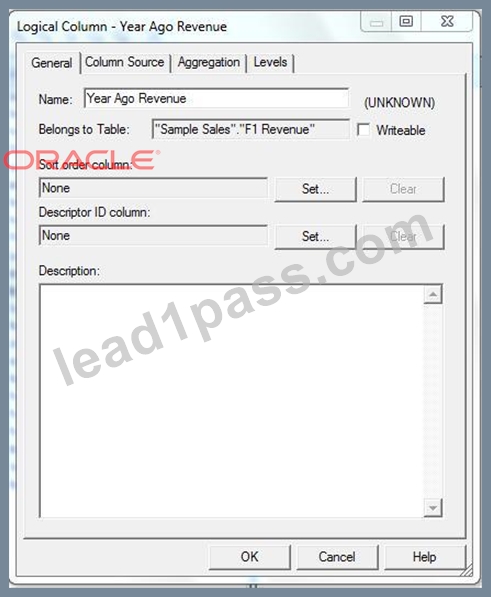
3. Goto the "Column Source" Tab and select "Derived from existing columns using an expression" radio button then click on the "Edit Expression" icon.
4. Enter the following expression in the "Expression Builder" Window by selecting "Functions" in the
"Category:" list, "Time Series Functions" in the "Functions:" list then "Ago" "Time Series Functions:" section.
5. Select the "<<Measure>>" in the "Ago( )" function, then select "Logical Tables" in the "Category:" list,
"F1 Revenue" in the "Logical Tables:" list, then double click the "Revenue" in the "Columns:" list.
Etc.
NEW QUESTION # 83
When designing a Star Schema, which option does not apply?
- A. Dimensional tables have one attribute primary key as Product_ID for products.
- B. The fact has several foreign keys that are primary keys in the dimensional table
- C. Dimensional tables are normalized.
- D. The facts are quantifiable.
- E. Fact table is joined to the related dimensional tables.
Answer: C
Explanation:
Explanation/Reference:
In a Star Schema the dimensional tables does not need to be normalized.
A Snowflake Schema is a modified Star Schema that has normalized the dimensional tables.
Incorrect answers:
B: A star schema is a dimensional schema with a single fact table that has foreign key relationships with several dimension tables.
C, E: A star join is a primary key to foreign key join :
* of the dimension tables
* to a fact_table.
See picture below: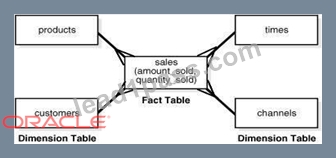
NEW QUESTION # 84
To add multiple sources to on existing logical table dimension in the Business Model and Mapping layer, the source of the data must first exist in which option?
- A. Web Catalog
- B. Presentation Layer
- C. Business Aggregate Layer
- D. Physical Layer
Answer: D
Explanation:
Note:
At the highest level, an OBIEE Metadata Repository includes three layers of information:
1.
First, a Physical layer is defined. The metadata layer identifies the source data.
2.Second, a Business Model and Mapping layer is defined. This metadata layer organizes the physical layer into logical categories and records the appropriate metadata for access to the source data.
3.Finally, the Presentation layer is defined. This metadata layer exposes the business model entities for end- user access.
NEW QUESTION # 85
You do not have a physical time table in your database but would like to use the time series functions that OBIEE offers. What two options do you have?
- A. Create a physical time table in your database.
- B. Create a time table that is joined through a intervening Table so there is no foreign key relationship.
- C. Create a Logical Table that is sourced from the time key in the fact table.
- D. Create a Logical Table that is sourced from a time field in one of your dimension tables.
- E. Create an "Opaque View" in the physical layer that contains the time columns from the fact and map it into your physical model.
Answer: A,D
Explanation:
Modeling Time Series Function in OBIEE
Modeling Time Series Data
Time series functions provide the ability to compare business performance with previous time periods, allowing you to analyze data that spans multiple time periods. For example, time series functions enable comparisons between current sales and sales a year ago, a month ago, and so on.
Because SQL does not provide a direct way to make time comparisons, you must model time series data in the Oracle BI repository. First, set up time dimensions based on the period table in your data warehouse. Then, you can define measures that take advantage of this time dimension to use the AGO, TODATE, and PERIODROLLING functions.
NEW QUESTION # 86
There are two aggregate tables that are available for query. How would they be mapped into the logical data model so queries can use them?
- A. Both A and B
- B. By creating two new logical tables sources
- C. By creating one new Logical Table Source
- D. By opening the two logical Table Source dialog boxes and mapping the appropriate levels in the Content tab
Answer: D
Explanation:
B: Example:
1. Configure the new source table to have the 'logical level' under the content set to 'Countries' (the summarized level)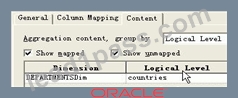
b
2. Do the similiar setting for dimension table
Now when user query the data at 'Counties' level, the query will be redirected to these summary table instead of the more detail fact table Note: Aggregate tables are Physical tables that store Aggregates of measures across multiple levels of a Hierarchy.
NEW QUESTION # 87
If you have a database with four aggregate tables, how should the repository be configured to take advantage of the aggregates?
- A. By creating four new logical table sources and using the Fragmentation content to specify the aggregation levels
- B. By creating four new logical table sources and choosing each dimension's level of aggregation in the Content tab
- C. By creating four new logical tables sources
- D. By creating four new logical table sources and using the "where" section of the Content tab to specify the aggregation levels
Answer: B
Explanation:
Explanation/Reference:
Content Tab
Aggregation Content
You can define the aggregation (ie the group by) of:
by hierarchy level
by logical column
It helps you to define an aggregate navigation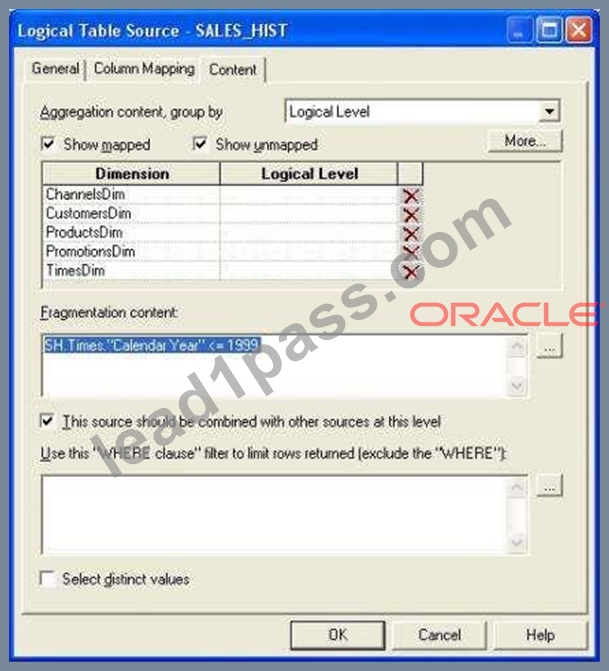
Note: logical table source
Logical table sources define the mappings from a single logical table to one or more physical tables. A logicaltable contains one or more logical table source. The mapping between physical columns and logical columns are done in this element.
The definition of the logical table source is used:
to specify transformations/calculations (in the column mapping tab),
to enable aggregate navigation and fragmentation (in the content tab)
The Content tab of the Logical Table Source is used to define :
any aggregate table content definitions (specify the grain of the physical tables), fragmented table definitions for the source, and WHERE clauses (if you want to limit the number of rows returned).
NEW QUESTION # 88
A customer needs to do a cross database join between two tables where, one of the tables has a small number of values and the other has a large number of values. How can you optimize the way the BI Server processes the query?
- A. By creating your logical join by using the Joins Manager
- B. By specifying a driving table
- C. By specifying a many to one join between the tables with the small and large numbers of values
- D. By specifying a one-to-many join between the tables with the small and large numbers of values
- E. By creating your joins by using the Business Model Diagram
Answer: B
Explanation:
Explanation/Reference:
You can specify a Driving table parameter in a complex join.
Driving tables are for use in optimizing the manner in which the Oracle BI Server processes cross- database joins when one table is very small and the other table is very large.
The BI Server will query the driving table (the small one) and will get a list of values. The BI Server will then generate a second SQL using a parameterized IN list with the values from the first query.
Specifying driving tables leads to query optimization only when the number of rows being selected from the driving table is much smaller than the number of rows in the table to which it is being joined.
NEW QUESTION # 89
OBIEE 11g authentication of users is performed by which two components listed below?
- A. Embedded WebLogic LDAP server
- B. Repository file (rpd)
- C. BI Presentation Services
- D. External directories such as Active Directory using WebLogic and Fusion Middleware's Oracle Platform Security Services framework
Answer: A,D
NEW QUESTION # 90
What are the two types of Repository Variables?
- A. Non System
- B. Dynamic
- C. System
- D. Static
Answer: B,D
Explanation:
Explanation
There are static and dynamic repository variables.
Note:
Variables in the Oracle BI Server can be either repository or session variables, and are defined using the Variable Manager within the Oracle BI Administrator (Manage > Variables).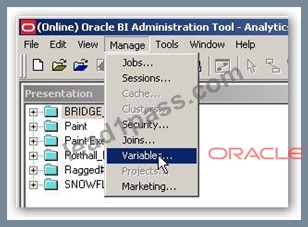
Variable1
This brings up the Variable Manager, that divides variables out into repository and session variables, with a further subdivision into static and dynamic repository ones and system and non-system session ones. You can also define variables at the Presentation Server level, these are scoped to individual dashboards and are used amongst other things for setting dashboard prompt values and integrating the dashboard with BI Publisher parameters. Here's a screenshot of a typical Variable Manager screen.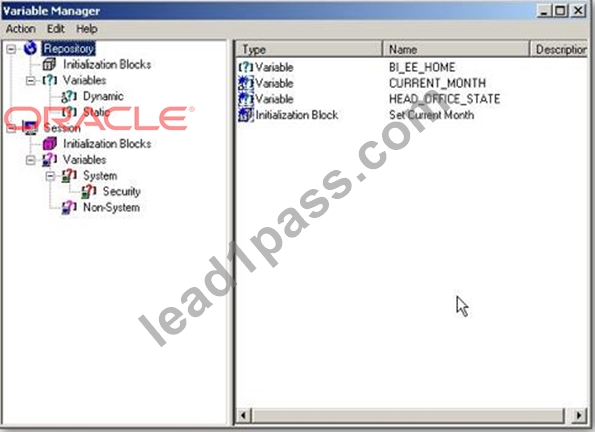
Variable2
NEW QUESTION # 91
......
Achieving the Oracle Business Intelligence Foundation Suite 11g Essentials certification is a great way to demonstrate your knowledge and skills in the field of business intelligence. It is also a valuable credential that can help you advance your career and increase your earning potential. With this certification, you will be able to demonstrate to potential employers that you are a highly skilled and knowledgeable professional who can create advanced business intelligence solutions using Oracle Business Intelligence Foundation Suite 11g.
Get Ready to Pass the 1Z1-591 exam Right Now Using Our Java and Middleware Exam Package: https://www.lead1pass.com/Oracle/1z1-591-practice-exam-dumps.html
Enhance Your Career With Available Preparation Guide for 1Z1-591 Exam: https://drive.google.com/open?id=19V7mqRpD90T8NSl8y2B_Qcy0qYMA2eGe