

2026 Latest HPE7-J02 Exam Dumps Recently Updated 52 Questions
HP HPE7-J02 Real 2026 Braindumps Mock Exam Dumps
NEW QUESTION # 29
Which statement is correct when enabling port trunking (FC ISL / Ethernet link aggregation)?
- A. Ports need to belong to the same port group of the switch.
- B. Port Trunking is supported by default on every B-Series FC switch.
- C. The port speed of the trunk ports can be different based on the used switches in the ISL group.
- D. For optimal performance, no more than 100 meters of cable length difference is acceptable.
Answer: A
Explanation:
Detailed Explanation:
Rationale for Correct Answer:
In B-Series (Brocade) SAN switches, trunking requires that all ports in a trunk group belong to the same port group (same ASIC) and run at the same speed. This ensures frame ordering and load balancing across ISLs.
Distractors:
A: Incorrect - cable length differences must be minimal, but not stated in meters like this.
C: Incorrect - speeds must match across all trunked ports.
D: Trunking requires a license on some Brocade models; not always enabled by default.
Key Concept: Port trunking requires same port group and same speed.
Reference: HPE B-Series SAN Switch Trunking Best Practices.
NEW QUESTION # 30
Exhibit shows HPE StoreOnce Catalyst Store Security Settings: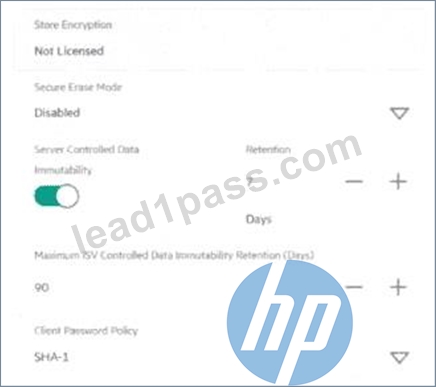
Server Controlled Data Immutability enabled (7 days).
Maximum ISV Controlled Data Immutability Retention (90 days).
Which statement is correct?
- A. Server-Controlled and ISV-Controlled Data Immutability values do not need to match when both are configured.
- B. The Maximum ISV Controlled Data Immutability Retention parameter must be set to 0 for optimal Veeam v12 support.
- C. Maximum ISV Controlled Data Immutability Retention allows the ISV backup application to manage item-level immutability.
- D. Server-Controlled Data Immutability is required to achieve the highest immutability with Veeam v12 backups.
Answer: C
NEW QUESTION # 31
You are sizing an HPE Alletra 5030. Unless otherwise indicated by the HPE sizer or the customer's requirements, HPE best practices state that you should default to which minimum FDR calculation?
- A. 23% of the largest drive size
- B. Above 12% for low-read latency
- C. 23% of the smallest drive size
- D. Below 12% for low-read latency
Answer: A
Explanation:
Detailed Explanation:
Rationale for Correct Answer:
In Alletra 5000/6000 sizing, the Failure Domain Reserve (FDR) is used to account for rebuild overhead in case of drive failure. HPE best practices define that, unless otherwise directed by the sizing tool or customer requirements, the minimum FDR value should be set to 23% of the largest drive size. This ensures enough reserve capacity for fault tolerance and sustained performance during rebuilds.
Distractors:
B/C: Low-read latency is influenced by cache and workload profile, not by arbitrary FDR percentages.
D: Using the smallest drive is incorrect - rebuild impact must be sized against the largest drive.
Key Concept: FDR sizing based on 23% of largest drive = HPE best practice.
Reference: HPE Alletra 5000/6000 Sizing and Configuration Guide.
NEW QUESTION # 32
You are sizing an HPE Alletra Storage MP B10000 array (graphic provided).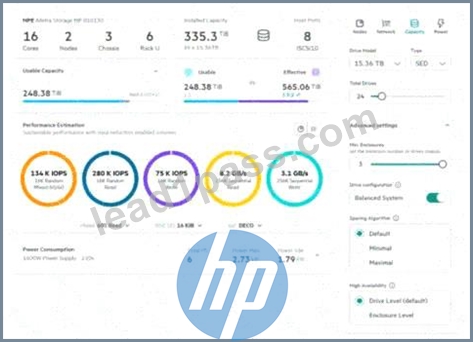
What happens when the High Availability (HA) option is switched from Drive Level to Enclosure Level?
- A. The Enclosure Level option is only available with a switched configuration
- B. The Usable Capacity for the array decreases when selecting Enclosure Level HA
- C. The Enclosure Level option is not possible with the current number of disk enclosures
- D. The estimated performance decreases due to lower IOPS and GB/s values
Answer: B
Explanation:
Detailed Explanation:
Rationale for Correct Answer:
Changing HA from Drive Level to Enclosure Level means the system must reserve additional capacity to tolerate the loss of an entire disk enclosure. This decreases usable capacity, as more parity/spare space is required. Performance remains similar, but capacity overhead increases.
Distractors:
A: Multiple enclosures exist in the config; option is valid.
B: Switched vs direct-connect is unrelated to HA settings.
C: Performance estimates are not directly reduced by HA level change; capacity is.
Key Concept: Enclosure HA = more reserve overhead # less usable capacity.
Reference: HPE Alletra MP Sizing Tool User Guide.
NEW QUESTION # 33
A growing technology company is planning to upgrade its data center infrastructure. Their considerations:
Budget: Predictable monthly payments, no upfront CapEx.
Flexibility: Long-term use, no forced returns.
Ownership: Prefer eventual ownership, spread payments.
Control: Full customization and upgrades.
Which procurement option best meets their needs?
- A. Consumption based
- B. Capital lease
- C. Capital purchase
- D. Operating lease
Answer: B
Explanation:
Detailed Explanation:
Rationale for Correct Answer:
A Capital Lease (also known as a finance lease) spreads costs over time like OpEx, while giving the customer the ability to own the equipment at the end of the lease term. This matches the desire for predictable payments, eventual ownership, and full control.
Distractors:
A (Consumption model): GreenLake provides OpEx flexibility but does not lead to ownership.
B (Operating lease): Pure rental; equipment must be returned, no ownership.
C (Capital purchase): Requires large upfront payment, which the customer wants to avoid.
Key Concept: Capital Lease = predictable payments + ownership path.
Reference: HPE Financial Services Procurement Options.
NEW QUESTION # 34
Review the diagram showing an Active Peer Persistence deployment across two arrays.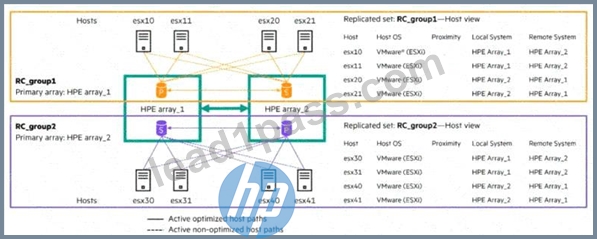
Question: Which Host Proximity Parameter should be configured for ESX31 to ensure localized access?
- A. Primary
- B. Exclusive
- C. Secondary
- D. All
Answer: C
NEW QUESTION # 35
You are migrating your customer's virtualization platform from an old third-party storage array to a newly installed HPE Alletra MP B10000 array. You are using HPE Zerto Move for the migration.
Which statement is correct when using HPE Zerto Move compared to the typical Failover feature?
- A. The migration results in an RPO and RTO of seconds
- B. You can keep the source VMs after the migration
- C. The source VMs are deleted automatically after the migration
- D. The Zerto Checkpoint (and RPO) is user-selectable during the move
Answer: B
Explanation:
Detailed Explanation:
Rationale for Correct Answer:
When using Zerto Move, unlike a typical disaster recovery failover, the migration process allows the source VMs to be retained after cutover. This is useful when testing or validating the migration. In contrast, failover scenarios typically assume the source environment has failed or is decommissioned. Therefore, keeping source VMs is a differentiator for Move.
Distractors:
A: Checkpoints and RPO are controlled by Zerto replication but are not selectable per migration cutover in this way.
B: Source VMs are not deleted automatically; this is intentionally avoided to allow rollback.
D: While Zerto does provide low RPO/RTO (seconds to minutes), this applies mainly to DR failover, not migration cutovers.
Key Concept: Zerto Move vs Zerto Failover semantics.
Reference: HPE Zerto Move Technical Overview, HPE Zerto Replication & Migration Best Practices.
NEW QUESTION # 36
Your customer is a regional bank with branches in two different cities. Each branch is run as an isolated independent business and IT manages their SANs as separate fabrics to limit the scope of any failure. They use B-Series Switches.
The customer has requested a disaster recovery option that will allow replication between the two sites without merging the fabrics.
Which SAN technology meets the requirements?
- A. FCIP
- B. NPIV
- C. FC-FC routing
- D. Fabric partitioning
Answer: C
Explanation:
Detailed Explanation:
Rationale for Correct Answer:
FC-FC routing (also known as Fibre Channel Routing / LSANs on B-Series switches) allows replication between separate SAN fabrics without merging them. This supports disaster recovery scenarios while preserving fabric isolation, exactly matching the bank's requirement.
Distractors:
A: FCIP tunnels extend Fibre Channel over IP networks, but this typically merges SAN domains.
C: NPIV (N_Port ID Virtualization) allows multiple virtual WWNs per port, not cross-fabric replication.
D: Fabric partitioning is zoning and segmentation within a single fabric, not between independent fabrics.
Key Concept: FC-FC routing on Brocade (B-Series) for SAN isolation with replication.
Reference: HPE B-Series SAN Design Guide, Brocade FCR/LSAN Concepts.
NEW QUESTION # 37
A junior engineer doing their first assessment makes the comment that all assessments are basically done
"entirely by the assessment tool" and all they must do is start the process in the HPE website.
You caution them that some assessment tools require a manual email by the engineer to HPE to really start the process.
Which type of assessments require an email?
- A. CloudPhysics
- B. Backup
- C. SAF
- D. Non-HPE
Answer: C
Explanation:
Detailed Explanation:
Rationale for Correct Answer:
The SAF (Storage Assessment Framework) requires engineers to manually email the collected assessment data to HPE for processing. This is different from fully automated tools like CloudPhysics or Backup assessments that integrate directly with portals. This distinction is important for new engineers performing customer assessments.
Distractors:
A: Backup assessments are usually tool-driven (StoreOnce, RMC, etc.) and automated.
C: Non-HPE assessments are outside scope and not part of HPE standard process.
D: CloudPhysics is fully automated and cloud-based - no manual email required.
Key Concept: SAF = requires manual email submission to HPE.
Reference: HPE Internal Assessment and Sizing Tools Guide.
NEW QUESTION # 38
Your new customer asks about HPE storage networking capabilities for multisite implementations.
Which statement about HPE's FCIP capabilities is correct?
- A. FCIP does not require multiple fabrics to ensure availability.
- B. FCIP can be encrypted with no impact on performance.
- C. Dedicated network links are required for data migration over FCIP.
- D. FCIP trunking provides both additional bandwidth and availability.
Answer: D
Explanation:
Detailed Explanation:
Rationale for Correct Answer:
In Brocade (HPE B-Series) SAN switches, FCIP trunking allows multiple IP circuits to be aggregated.
This increases bandwidth and provides resiliency (if one link fails, traffic continues over remaining paths). It is the correct statement regarding HPE's FCIP feature set.
Distractors:
B: High availability still requires redundant fabrics; FCIP trunking alone doesn't replace fabric design best practices.
C: FCIP can run over shared IP WANs; no need for dedicated links.
D: Encryption adds overhead; performance impact exists (although minimal with hardware offload).
Key Concept: FCIP trunking = bandwidth + availability for multisite SAN.
Reference: HPE B-Series SAN Networking FCIP Trunking Best Practices.
NEW QUESTION # 39
A pool of Microsoft SQL servers started to use the Alletra 6000 family array six months ago. The data growth has been higher than expected, and the performance of the databases is facing some latency issues.
Which method would allow both capacity and performance to grow when expanding the array, while keeping the management simple?
- A. By selecting more flash to cache ratio on the expansion shelves.
- B. By adding more arrays and capacity to a single scale-out group.
- C. By including more NIC cards to load balance host traffic.
- D. By initially selecting the timeless storage option for the array.
Answer: B
Explanation:
Detailed Explanation:
Rationale for Correct Answer:
HPE Alletra 6000 is a scale-out architecture array. Adding more arrays to a single scale-out group increases both performance (IOPS, throughput) and capacity, while maintaining single-pane management via HPE Data Services Cloud Console. This is the most efficient way to address both capacity growth and latency reduction for SQL workloads.
Distractors:
B: Adding NICs may help with throughput but not backend latency or capacity scaling.
C: Flash-to-cache ratios can optimize read caching but don't fundamentally increase system-wide performance.
D: Timeless storage is a procurement/licensing option, not a performance/capacity scaling method.
Key Concept: Alletra 6000 scale-out clustering for balanced growth of capacity and performance.
Reference: HPE Alletra 6000 Technical Architecture Guide.
NEW QUESTION # 40
Refer to the exhibit.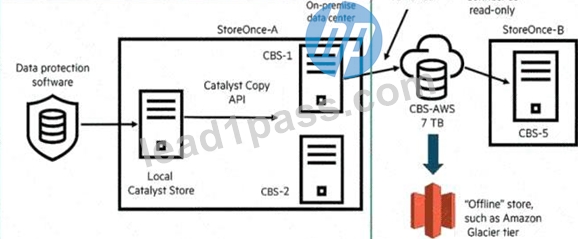
A junior engineer is expanding a StoreOnce deployment for a law firm with a hybrid environment. The customer already has Veeam backing up to StoreOnce 3660 Gen 4 at both primary and secondary sites. They want to add Cloud Bank Storage (CBS) to archive into AWS Glacier tier for compliance. The junior engineer has added Cloud Bank licenses for the 80TB onsite capacity at the primary office.
Question: What does the junior engineer need to add to enable this scenario?
- A. Detach License on StoreOnce-A
- B. Catalyst License for StoreOnce-B
- C. Federated Management
- D. Cloud Bank Storage for AWS Glacier
Answer: A
NEW QUESTION # 41
Refer to the exhibit.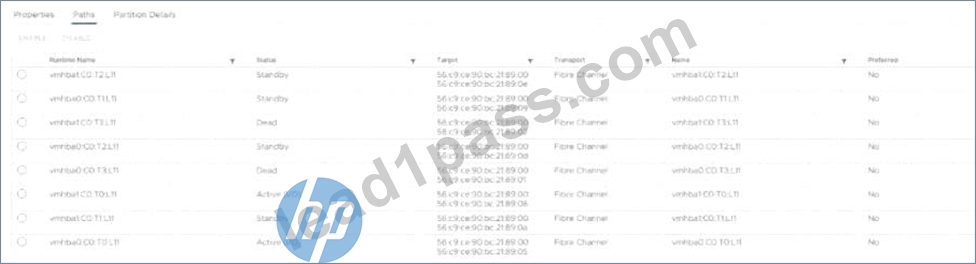
The above image represents an existing Alletra 6000 Peer Persistence configuration.
Which statement could be true in this scenario?
- A. The amount of active (0) paths could reduce the performance of the array.
- B. The performance of the array could be reduced due to the amount of paths active.
- C. The performance of the array could be reduced due to a missing controller.
Answer: C
Explanation:
Detailed Explanation:
Rationale for Correct Answer:
In the exhibit, several paths show "Standby" and some appear "Dead", while only a subset is Active (0).
This typically indicates that one storage controller may be missing or offline, which reduces redundancy and can cause performance degradation. In a healthy Peer Persistence environment, both controllers should present active and non-optimized paths.
Distractors:
A & B: Having multiple active paths does not inherently reduce performance; in fact, MPIO load balances traffic. The issue here is path failures, not excessive active paths.
Key Concept: MPIO pathing in HPE Peer Persistence and controller health.
Reference: HPE Alletra 6000 Peer Persistence Implementation Guide.
NEW QUESTION # 42
Select the scenario where implementing FCoE would be an appropriate solution.
- A. A large enterprise data center with existing Fibre Channel SANs is looking to reduce hardware complexity and costs by consolidating their storage and production networks onto a single infrastructure, while maintaining high performance for mission-critical applications.
- B. A company with data centers in different states wants to establish a unified SAN infrastructure. The goal is to centralize storage management across all sites, using a single protocol that can efficiently handle high-latency, long-distance connections between data centers.
- C. A tech startup is developing an AI-based application that relies heavily on machine learning models.The team needs a solution that allows them to access and process large datasets in the cloud.
- D. A corporation needs to replicate data between data centers in different countries. The data must be synchronized in real-time across a WAN, and the solution must tolerate variable network conditions with minimal impact on performance.
Answer: A
Explanation:
Detailed Explanation:
Rationale for Correct Answer:
Option A is correct because Fibre Channel over Ethernet (FCoE) is designed for large enterprise environments that already have Fibre Channel (FC) infrastructures but want to simplify cabling and reduce hardware by converging LAN and SAN traffic over a single Ethernet fabric. FCoE retains the efficiency, low latency, and reliability of Fibre Channel while leveraging Ethernet to minimize physical infrastructure costs.
This aligns with HPE's best practices for environments using HPE Alletra 9000/Primera or HPE Nimble arrays connected to converged networks where cost reduction and high performance are equally important.
Analysis of Incorrect Options (Distractors):
B: Real-time replication across WANs requires protocols like HPE 3PAR/Alletra Remote Copy, asynchronous/synchronous replication, or HPE Peer Persistence. FCoE is not suited for high-latency WANs because it is a LAN protocol designed for short distances within a data center.
C: For inter-data center SAN unification, FCIP (Fibre Channel over IP) or iSCSI are more suitable. FCoE does not handle long-distance high-latency links effectively.
D: A startup building AI applications with cloud workloads typically benefits from object storage (HPE Scality RING, HPE GreenLake for File and Object) or direct cloud-native APIs (S3/Blob). FCoE is irrelevant in this use case since it is on-prem and infrastructure-focused.
Key Concept:
The question is testing knowledge of FCoE and its appropriate deployment scenarios - specifically, its role in consolidating storage and network traffic inside enterprise data centers while preserving Fibre Channel protocol advantages.
Reference:
HPE Storage Networking Best Practices Guide
HPE Primera/Alletra 9000 Technical White Paper
Fibre Channel over Ethernet Standards Overview (IEEE 802.1Qbb, 802.1Qaz)
NEW QUESTION # 43
A customer is replacing their HPE 3PAR 8200 Peer Persistence setup with Alletra 6000. In a recent audit, they were warned that the Quorum Witness VM was missing security updates.
How would you respond regarding the new setup?
- A. Quorum witness appliance security patch updates follow the array release train updates.
- B. Quorum witness is deployed as a SaaS option, and security updates are applied automatically.
- C. Quorum witness appliance can be set to automatically download and apply available updates.
- D. Quorum witness is installed as a service on a supported Linux server, which can be updated as needed.
Answer: B
Explanation:
Detailed Explanation:
Rationale for Correct Answer:
With Alletra and Primera Peer Persistence, the Quorum Witness is no longer a self-hosted VM. It is delivered as a cloud-based SaaS service managed by HPE. This eliminates customer responsibility for patching and ensures HPE automatically applies updates and security fixes. This resolves the audit concern.
Distractors:
A: Applies to older 3PAR environments, not Alletra/Primera.
C/D: Quorum Witness is no longer an appliance - it is SaaS managed, so these don't apply.
Key Concept: Alletra Quorum Witness is SaaS-managed, removing patching responsibility.
Reference: HPE Alletra Peer Persistence and Cloud Quorum Witness Guide.
NEW QUESTION # 44
You are troubleshooting a storage environment using HPE Alletra Storage MP B10000 in a Peer Persistence configuration. A customer reports high latency when accessing data from applications.
When reviewing the MPIO path status on the host, what should be the path status for connections to the storage array located in the remote data center?
- A. Active Non-optimized
- B. Passive
- C. Active Optimized
- D. Standby
Answer: A
Explanation:
Detailed Explanation:
Rationale for Correct Answer:
In an HPE Peer Persistence configuration (supported on HPE Alletra MP, Primera, and 3PAR), hosts see volumes presented from arrays at both sites. For optimal load balancing and transparent failover, the local array paths are shown as "Active Optimized" while the remote array paths are marked "Active Non- optimized". The "Non-optimized" label indicates these paths are functional but involve remote access with higher latency. This design ensures automatic transparent failover if the local site becomes unavailable.
Distractors:
A: "Active Optimized" applies only to local array paths, not remote ones.
B: Passive paths are typical of ALUA implementations without Peer Persistence, not here.
D: "Standby" is not the term used in Peer Persistence multipathing.
Key Concept: MPIO with Peer Persistence (ALUA Active/Active configuration).
Reference: HPE Primera/Alletra Peer Persistence Best Practices Guide.
NEW QUESTION # 45
......
Verified HPE7-J02 Exam Dumps Q&As - Provide HPE7-J02 with Correct Answers: https://www.lead1pass.com/HP/HPE7-J02-practice-exam-dumps.html
HPE7-J02 Exam Questions | Real HPE7-J02 Practice Dumps: https://drive.google.com/open?id=1V7Kv2OKjMI7SXQtFCvMmne_HBJHb2y9X