

2025 Updated Verified Pass FCP_FGT_AD-7.4 Study Guides & Best Courses
Ultimate Guide to the FCP_FGT_AD-7.4 - Latest Edition Available Now
NEW QUESTION # 12
Which statement about the deployment of the Security Fabric in a multi-VDOM environment is true?
- A. VDOMs without ports with connected devices are not displayed in the topology
- B. Security rating reports can be run individually for each configured VDOM
- C. Each VDOM in the environment can be part of a different Security Fabric
- D. Downstream devices can connect to the upstream device from any of their VDOMs
Answer: C
Explanation:
In a multi-VDOM environment, each VDOM can be treated as an independent virtual firewall, and each VDOM can belong to a separate Security Fabric. This allows administrators to configure and manage separate Security Fabrics for different VDOMs, providing flexibility in managing security policies and fabric connections across virtual domains.
NEW QUESTION # 13
What is the primary FortiGate election process when the HA override setting is disabled?
- A. Connected monitored ports > Priority > System uptime > FortiGate serial number
- B. Connected monitored ports > HA uptime > Priority > FortiGate serial number
- C. Connected monitored ports > Priority > HA uptime > FortiGate serial number
- D. Connected monitored ports > System uptime > Priority > FortiGate serial number
Answer: A
Explanation:
When the HA override setting is disabled, FortiGate uses the primary election process based on the following criteria:
* Connected monitored ports: The unit with the most monitored ports up is preferred.
* Priority: The unit with the highest priority is preferred.
* System uptime: The unit with the longest uptime is preferred.
* FortiGate serial number: Used as the final criterion to break any remaining ties.
References:
* FortiOS 7.4.1 Administration Guide: HA election process
NEW QUESTION # 14
Which two statements are true regarding FortiGate HA configuration synchronization? (Choose two.)
- A. Checksums of devices are compared against each other to ensure configurations are the same.
- B. Checksums of devices will be different from each other because some configuration items are not synced to other HA members.
- C. Incremental configuration synchronization can occur from changes made on any FortiGate device within the HA cluster
- D. Incremental configuration synchronization can occur only from changes made on the primary FortiGate device.
Answer: A,D
NEW QUESTION # 15
When FortiGate performs SSL/SSH full inspection, you can decide how it should react when it detects an invalid certificate.
Which three actions are valid actions that FortiGate can perform when it detects an invalid certificate?
(Choose three.)
- A. Block & Warning
- B. Allow & Warning
- C. Allow
- D. Block
- E. Trust & Allow
Answer: A,B,D
Explanation:
When FortiGate performs SSL/SSH full inspection and detects an invalid certificate, there are three valid actions it can take:
* Allow & Warning: This action allows the session but generates a warning.
* Block & Warning: This action blocks the session and generates a warning.
* Block: This action blocks the session without generating a warning.
Actions such as "Trust & Allow" or just "Allow" without additional configurations are not applicable in the context of handling invalid certificates.
References:
* FortiOS 7.4.1 Administration Guide: Configuring SSL/SSH inspection profile
NEW QUESTION # 16
Refer to the exhibit.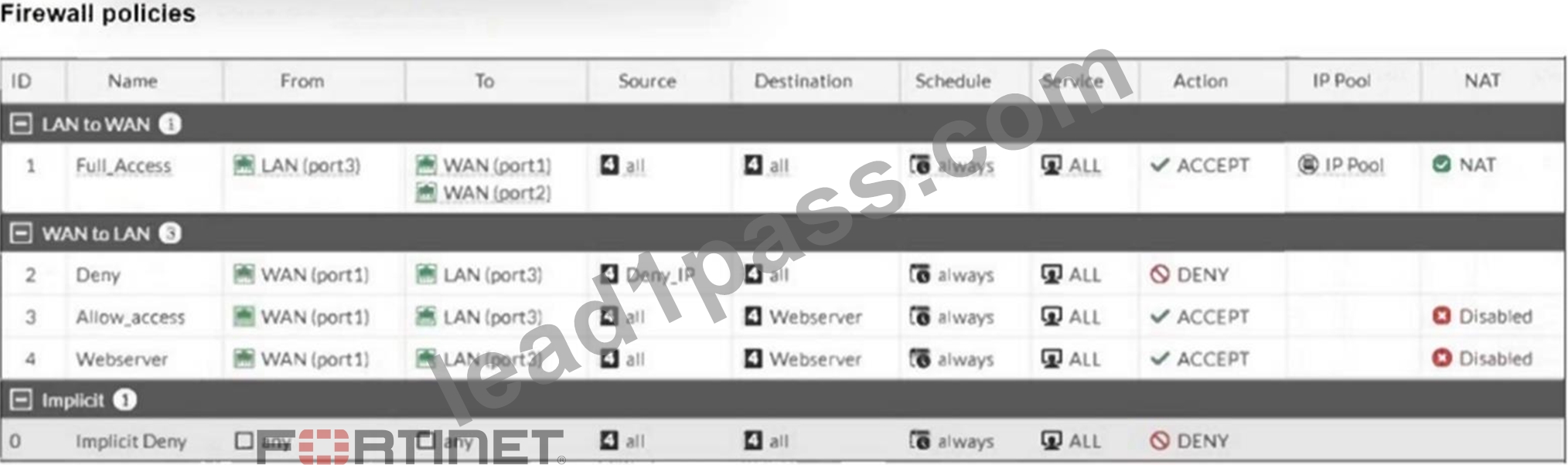
Which statement about this firewall policy list is true?
- A. The Implicit group can include more than one deny firewall policy.
- B. The firewall policies are listed by ID sequence view.
- C. The firewall policies are listed by ingress and egress interfaces pairing view.
- D. LAN to WAN. WAN to LAN. and Implicit are sequence grouping view lists.
Answer: D
NEW QUESTION # 17
Which two statements about incoming and outgoing interfaces in firewall policies are true? (Choose two.)
- A. Only the "any" interface can be chosen as an incoming interface.
- B. Multiple interfaces can be selected as incoming and outgoing interfaces.
- C. A zone can be chosen as the outgoing interface.
- D. An incoming interface is mandatory in a firewall policy, but an outgoing interface is optional.
Answer: B,C
Explanation:
C. Multiple interfaces can be selected as incoming and outgoing interfaces.
This statement is correct. You can specify multiple interfaces as both incoming and outgoing interfaces in a firewall policy.
D. A zone can be chosen as the outgoing interface.
This statement is correct as well. In FortiGate firewalls, you can choose a zone as the outgoing interface in a firewall policy, providing a convenient way to apply policies to multiple physical or logical interfaces grouped under the same zone.
So, the correct choices are C and D.
NEW QUESTION # 18
Which two statements are true about the FGCP protocol? (Choose two.)
- A. Not used when FortiGate is in Transparent mode
- B. Elects the primary FortiGate device
- C. Runs only over the heartbeat links
- D. Is used to discover FortiGate devices in different HA groups
Answer: B,C
Explanation:
C: Runs only over the heartbeat links: FGCP utilizes heartbeat links for exchanging heartbeat packets to monitor the health of the cluster. While heartbeat links play a crucial role, other interfaces can also be used for synchronization and communication within the cluster.
D: Elects the primary FortiGate device: FGCP is responsible for the election of the primary FortiGate device in a high availability (HA) cluster. The primary FortiGate manages the traffic while the secondary FortiGate stays in standby mode.
NEW QUESTION # 19
Refer to the exhibit.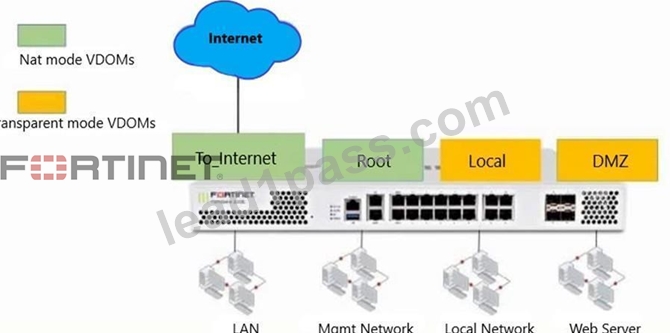
The Root and To_Internet VDOMs are configured in NAT mode. The DMZ and Local VDOMs are configured in transparent mode.
The Root VDOM is the management VDOM. The To_Internet VDOM allows LAN users to access the internet. The To_Internet VDOM is the only VDOM with internet access and is directly connected to ISP modem.
With this configuration, which statement is true?
- A. Inter-VDOM links are required to allow traffic between the Local and Root VDOMs.
- B. Inter-VDOM links are required to allow traffic between the Local and DMZ VDOMs.
- C. A default static route is not required on the To_Internet VDOM to allow LAN users to access the internet.
- D. Inter-VDOM links are not required between the Root and To_Internet VDOMs because the Root VDOM is used only as a management VDOM.
Answer: A
Explanation:
A. Inter-VDOM links are required to allow traffic between the Local and Root VDOMs.
Incorrect:
B. A default static route is not required on the To_Internet VDOM to allow LAN users to access the internet.
C. Inter-VDOM links are required to allow traffic between the Local and DMZ VDOMs. (transparent- transparent)
D. Inter-VDOM links are not required between the Root and To_Internet VDOMs because the Root VDOM is used only as a management VDOM.
Each VDOM has independent security policies and routing tables. Also, and by default, traffic from one VDOM cannot go to a different VDOM.
You cannot create an inter-VDOM link between Layer 2 transparent mode VDOMs. At least one of the VDOMs must be operating in NAT mode.
Similar to FortiGate without VDOMs enabled, the management VDOM should have outgoing internet access. Otherwise, features such as scheduled FortiGuard updates, fail.
NEW QUESTION # 20
Refer to the exhibit.
Why did FortiGate drop the packet?
- A. It matched the default implicit firewall policy
- B. It failed the RPF check.
- C. 11 matched an explicitly configured firewall policy with the action DENY
- D. The next-hop IP address is unreachable.
Answer: A
NEW QUESTION # 21
Refer to the exhibit to view the authentication rule configuration.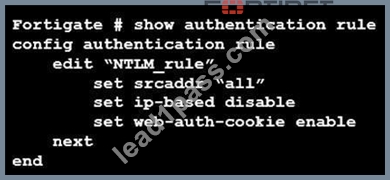
In this scenario, which statement is true?
- A. Policy-based authentication is enabled
- B. Session-based authentication is enabled
- C. IP-based authentication is enabled
- D. Route-based authentication is enabled
Answer: B
Explanation:
The correct statement is:
A. Session-based authentication is enabled
The configuration specifies the use of web authentication cookies (set web-auth-cookie enable), which is a form of session-based authentication. NTLM authentication = session-based
NEW QUESTION # 22
Which inspection mode does FortiGate use for application profiles if it is configured as a profile-based next- generation firewall (NGFW)?
- A. Full content inspection
- B. Certificate inspection
- C. Proxy-based inspection
- D. Flow-based inspection
Answer: D
NEW QUESTION # 23
Refer to the exhibit.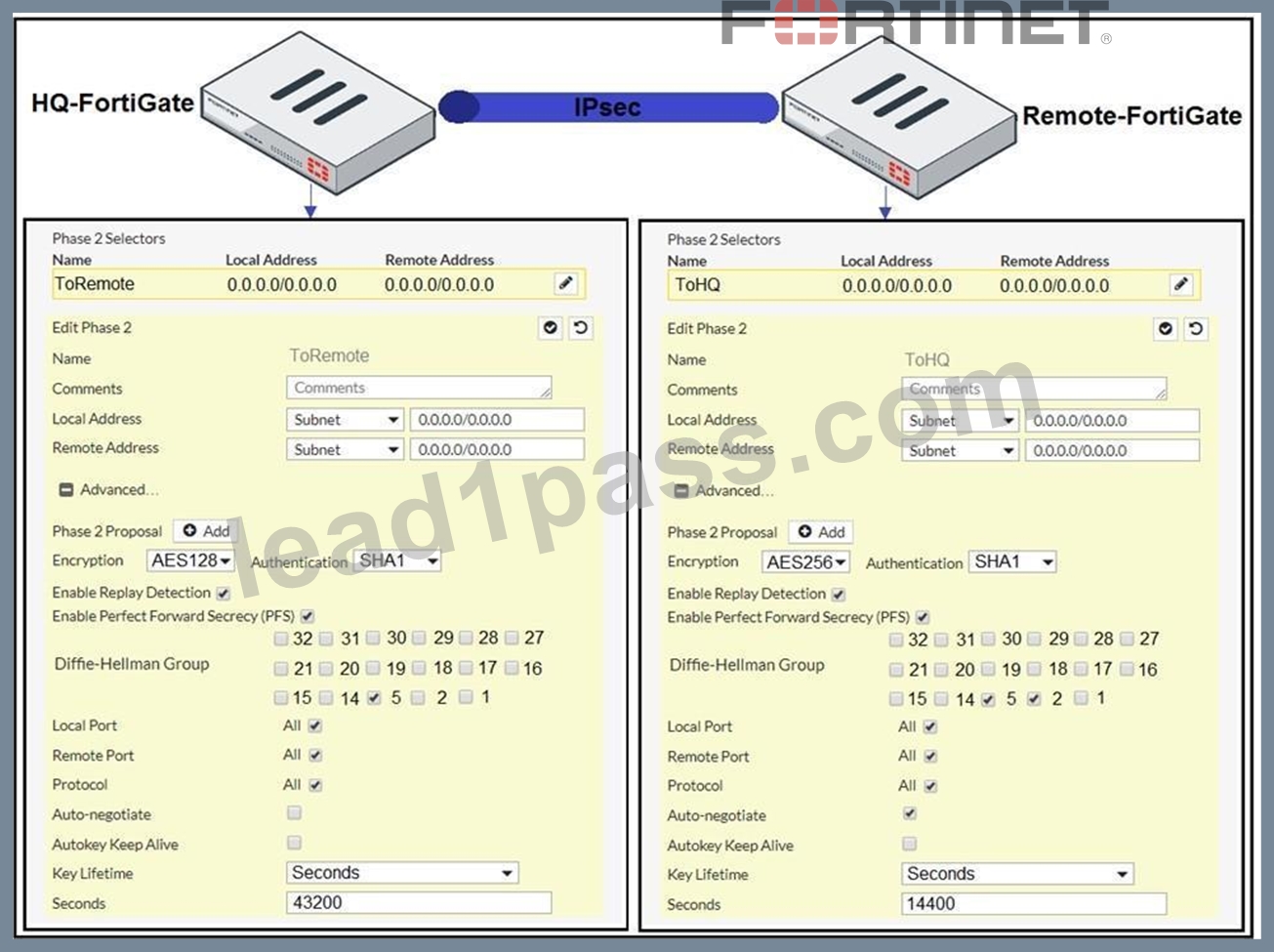
A network administrator is troubleshooting an IPsec tunnel between two FortiGate devices. The administrator has determined that phase 1 status is up, but phase 2 fails to come up.
Based on the phase 2 configuration shown in the exhibit, what configuration change will bring phase 2 up?
- A. On HQ-FortiGate, enable Auto-negotiate.
- B. On HQ-FortiGate, enable Diffie-Hellman Group 2.
- C. On HQ-FortiGate, set Encryption to AES256.
- D. On Remote-FortiGate, set Seconds to 43200.
Answer: C
Explanation:
D. On HQ-FortiGate, set Encryption to AES256.
A phase 2 proposal defines the algorithms supported by the peer for encrypting and decrypting the data over the tunnel. You can configure multiple proposals to offer more options to the remote peer when negotiating the IPsec SAs.
Like in phase 1, you need to select a combination of encryption and authentication algorithms. D is correct, the Encryption and authentication algorithm needs to match inorder for IPSEC be successfully established Encryption algorithm must be the same.
NEW QUESTION # 24
An administrator needs to increase network bandwidth and provide redundancy.
What interface type must the administrator select to bind multiple FortiGate interfaces?
- A. Redundant interface
- B. VLAN interface
- C. Aggregate interface
- D. Software Switch interface
Answer: C
Explanation:
Link aggregation (IEEE 802.3ad) enables you to bind two or more physical interfaces together to form an aggregated (combined) link. This new link has the bandwidth of all the links combined. If a link in the group fails, traffic is transferred automatically to the remaining interfaces with the only noticeable effect being a reduced bandwidth.
To increase network bandwidth and provide redundancy, an administrator can use an Aggregate Interface (also known as Link Aggregation or Port Channel). This interface type allows multiple physical interfaces to be combined into a single logical interface, providing increased bandwidth and fault tolerance. This logical interface appears as a single interface to the rest of the network, and it distributes traffic across the member interfaces.
NEW QUESTION # 25
An administrator manages a FortiGate model that supports NTurbo.
How does NTurbo enhance performance for flow-based inspection?
- A. NTurbo offloads traffic to the content processor.
- B. NTurbo buffers the whole file and then sends it to the antivirus engine.
- C. NTurbo creates two inspection sessions on the FortiGate device.
- D. NTurbo creates a special data path to redirect traffic between the IPS engine its ingress and egress interfaces.
Answer: A
Explanation:
NTurbo enhances performance for flow-based inspection by offloading traffic to the content processor.
NEW QUESTION # 26
Refer to the exhibit.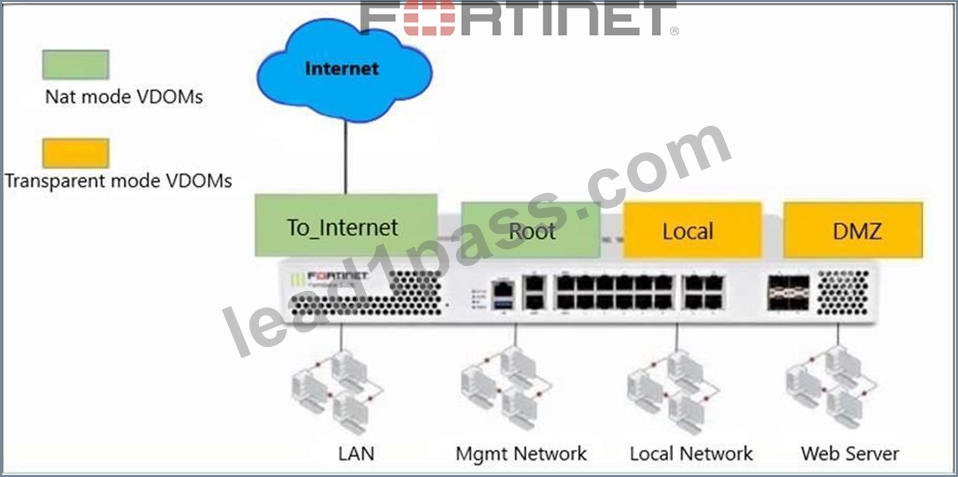
The Root and To_Internet VDOMs are configured in NAT mode. The DMZ and Local VDOMs are configured in transparent mode.
The Root VDOM is the management VDOM. The To_Internet VDOM allows LAN users to access the internet. The To_Internet VDOM is the only VDOM with internet access and is directly connected to ISP modem.
With this configuration, which statement is true?
- A. Inter-VDOM links are required to allow traffic between the Local and Root VDOMs.
- B. Inter-VDOM links are required to allow traffic between the Local and DMZ VDOMs.
- C. A default static route is not required on the To_Internet VDOM to allow LAN users to access the internet.
- D. Inter-VDOM links are not required between the Root and To_Internet VDOMs because the Root VDOM is used only as a management VDOM.
Answer: A
Explanation:
A. Inter-VDOM links are required to allow traffic between the Local and Root VDOMs.
Incorrect:
B. A default static route is not required on the To_Internet VDOM to allow LAN users to access the internet.
C. Inter-VDOM links are required to allow traffic between the Local and DMZ VDOMs. (transparent- transparent)
D. Inter-VDOM links are not required between the Root and To_Internet VDOMs because the Root VDOM is used only as a management VDOM.
Each VDOM has independent security policies and routing tables. Also, and by default, traffic from one VDOM cannot go to a different VDOM.
You cannot create an inter-VDOM link between Layer 2 transparent mode VDOMs. At least one of the VDOMs must be operating in NAT mode.
Similar to FortiGate without VDOMs enabled, the management VDOM should have outgoing internet access. Otherwise, features such as scheduled FortiGuard updates, fail.
NEW QUESTION # 27
What are three key routing principles in SD-WAN? (Choose three.)
- A. By default. SD-WAN members are skipped if they do not have a valid route to the destination
- B. By default. SD-WAN rules are skipped if only one route to the destination is available
- C. By default. SD-WAN rules are skipped if the best route to the destination is not an SD-WAN member
- D. Regular policy routes have precedence over SD-WAN rules
- E. SD-WAN rules have precedence over any other type of routes
Answer: A,C,D
Explanation:
SD-WAN rules are matched only if the best route to the destination points to SD-WAN SD-WAN member is selected only if it has a route to the destination
https://docs.fortinet.com/document/fortigate/7.0.0/sd-wan-sd-branch-architecture-for-mssps/768108/sd-wan-routing-logic SDWAN rules are 'policy routes', but regular policy routes have precedence over SD-WAN rules.
https://community.fortinet.com/t5/FortiGate/Technical-Tip-Explaining-the-SD-WAN-rule-matching-process/ta-p/284325
NEW QUESTION # 28
Refer to the exhibit.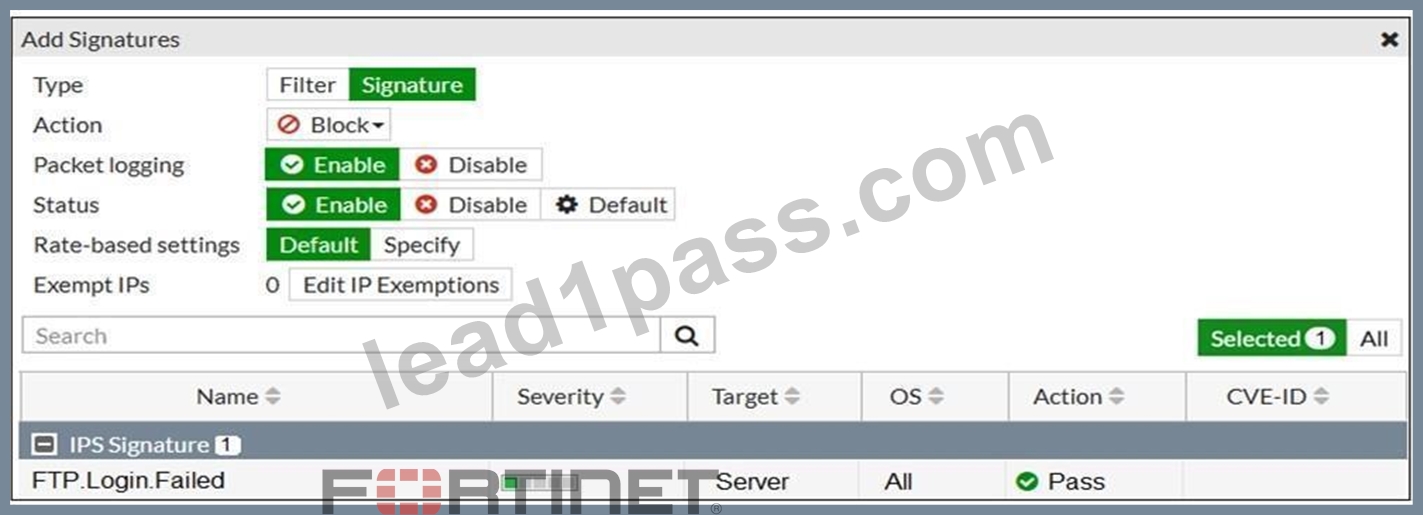
Review the Intrusion Prevention System (IPS) profile signature settings.
Which statement is correct in adding the FTP .Login.Failed signature to the IPS sensor profile?
- A. Traffic matching the signature will be silently dropped and logged.
- B. Traffic matching the signature will be allowed and logged.
- C. The signature setting uses a custom rating threshold.
- D. The signature setting includes a group of other signatures.
Answer: A
Explanation:
"pass" is only default action.
The Pass action on the specific signature would only be chosen, if the Action (on the top) was set to Default. But instead its set to Block, se the action is will be to block and drop.
Select Allow to allow traffic to continue to its destination. Select Monitor to allow traffic to continue to its destination and log the activity. Select Block to silently drop traffic matching any of the signatures included in the entry. Select Reset to generate a TCP RST packet whenever the signature is triggered.
Select Default to use the default action of the signatures.
If you enable Packet logging, FortiGate saves a copy of the packet that matches the signature.
NEW QUESTION # 29
Which two settings are required for SSL VPN to function between two FortiGate devices? (Choose two.)
- A. The client FortiGate requires the SSL VPN tunnel interface type to connect SSL VPN.
- B. The client FortiGate requires a manually added route to remote subnets.
- C. The client FortiGate requires a client certificate signed by the CA on the server FortiGate.
- D. The server FortiGate requires a CA certificate to verify the client FortiGate certificate.
Answer: A,D
Explanation:
If fortigate is used as an SSL VPN client, it needs a ssl virtual tunnel interface to connect to the SSL VPN server. This is the client virtual interface that the vpn server will assign the temporary IP address to during the lifetime of an ssl connection. The SSL VPN server also needs a correct CA certificate to authenticate/trust client's certificate.
NEW QUESTION # 30
FortiGate is operating in NAT mode and is configured with two virtual LAN (VLAN) subinterfaces added to the same physical interface.
In this scenario, what are two requirements for the VLAN ID? (Choose two.)
- A. The two VLAN subinterfaces must have different VLAN IDs.
- B. The two VLAN subinterfaces can have the same VLAN ID, only if they have IP addresses in the same subnet.
- C. The two VLAN subinterfaces can have the same VLAN ID, only if they belong to different VDOMs.
- D. The two VLAN subinterfaces can have the same VLAN ID, only if they have IP addresses in different subnets.
Answer: A,C
Explanation:
B: The two VLAN subinterfaces can have the same VLAN ID, only if they belong to different VDOMs.
C: The two VLAN subinterfaces must have different VLAN IDs.
https://community.fortinet.com/t5/FortiGate/Technical-Note-How-to-use-emac-vlan-to-share-the-same-VL AN/ta-p/192843?externalID=FD43883 Each interface (physical or VLAN) can belong to only one VDOM.
Meaning that sub-interfaces (VLANs) from the same physical interface can have the same VLAN ID as long as they are not assign to the same VDOM.
VLAN
https://community.fortinet.com/t5/FortiGate/Technical-Tip-rules-about-VLAN-configuration-and-VDOM- interface/ta-p/197640
* VLANs can be created on any physical or aggregate (802.3ad) interfaces
- The same VLAN number cannot be configured twice on the same physical interface
- The same VLAN number can be used on different physical interfaces
- The usable VLAN ID range is from 1 to 4094
* VDOM interface assignment
- Two VDOMs cannot share the same interface or VLAN
- A VLAN sub-interface can belong to a different VDOM than the physical interface it is attached to.
NEW QUESTION # 31
Examine the exhibit, which shows a firewall policy configured with multiple security profiles.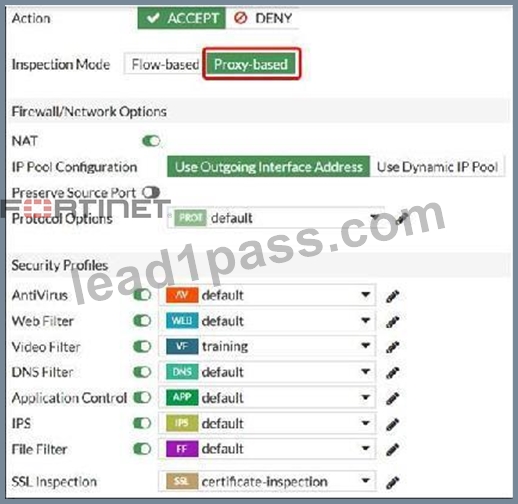
Which two security profiles are handled by the IPS engine? (Choose two.)
- A. IPS
- B. Application Control
- C. AntiVirus
- D. Web Filter
Answer: A,B
Explanation:
When the FortiGate is set for proxy inspection mode, the IPS engine will handle the Application Control and IPS security profiles.
The security profiles that will be handled by the IPS engine when the FortiGate is set for proxy inspection mode are Application Control and IPS. In this mode, the FortiGate acts as an intermediary between the client and the server, intercepting and inspecting traffic to enforce security policies. The IPS engine is responsible for analyzing network traffic and identifying any malicious or suspicious activity based on predefined rules and signatures.
NEW QUESTION # 32
An administrator manages a FortiGate model that supports NTurbo.
How does NTurbo enhance performance for flow-based inspection?
- A. NTurbo offloads traffic to the content processor.
- B. NTurbo buffers the whole file and then sends it to the antivirus engine.
- C. NTurbo creates two inspection sessions on the FortiGate device.
- D. NTurbo creates a special data path to redirect traffic between the IPS engine its ingress and egress interfaces.
Answer: A
NEW QUESTION # 33
......
Dumps MoneyBack Guarantee - FCP_FGT_AD-7.4 Dumps Approved Dumps: https://www.lead1pass.com/Fortinet/FCP_FGT_AD-7.4-practice-exam-dumps.html
2025 Updated Verified Pass FCP_FGT_AD-7.4 Exam - Real Questions and Answers: https://drive.google.com/open?id=1IOO7bWe8x2dqjiWIDVRwEPIhgZcgJoYA